🦐 Brine Shrimp Feeding Calculator
Estimate baby brine shrimp nauplii meals from fry count, age, hatch rate, enrichment, and water fouling risk.
Brine Shrimp Feeding Estimate
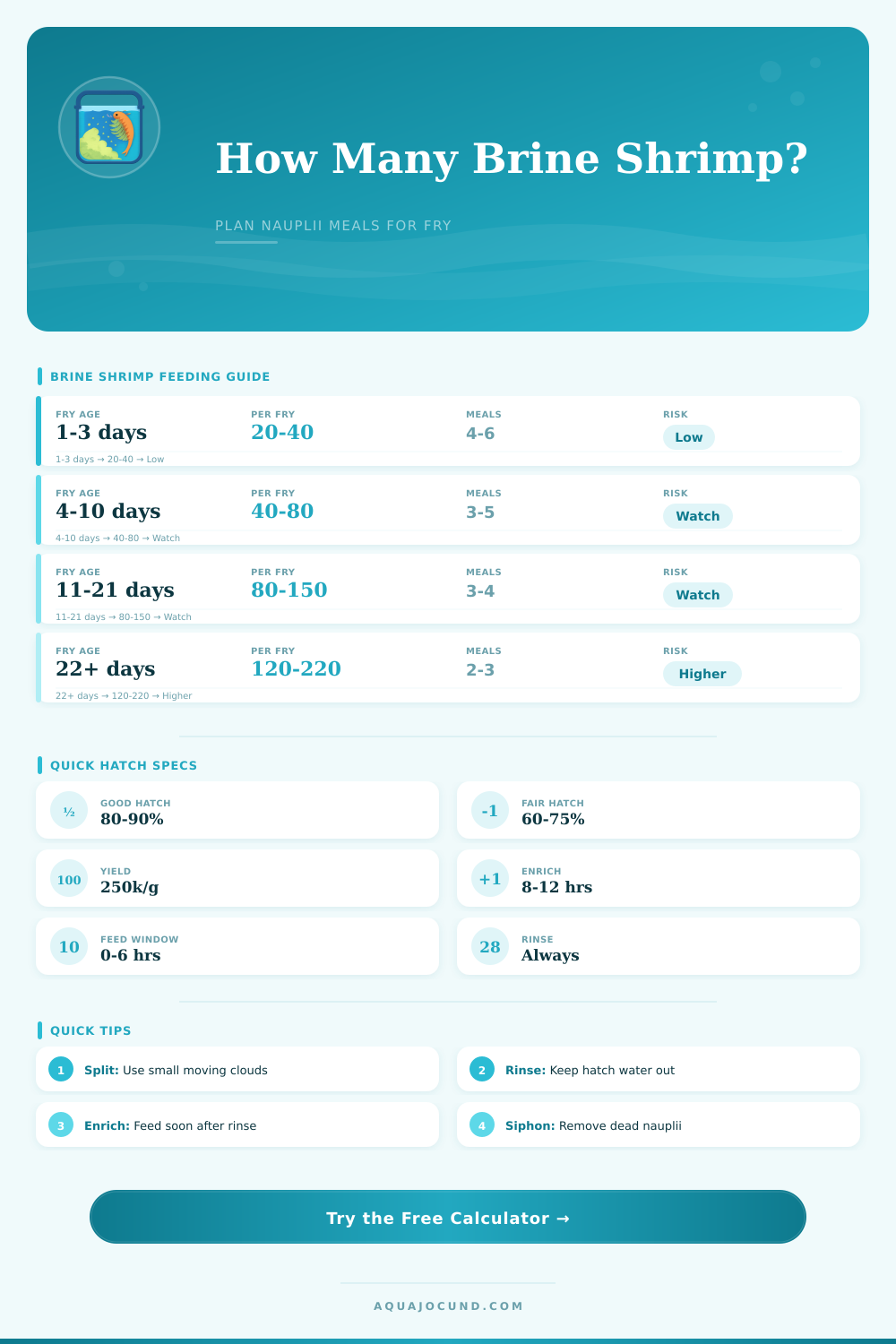
| Fry stage | Age | Nauplii per fry per feeding | Meals per day | Feeding cue |
|---|---|---|---|---|
| First free-swimming | 1-3 days | 20-40 | 4-6 | Small moving cloud, bellies just tint orange |
| Early growth | 4-10 days | 40-80 | 3-5 | Food mostly gone within 20 minutes |
| Mid grow-out | 11-21 days | 80-150 | 3-4 | Fry actively hunt through the tank |
| Late fry | 22+ days | 120-220 | 2-3 | Begin mixing larger starter foods |
| Hatch quality | Typical hatch rate | Usable yield setting | Harvest note | Calculator use |
|---|---|---|---|---|
| Old or poorly stored cysts | 35-55% | 180k/g | Expect many shells and duds | Use larger hatch margin |
| Fair room-temp hatch | 60-75% | 220k/g | Good for small broods | Watch balance result |
| Strong fresh cysts | 80-90% | 250k/g | Clean orange harvest | Good default setting |
| Premium cone hatch | 90%+ | 280k-320k/g | High separation efficiency | Reduce wasted surplus |
| Nauplii condition | Nutrition effect | Fouling effect | Best use | Handling note |
|---|---|---|---|---|
| Freshly hatched | Yolk-sac energy | Lowest | Daily fry feeding | Feed soon after rinse |
| 4-6 hour enrichment | Moderate HUFA gain | Slightly higher | Growth support | Rinse enrichment water away |
| 8-12 hour enrichment | Highest enrichment gain | Higher | Marine or cichlid fry | Use smaller, cleaner meals |
| Older nauplii | Lower yolk value | Higher | Backup only | Siphon leftovers quickly |
| Tank or tray | Volume | Light meal range | Watch zone | High-risk signal |
|---|---|---|---|---|
| 2.5 gal nursery | 9.5 L | 2k-8k nauplii | 8k-18k | Dead nauplii collect fast |
| 5.5 gal grow-out | 20.8 L | 6k-20k nauplii | 20k-45k | Cloudy bottom corners |
| 10 gal fry tank | 37.9 L | 12k-40k nauplii | 40k-85k | Ammonia after feeding |
| 20 gal long | 75.7 L | 25k-85k nauplii | 85k-170k | Persistent haze |
| 40 breeder | 151 L | 50k-170k nauplii | 170k-330k | Food trapped in sponge areas |
The guppies is fry. They’re tiny, vulnerable creature. How do you feed them? Where’s the line between too little food and too much? Do you guess or do you know?
If you guess, you’ll fall into one of two holes. Either you won’t feed enough when they needs it most, or else you’ll feed too much, fouling the tank in the process. Neither are a good outcome for fish.
How to Feed Guppy Fry Correctly
Enter the calculator. It takes hazy ideas and converts them to concrete figures. It matches feeding to water quality while providing sufficient nutrition for your condition.
Secondly, the feeding plan need to match what they can eat versus what they need. How much do fry stomachs hold? Not much! That’s why adult fish can consumes a large meal once per day but fry cannot. What do they need instead? Small meals frequently throughout the day.
You can customize this via the tool. For example, very young fry require six meals daily. Older fry will needs fewer meals because their guts gets bigger.
Consistency is key. If you miss a meal here or there, it adds up over weeks, it impacts development.
You will sometimes have problems with brine shrimping hatching. Depending on how long your cysts were stored and its age, they may have high or low hatch rates. Maybe 90% of them will be viable. Maybe less than half will hatch. Enter what you think your hatch rate is into the calculator. Enter your expected harvest efficiency into the calculator. The calculator will tells you whether you’re getting enough nauplii to feed that many fish. Did you want fifty thousand shrimp, but only have thirty thousand? Then you’re in the hole. Add another feeding or accept fewer. This eliminates food shortage anxiety.
Good water quality matter when raising fry. Dead/uneaten nauplii will decay rapidy. This increases ammonia rapidy. Small tank cannot handle this load. An assessment of fouling risk is included as part of the tool. It calculates the relationship between the food amount and the tank volume. Feeding heavily in a small tank create an organic load quickly. Warning signs include cloudy spots or green haze. Light filtration can only safely handles a conservative estimate of what the calculation suggests. It requires thinking about water quality after feeding rather than before.
It gets complicated with enrichment. Shrimp are nutritious when fresh, but not all species require high fat levels. Some shrimp will take the enrichment well and can be fed up to a few hours after it is added. Feed them later to improve nutrition. Enriched food also fouls water sooner different than plain nauplii. The tool considers this trade-off. It says enriching improves growth at the expense of higher maintenance needs. That means more frequent water changes (you can schedule them accordingly).
The tool provides options to adjust the number of feedings per day and input your expected hatch rate and harvest efficiency. New breeders have reference tables that put their new fry into perspective. The tables list average amounts of food consumed by various species at different ages. Betta fry are different than goldfish fry. So, they will needs different amount of food. Knowing this helps you set realistic expectations.
Don’t worry about having to memorize all those numbers. Simply know the trend. The younger the fry, the more often they are fed but in smaller quantities. As the fry age, they consume larger amounts but less often. This pattern is simple once you break it down.
To raise healthy fry you must watch and adjust. The calculator gives you a start. You can see the rest with your own eyes. Observe their belly. If they are full and active, they are being fed correctly. If 20 minutes later they are hunting for food, feed them a little more. It’s a fine line. Do it right and you have healthy, strong fish. Maintain the water quality. Feed them. Allow them to grow.