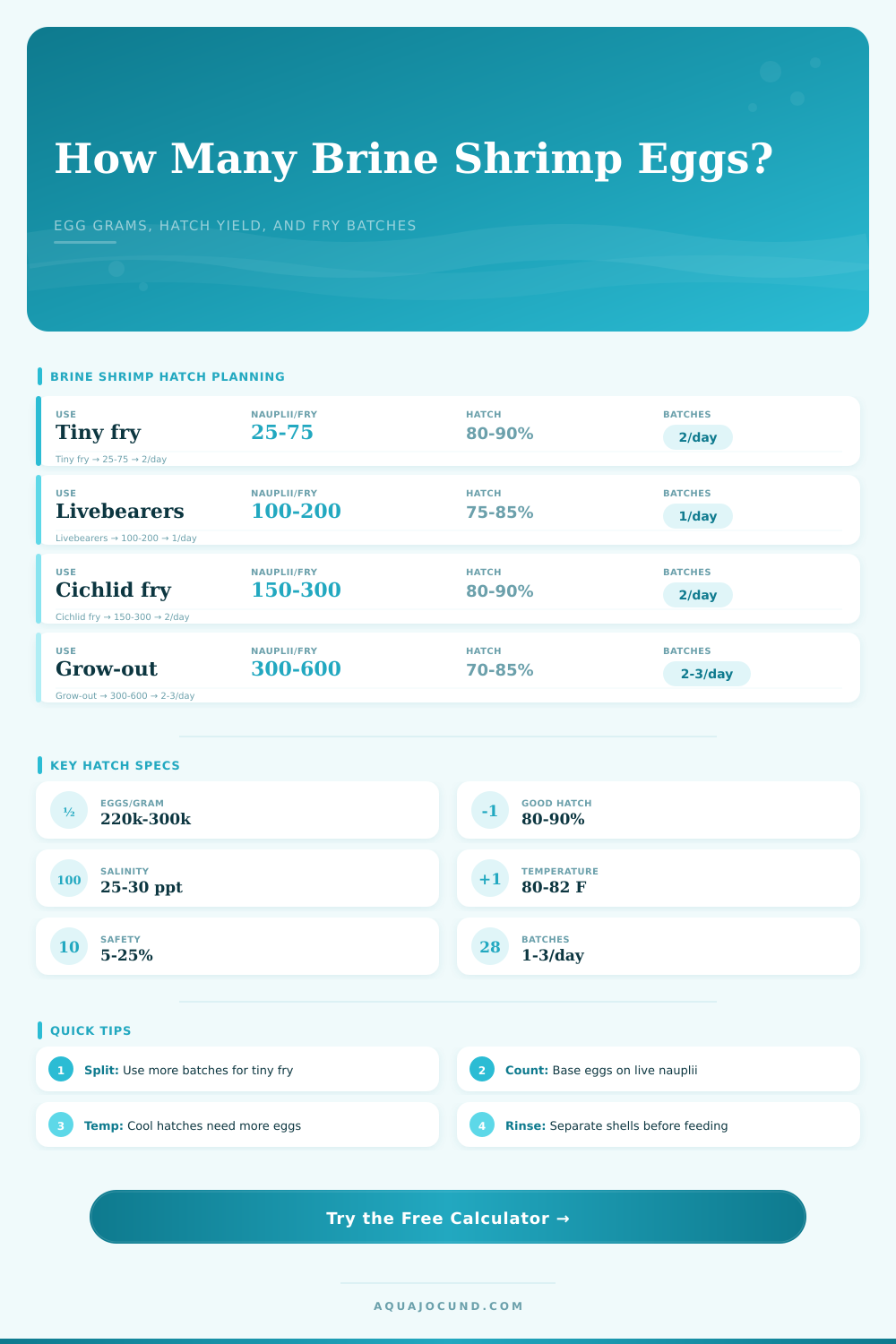
🦐 Brine Shrimp Egg Quantity Calculator
Estimate dry Artemia cyst weight from fry count, nauplii demand, hatch rate, eggs per gram, salinity, temperature, and daily hatch batches.
Calculation Breakdown
| Cyst Grade | Eggs Per Gram | Label Hatch | Best Use |
|---|---|---|---|
| Premium 90% hatch cysts | 250,000 to 280,000 | 88% to 92% | Small batches where predictable yield matters. |
| High grade 85% cysts | 240,000 to 270,000 | 82% to 87% | Everyday fry feeding with good storage. |
| Standard 80% cysts | 230,000 to 260,000 | 75% to 82% | General hatch cones and larger fry. |
| Older opened can | 220,000 to 250,000 | 55% to 72% | Use extra margin and test hatch before big spawns. |
| Economy mixed lot | 210,000 to 250,000 | 60% to 78% | Grow-out feeding where exact yield is less critical. |
| Small-strain Artemia cysts | 280,000 to 320,000 | 75% to 88% | Tiny mouths, smaller nauplii, and delicate fry. |
| Fry Scenario | Typical Fry Count | Nauplii Per Fry Per Feeding | Common Schedule |
|---|---|---|---|
| Betta or gourami first foods | 50 to 150 | 25 to 75 | 5 to 8 small feedings, 2 to 3 hatches/day. |
| Guppy, platy, or molly newborns | 30 to 100 | 100 to 200 | 3 to 5 feedings, 1 to 2 hatches/day. |
| Corydoras nursery fry | 60 to 180 | 75 to 180 | 4 to 6 feedings, 2 hatches/day. |
| Angelfish and small cichlids | 150 to 400 | 150 to 300 | 4 to 6 feedings, 2 hatches/day. |
| Goldfish or carp fry | 80 to 300 | 250 to 500 | 3 to 5 feedings, 2 hatches/day. |
| Fish room mixed grow-out | 500 to 2,000 | 200 to 600 | 3 to 6 feedings, 2 to 4 hatches/day. |
| Condition | Near-Ideal Range | Modifier Used | Quantity Effect |
|---|---|---|---|
| Temperature | 80 to 82 F / 26.7 to 27.8 C | 1.00 | No extra eggs for temperature. |
| Cool hatch | 72 to 76 F / 22.2 to 24.4 C | 0.75 to 0.88 | More eggs are needed for the same live nauplii target. |
| Hot hatch | 86 to 90 F / 30.0 to 32.2 C | 0.72 to 0.92 | Fast hatch, but reduced practical yield. |
| Salinity | 25 to 30 ppt | 1.00 | No salinity penalty in the common hatch range. |
| Low or high salinity | Under 18 ppt or over 38 ppt | 0.70 to 0.86 | Increase egg quantity or adjust brine before relying on yield. |
| Batch Size | Hatch Vessel | Comfortable Egg Load | Use Case |
|---|---|---|---|
| Micro cup | 250 mL / 0.26 qt | 0.05 to 0.25 g | Small fry batches and frequent fresh hatches. |
| Small bottle | 500 mL / 0.53 qt | 0.10 to 0.75 g | Most home fry tanks. |
| Standard cone | 1 L / 1.06 qt | 0.25 to 1.5 g | Medium spawns and daily hatch planning. |
| Large cone | 2 L / 2.11 qt | 0.50 to 3.0 g | Fish room and grow-out feeding. |
You want live food now, and there is a specific kind of panic that sets in when you realize your new batch of baby fish has cleared every bit of infusoria you cultured.
The usual response is to use brine shrimp, but making brine shrimp requires some math, How many cysts do I need in order to have exactly as many live nauplii as my fry will eat? And you must also consider the unhatched egg.
How to Calculate Brine Shrimp for Fish Food
It’s really nice because it will run those calculations after you enter amount of fry you have and their feeding stage. It’s more helpful if you understand what the inputs are so you can better apply them.
For instance, most of us measure brine shrimp by volume. What you want to do though is think in terms of yield. Maybe you’ve got a cup of hatched shrimp, but maybe they only had a 50% hatch rate, which means that most of the cup are empty shells. The calculator accounts for that by letting you choose quality of cysts (from an old and less reliable can, to a newer and higher 90+% hatch).
This one trips people up as a beginner because most of them think that one bag of brine shrimp eggs is different than another. They’re not. Brine shrimp eggs sitting in a damp bathroom for a year aren’t going to be as good as those in a sealed pack in the fridge. With the calculator, you can input how much of a hatch you expect and it will scale down or up to account for that. So if your stock isn’t fresh you’ll put in more of a safety margin so you end up weighing out enough dry cysts to accommodate the dead ones. That’s why what used to be a vague guess becomes an exact weight.
The other half of the equation is temperature. Warmer water accelerate hatching time but also causes higher oxygen demands. Hatching time are prolonged if the water isn’t warm enough; if it’s too warm you run the risk of killing embryos prior to emergence. According to the reference data, hatching efficiency is best when the water temp runs between eighty and eighty two degrees Fahrenheit. Efficiency goes down the further away from the norm you are. Again, you’ll need more eggs to achieve your desired result.
Spread your hatching into two or three smaller batches throughout the day. A double daily feed is not always best practice. Because nauplii are alive they expend energy. They will also gets older. If you want to spread out the hatching over a couple days rather than having one big batch all at once, then the food stays more lively.
By changing number of batches per day (the modeling tool), you can determine how much egg to put in each cone. This way you don’t overload any cone with too many cysts which might lower the survival rate.
There’s also the actual capacity of your hatch system to think about. Each hatch vessel can only hold so many cysts in its water. Beyond this, the eggs won’t release clean from their shell. You end up with a mess that is difficult to feed and difficult to wash. This density is also calculated for you on the calculator. It will warn you if you’re approaching the limit of how much your particular water volume will hold.
The nutritional value of brine shrimp is undeniable, but maintaining them in a viable condition takes some work. Maintaining live food is a logistics challenge pretending to be a hobby.
If you’re looking at raw egg weight instead of live yield, then you’ll be burning money and wasting time on unsatisfactory hatches. You need to maintain consistent temperatures, aeration, and dryness with your eggs. But when you hit that sweet spot for the ratio, it’s no longer a chore, it’s a guarantee.
You should of seen how much better this works. It actually makes things more comfortabley handled. The moddern way is better than the old ways.