🐟 Breeder Tank Volume Calculator
Estimate real breeder aquarium water volume from the wide footprint, internal dimensions, glass thickness, fill height, substrate depth, decor displacement, freeboard, and stocking buffer.
| Substrate style | Solid-volume factor | Typical depth | Breeder volume effect |
|---|---|---|---|
| Bare glass bottom | 0% | 0 in / 0 cm | No substrate displacement, common for rack breeders. |
| Thin sand nursery | 52% | 0.25-0.75 in / 0.6-1.9 cm | Small deduction with enough cover for fry behavior. |
| Fine sand bed | 58% | 0.75-2 in / 1.9-5.1 cm | Moderate volume loss across wide breeder footprints. |
| Rounded gravel | 64% | 1-2.5 in / 2.5-6.4 cm | Higher displacement because void space is lower. |
| Aquasoil with cap | 60% | 1.5-3 in / 3.8-7.6 cm | Large planted breeder deduction, especially with slopes. |
| Eggcrate / divider grid | 18% | 0.25-0.5 in / 0.6-1.3 cm | Light physical displacement but useful for divider systems. |
| Tile or slate bottom | 95% | 0.25-0.75 in / 0.6-1.9 cm | Dense bottom panels remove more water per inch. |
| Breeder size | Nominal outside dimensions | Full nominal volume | Typical net volume |
|---|---|---|---|
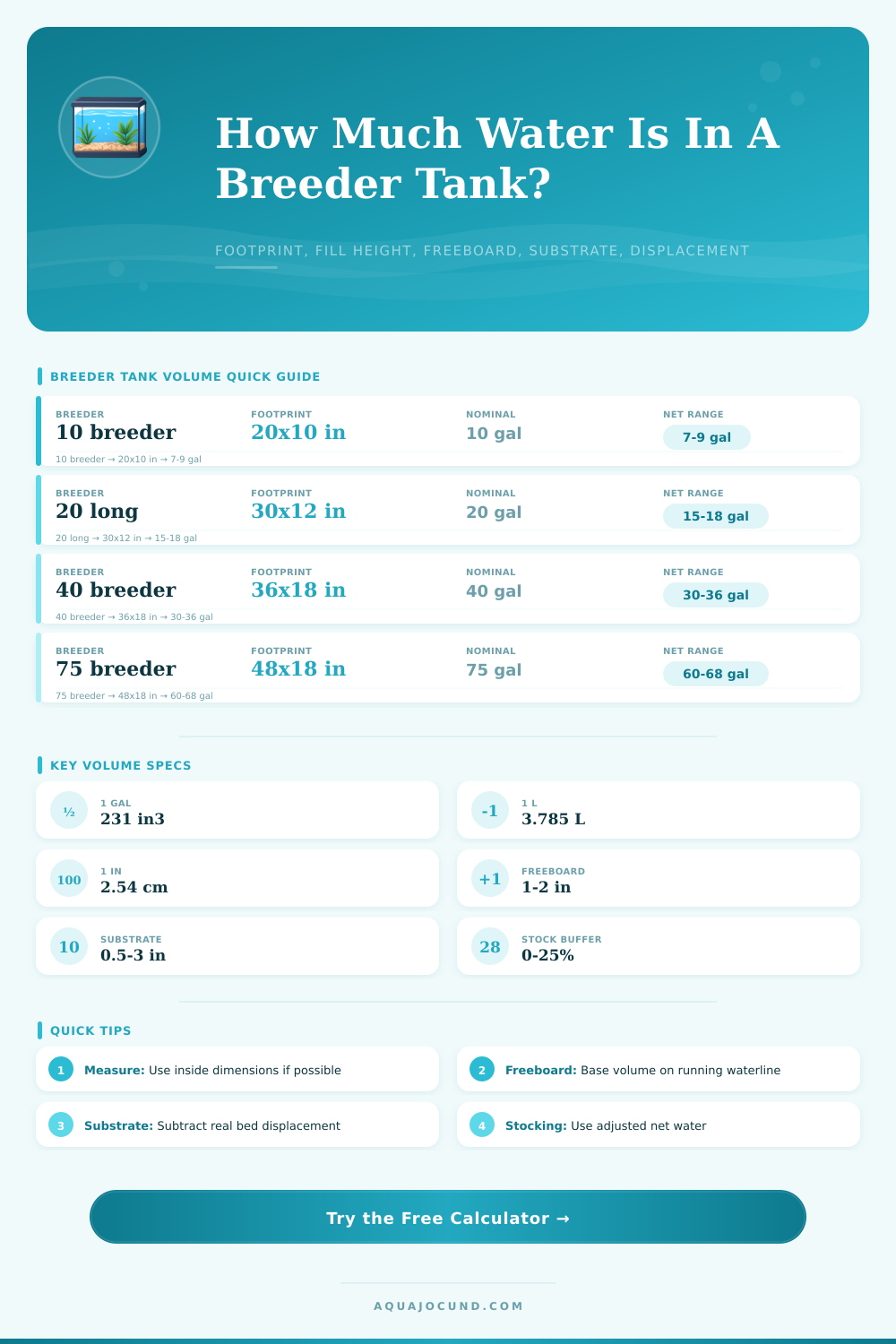
| 10 breeder / nursery | 20 x 10 x 12 in / 51 x 25 x 30 cm | 10 gal / 38 L | 7-9 gal / 26-34 L |
| 15 breeder | 24 x 12 x 12 in / 61 x 30 x 30 cm | 15 gal / 57 L | 11-13 gal / 42-49 L |
| 20 long breeder | 30 x 12 x 12 in / 76 x 30 x 30 cm | 20 gal / 76 L | 15-18 gal / 57-68 L |
| 29 breeder style | 30 x 12 x 18 in / 76 x 30 x 46 cm | 29 gal / 110 L | 22-26 gal / 83-98 L |
| 30 breeder | 36 x 18 x 12 in / 91 x 46 x 30 cm | 30 gal / 114 L | 23-27 gal / 87-102 L |
| 40 breeder | 36 x 18 x 16 in / 91 x 46 x 41 cm | 40 gal / 151 L | 30-36 gal / 114-136 L |
| 50 lowboy breeder | 48 x 24 x 10 in / 122 x 61 x 25 cm | 50 gal / 189 L | 38-45 gal / 144-170 L |
| 75 breeder colony | 48 x 18 x 21 in / 122 x 46 x 53 cm | 75 gal / 284 L | 60-68 gal / 227-257 L |
| Breeder format | Typical fill habit | Stocking buffer | Calculator cue |
|---|---|---|---|
| Fry nursery | Lower waterline for access and sponge filters | 15-25% | Use heavy or quarantine buffer when feeding is frequent. |
| Breeding pair | Near normal display fill, modest cover | 5-10% | Use light or moderate buffer for a pair with fry. |
| Juvenile grow-out | Broad shallow surface area with open swimming room | 10-20% | Use stocking-adjusted volume for water-change planning. |
| Colony breeder | Often includes caves, dividers, or dense hardscape | 15-20% | Enter decor displacement plus colony buffer. |
| Bare rack tank | High usable volume, little substrate deduction | 5-15% | Use bare bottom and enter sponge or divider displacement. |
| Measurement item | Where it affects volume | Common range | Best entry method |
|---|---|---|---|
| Glass thickness | Reduces internal length, width, and usable height | 1/8-3/8 in / 3-10 mm | Measure panel edge or use manufacturer spec. |
| Freeboard | Limits water height below the rim | 0.75-2 in / 2-5 cm | Use the normal running waterline, not the rim height. |
| Substrate depth | Displaces water across the entire covered footprint | 0-3 in / 0-8 cm | Average the front, back, and slope depth. |
| Decor displacement | Subtracts caves, filters, wood, and dividers | 0.2-8 gal / 1-30 L | Measure by bucket displacement when accuracy matters. |
| Stocking buffer | Converts net water into a conservative planning volume | 5-25% | Increase it for fry density and heavy feeding. |
There’s this popular misconception in the fish keeping hobby that if you buy a 40g breeder tank, then you have 40 gallons of water. While that might seem true on paper, it doesn’t work out in real life. For one thing, the “nominal” size refers to exterior dimensions of glass shell (i.e., marketing). The actual amount of water it can hold is much less.
This is because you have to factor in thickness of the glass, the substrate, rockwork, filters, and the airspace at the top that keeps your fish from jumping out. If new breeders would just take time to do the math rather than blindly rely off the label, they’d realize their mistake sooner and save themselves some grief. They overdose their meds/ferts and overstock tanks with fry. These issues all lead to poor outcomes.
Why Your Tank Holds Less Water Than You Think
When you put in your tank’s measurements into the calculator (above), it does all the math for you. It begins with glass thickness, which is a simple starting point that many people ignore. Thicker side or bottom glass reduces the inside width and length as well as the available height. You can’t include those tank panes when you’re measuring “from the outside of the tank” and still expect to get an accurate estimate on volume. Every doser says “per gallon of water,” meaning they don’t count cubic inches of packaging material. That’s going to add a few gallons to your estimate if you start out mismeasuring your baseline.
Volume is also decreased by substrate depth. You may only have enough sand to cover a very small portion of your aquarium if you are keeping fry in a shallow nursery. Conversely, if you are using a planted colony tank, you may be piling on two inches of gravel and aquasoil. All that goes over the whole footprint of the tank displacing the water below. Check out the reference table on the page; some substrates displaces more water per inch than others do. For instance, loose gravel displaces less water per inch different than dense tile does, since it has far more air trapped between the particles.
Seems minor, right? Then multiply that depth by large surface area of a breeder box and you’re losing measurable amounts of capacity. And then there’s equipment and freeboard. Do you ever fill your tank all the way to the top? Unless you want the overflow to be siphoned and/or have fish jump out, it’s good practice to leave an inch or two of empty space. However, doing so means you lose volume.
If you use divider grids, some driftwood, a large sponge filter, a heater, etc., those things displaces physical space that can’t be filled with water. The tool will help you estimate that displacement so you’ll know how much water space is actualy remaining to make fish comfortable while still maintaining enough space for biofiltration. Until you’ve got the tank set up and running dry on capacity, it’s easy to forget that decor also displaces space.
Everything else depends on the stocking density. You can fill a tank with dense plants, lots of cave-like decorations, and rocks to divide breeding pairs. Or, you could simply place one or two sponge filters into a rack tank with nothing but the filters and empty water. The usable water volume is much higher in the second case. That’s where the stocking adjustment buffer in the calculator comes in. It doesn’t subtract water out of the actual tank. Rather, it reduces the amount of time you have to plan so that you’re operating in a safer margin.
You are raising hundreds of fry? They’ll generate a lot of waste and eat a lot while doing so. Operating under the assumption that the tank holds fewer gallons than it actualy does ensures you stay a step ahead of an ammonia spike. That’s how most of us hobbyists learned it, the hard way following either a failed breeding attempt or crash. It’s one of those things where knowing what it means is often the difference between success and failure.
You should of known this earlier. In reality, your “nominal” forty may be closer to twenty-eight. That figure will help you know how much to dose, how many fish you should stock, etc., so you keep everything stable. Shelf space planning? Trust the shell size. Keeping fish alive? Trust the net water calculation. It’s a tiny adjustment in mindset, but the result is huge.