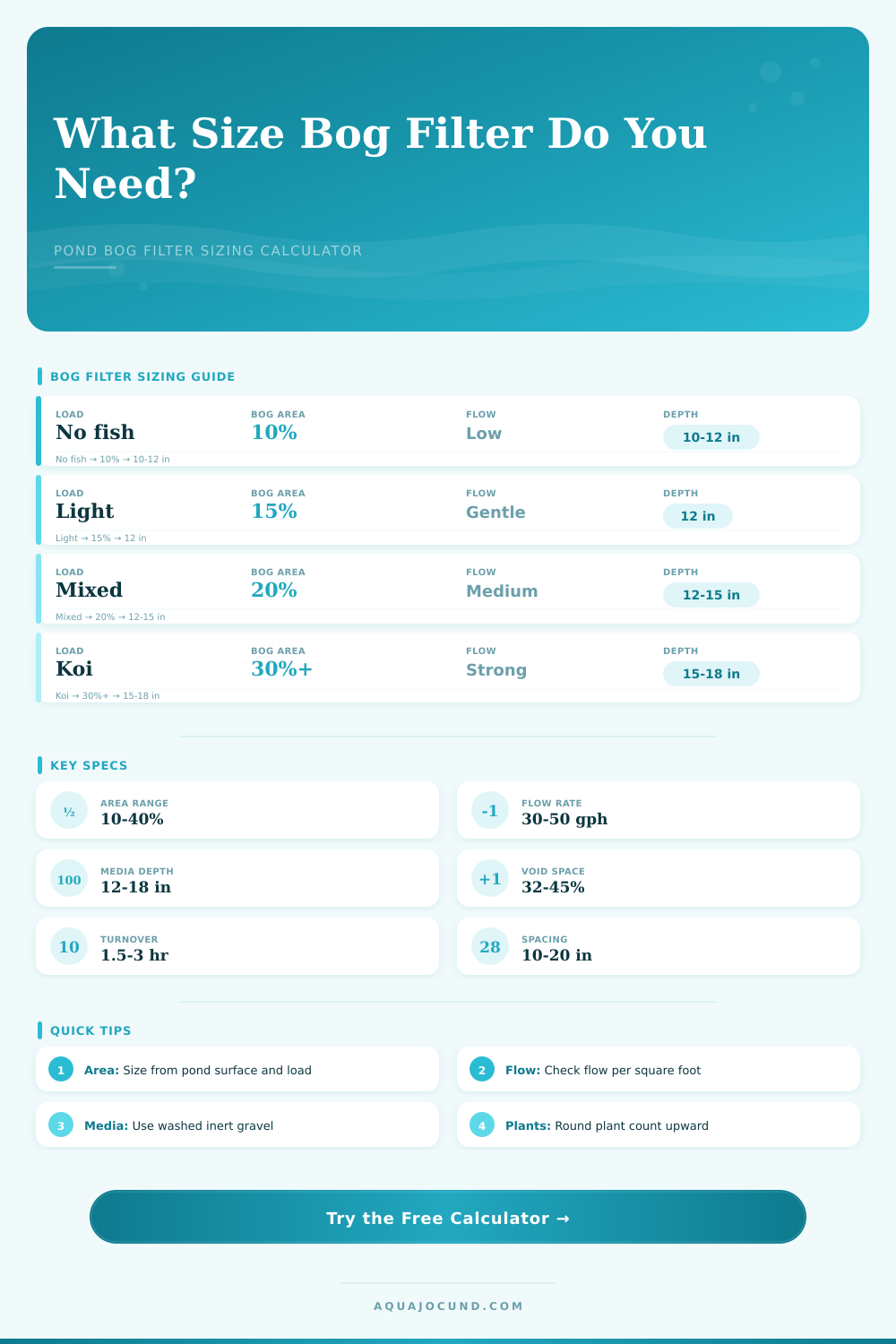
🌿 Bog Filter Size Calculator
Size a pond bog filter bed from pond volume, surface area, fish load, gravel depth, plant spacing, and water flow.
| Media Type | Porosity | Dry Bulk Weight | Flow Capacity | Best Calculation Use |
|---|---|---|---|---|
| Washed Pea Gravel | 35% | 95 lb/cu ft | 40 gph/sq ft | General planted pond bogs with small to medium fish loads |
| Rounded River Gravel | 40% | 100 lb/cu ft | 45 gph/sq ft | Higher pore water volume and smoother root movement |
| Lava Rock / Scoria | 45% | 50 lb/cu ft | 32 gph/sq ft | Lightweight biological media where fines are well rinsed out |
| Expanded Shale | 38% | 65 lb/cu ft | 35 gph/sq ft | Medium weight beds needing good porosity and root space |
| Crushed Granite Chip | 32% | 105 lb/cu ft | 30 gph/sq ft | Durable beds where extra surface area is preferred over flow |
| Mixed Rounded Gravel | 37% | 96 lb/cu ft | 42 gph/sq ft | Blended gravel beds with stable hydraulic performance |
| Gravel With Mat Layer | 34% | 92 lb/cu ft | 28 gph/sq ft | Polishing beds where roots and matting slow water movement |
| Light Expanded Aggregate | 44% | 28 lb/cu ft | 30 gph/sq ft | Raised bogs that need lower structural load |
| Pond Style | Dimensions | Volume | Typical Bog Area | 12 in Media |
|---|---|---|---|---|
| Patio Plant Pond | 4 x 3 x 1.5 ft / 1.2 x 0.9 x 0.46 m | 135 gal / 511 L | 1.2 to 2.0 sq ft | 0.05 to 0.07 cu yd |
| Small Goldfish Pond | 6 x 4 x 2 ft / 1.8 x 1.2 x 0.61 m | 359 gal / 1359 L | 3.6 to 5.4 sq ft | 0.13 to 0.20 cu yd |
| Wildlife Oval | 8 x 5 x 1.5 ft / 2.4 x 1.5 x 0.46 m | 449 gal / 1699 L | 4.0 to 6.0 sq ft | 0.15 to 0.22 cu yd |
| Mixed Garden Pond | 10 x 6 x 2 ft / 3.0 x 1.8 x 0.61 m | 898 gal / 3400 L | 12 to 18 sq ft | 0.44 to 0.67 cu yd |
| Koi Starter Pond | 12 x 8 x 3 ft / 3.7 x 2.4 x 0.91 m | 2154 gal / 8154 L | 29 to 38 sq ft | 1.1 to 1.4 cu yd |
| Large Koi Pond | 16 x 10 x 3.5 ft / 4.9 x 3.0 x 1.1 m | 4189 gal / 15856 L | 48 to 64 sq ft | 1.8 to 2.4 cu yd |
| Design Check | Planning Range | Calculator Use | Notes |
|---|---|---|---|
| Bog Footprint Ratio | 10% to 40% of pond surface | Biological area target | Higher fish load needs more planted gravel area |
| Hydraulic Loading | 25 to 50 gph per sq ft | Minimum flow area check | Lower rates help prevent channeling in dense roots |
| Turnover Target | 1.5 to 4 hours | Pump flow estimate | Actual pump must be checked after lift and plumbing loss |
| Media Depth | 10 to 18 inches | Gravel volume and water held | Deeper beds hold more pore water but add weight |
| Plant Spacing | 10 to 20 inches | Plant count estimate | Use closer spacing for fast nutrient uptake |
| Status | Existing Bog Area | Meaning | Calculation Response |
|---|---|---|---|
| Short | Under 85% | Existing bed is below the calculated target | Increase area, reduce flow, or lower fish load |
| Close | 85% to 110% | Bed is near the target with little reserve | Use conservative feeding and monitor clarity |
| Sized | 110% to 160% | Area has a practical everyday buffer | Check that water spreads across the full bed |
| Oversized | Over 160% | More bog area than the entered load requires | Keep flow distributed to avoid stagnant corners |
Use the larger area result: the calculator compares fish-load footprint against flow loading, then sizes the bog from whichever needs more surface area.
Account for pore water and weight: the media volume is the full bed volume, while the water-held estimate uses the selected gravel porosity.
IF YOU OWN A POND, chances are you ordered your koi first. And then what? That’s how things go: You buy some flashy fish; within days, your garden feature resemble a swamp.
Why? Because you have the wrong size filtration system; for the pump, not the biology. A mechanical skimmer won’t do the trick; neither will rocks alone, or even plants without rocks, which is where a bog filter differ. Gravel plus living plants literal eat away at detritus in a way that prevents waste from becoming waste.
How to Size Your Bog Filter
Run the numbers on the calculator above, and learn the reasoning behind calculations so you don’t get stranded with too many rock (or too few plant). Ammonia is the key variable. How much bio-load are you managing? A small lily pond with a couple of goldfish has a light footprint. But a heavily stocked turtle and big koi pond are going to create a huge load of ammonia.
The next step in the tool’s question sequence is you choosing one of several load scenarios. That’s how the size of your bog compared to your pond gets established… The surface area of the bog compared to the surface area of the pond.
Manage a heavy koi load like a wildlife pond and you’re going to have cloudy water and nutrient-starved plants as they drown from nutrients. It’s the easy mistake to make, but important because the surface area ratio take care of the biological processing. Fish generate phosphorus and nitrogen, and those elements must be absorbed by the plant, so they require space to do their work.
The other key parameter is depth. Most gravel bed are roughly ten to eighteen inches deep. Why? First, there’s plenty of surface area for good bacteria to grow and populate the stones. Second, water stays in place within the gaps (the voids) between rocks. This allows plant roots to get moisture when it’s hot and dry.
Too much depth create anaerobic zones where no bacteria function; too little, and all that water simply rushes right past the media and out the bottom. Depending off which kind of rock you use, its degree of porosity will change the amount of volume required to fill the tank. The calculator takes this into account. Lava rock won’t hold water like washed pea gravel does. Expanded shale won’t hold water like lava rock either. You need a medium that strikes a balance between weight, cost, and void space.
Then there’s physics (and I mean that in a good way). Biology and flow rate. You want slow flow, enough so the plants has time to do their job, but fast enough to avoid stagnant conditions. Here, the tool calculates your needed pump capacity from the target turnover time and your pond’s volume. Two hours is typical for healthy pond turnover.
Mechanical removal of debris may be quicker then slower flow, but you’re also washing away the nutrient substrate that the plants require to grow. On the other hand, slower flow allows the bog some time to work but care must be taken not to allow standing water. This is where you can use reference table on the page. It explains the hydraulic loading rates clearly as they vary based on type of media.
Remember? Root mats slow the water down naturaly. This is why plant spacing is another input. The spacing calculator tells you how many plugs of cattails, pickerel weed, or iris to order to make a full bed. Why is it important? Because if you don’t have enough, they won’t form a good mat; instead there will be isolated “islands” of vegetation where water can easily flow around the filtration area. Too much and they’ll fight each other for resources, weakening the whole area.
There’s also a size margin added in the calculation, because a little breathing room is always smart with live things. As the plants fill out, and as your fish get bigger, nature will never be perfect. Add a ten or twenty percent cushion and your pond has room to breathe.
A bog isn’t just something you throw rocks in a hole to make. A bog is an ecosystem. It is an ecosystem that handles waste well enough so the pond doesn’t need daily attention to keep it clean. The right size prevents algae blooms and keeps your water clear. Other factors besides rock require planning, but once established the pond is self-sustaining.
Fish are great to have, but a filter is what makes the fish liv. If the size of the bog is incorrect at the start, then there will be more effort over time and the pond won’t be as healthy or as clean as it could of been for anyone to use.