💧 Blend RO and Tap Water Calculator
Calculate a tap and RO water blend from TDS, GH, KH, batch volume, remineralizer offsets, water-change volume, and a target tolerance band.
Blend Breakdown
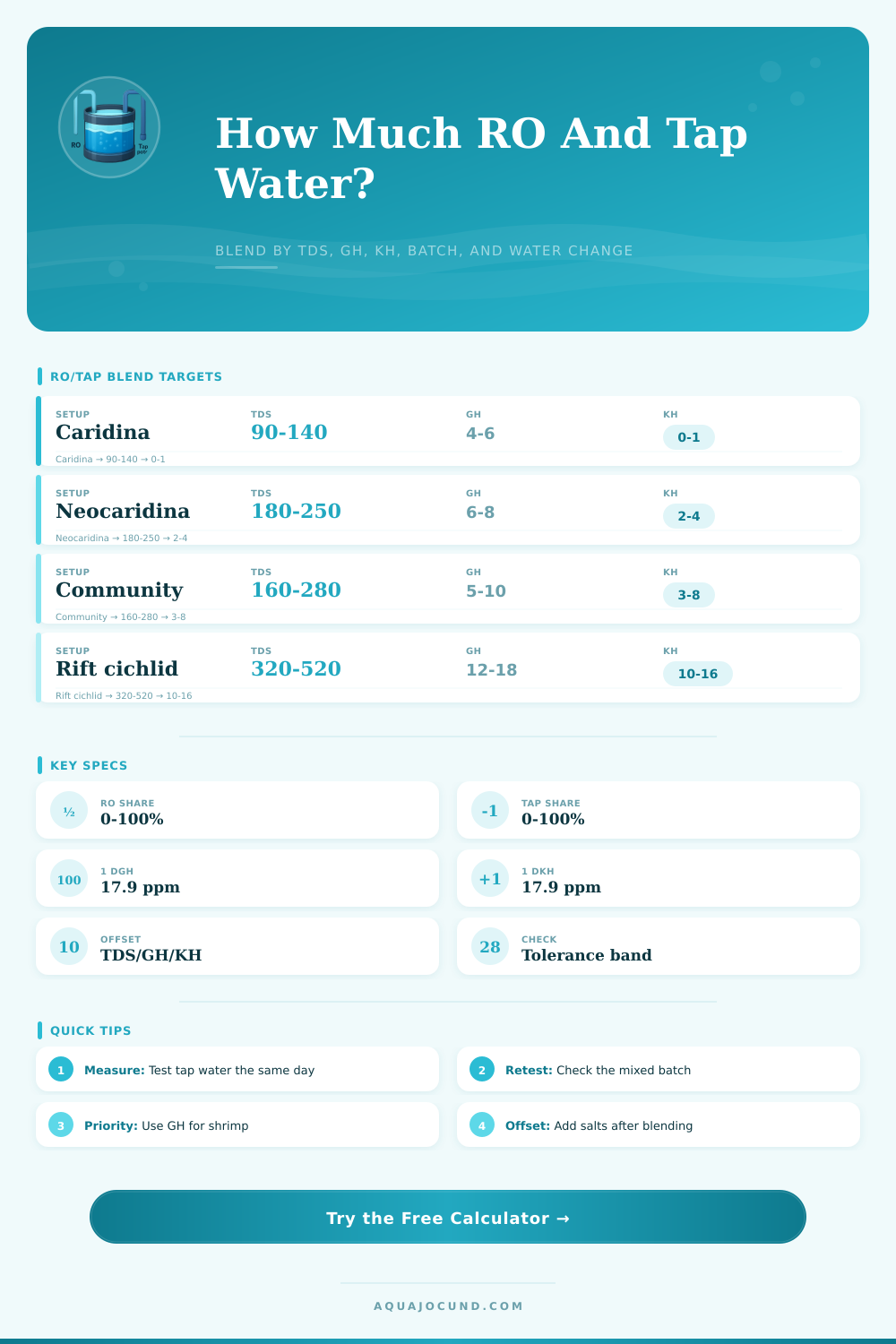
| Profile | TDS ppm | GH dGH | KH dKH | Blend note |
|---|---|---|---|---|
| Caridina shrimp | 90-140 | 4-6 | 0-1 | Often RO-heavy, GH-first, very low KH. |
| Neocaridina shrimp | 180-250 | 6-8 | 2-4 | Moderate tap share can work if KH is not excessive. |
| Planted community | 150-280 | 4-8 | 2-6 | Balance plant minerals with stable alkalinity. |
| Softwater fish | 40-140 | 1-5 | 0-3 | Use low tap share and confirm pH stability separately. |
| Livebearer hardwater | 250-420 | 8-15 | 5-10 | Tap-heavy blends may need little RO. |
| Rift lake cichlid | 320-520 | 12-18 | 10-16 | Often tap-heavy with buffer adjustment. |
| Source | TDS range | GH range | KH range | Use in blend |
|---|---|---|---|---|
| Fresh RO/DI | 0-5 ppm | 0-0.2 | 0-0.2 | Base for sensitive low-mineral setups. |
| Aged RO storage | 2-15 ppm | 0-0.5 | 0-0.5 | Check container residue before assuming zero. |
| Soft municipal tap | 60-160 ppm | 2-6 | 1-4 | Can be useful in community or planted blends. |
| Moderate tap | 160-320 ppm | 6-12 | 3-8 | Often diluted for shrimp and softwater fish. |
| Hard tap | 320-600 ppm | 12-22 | 8-18 | Use small shares unless hardwater is intended. |
| Container | Imperial volume | Metric volume | Best use | Measuring note |
|---|---|---|---|---|
| Small bucket | 2.5 gal | 9.5 L | Nano shrimp changes | Mark tap and RO fill lines after confirming the blend. |
| Standard bucket | 5 gal | 18.9 L | Routine small tanks | Leave space for mixing and conditioner. |
| Brute-style can | 20 gal | 75.7 L | Planted and community batches | Circulate before retesting GH and KH. |
| Large reservoir | 44 gal | 166.6 L | Fish room water changes | Tap water variability matters more at this scale. |
| Change size | Tank effect | Use case | Blend caution |
|---|---|---|---|
| 10% | Small parameter move | Sensitive shrimp or correction testing | Useful when GH or KH mismatch is uncertain. |
| 20-25% | Moderate move | Routine planted or community change | Most blends should be within the tolerance band first. |
| 30-40% | Strong move | Large nutrient reset or hardwater correction | Match temperature and retest before repeating. |
| 50%+ | Dominates tank result | Emergency dilution or planned reset | Use staged changes for livestock sensitive to mineral shifts. |
The idea behind mixing tap and reverse osmosis water are as much about expectation management as it is about understanding chemistry. Tap water has what your municipal water company puts into the pipes, and RO water is almost pure water. You’re looking for something consistent not perfect. If you have sensitive livestock such as softwater fish or Caridina shrimp, there’s a particular ratio of the two you should of mix before adding conditioners. Get that right, and they’ll be happy; get it wrong and you stress out the livestock.
The trick is knowing what’s coming out of your tap water in the first place. Seasonal changes, maintenance work, and shifting sources all alter municipal supply. Relying on memory about previous tests can lead you astray. To get accurate results, you must take samples from the tap as well as the RO output on the same day. Enter just those two numbers into the calculator, and it will do the rest. Since you’re working backwards from your desired parameters, there’s no need to guess at conversions or coefficients. That eliminates any anxiety about getting it right since you know exactly how many gallon of each ingredient to use for every batch size.
How to Mix Tap Water and RO Water for Fish
TDS (total dissolved solids) is a commonly used value that are simple to test using a cheap pen. The downside? It doesn’t tell you what the ions are; only how many there are. Unless you have very sensitive fish or shrimps, TDS alone is typically good enough for keeping community fish and plants. Most such animals is hardy and will tolerate a wide range of mineral content if the conductance remains within reasonable limits.
If you are keeping shrimp, however, particularly shellies like Neocaridina or Caridina species, then GH is king. That’s because shells require both magnesium and calcium for proper development and shedding. You could reach your target TDS value by sacrificing GH, but you must avoid doing this if you are keeping sensitive livestock. Stressing them without it being obvious by failing to maintain enough GH levels will result in shorter lives or unsuccessful molts. Keep this in mind: GH > TDS
You also have a priority setting with the tool. You decide if the goal is more TDS or GH driving the blend. For example, you might be going for softer water parameters. But maybe your tap water is very hard and you don’t want to dilute it as much. So now you’re seeing a high reverse osmosis percentage on the calc. That’s OK, just add some remineralizers to the output to boost up the GH until it’s at a livable level. Those are the offsets shown in the tool. You enter the offsets (i.e. For example, my salt mix boosts the TDS by five parts per million. The tool will then adjust the blend to match so the end result stays within your preferred range.
Batch size matter more than you might think. However, mixing water thoroughly in large containers will produce a more reliable result different than simply eyeballing ratios straight into your tank. Below is a chart showing commonly used container sizes. As you can see, a typical five gallon bucket works well for most routine maintenance tasks. It is large enough to be mixed thoroughly and small enough to carry around.
You’re not just exchanging water when you do a water change; you’re changing the parameters. Changing parameters slowly (e.g., 10% change) is safer but means doing it more often. Making a larger parameter change (e.g., 30%) impacts dissolved organics/nutrient levels more quickly but runs the risk of shocking your livestock if the replacement water are significantly different than the existing water.
What causes most of our errors? We do it all wrong: we add water to the tank and then we chase a number. Once you mix hardness into the tank, its hard to get rid of. Adjusting the ratio prior to adding to the tank is far easier than trying to adjust it right there in the tank. Test the combination, measure the GH & KH, make sure it’s within your tolerance band. Tweak the next batch by adjusting the tap percentage; don’t try to fix what’s in the tank directly. Doing this beforehand stabilizes the system.
The longer the water is in your aquarium the more it shows all those little mistakes. It’s not luck. What you do when mixing is an art; it’s a mix of thinking and not being on auto-pilot. Understanding what your livestock lives in isn’t about having the most gear. It’s about how to get them what they need. That combination of tap minerals and reverse osmosis water yield a balance that is closer to what is found in nature than one or the other does. Knowing how to achieve that balance makes it easy instead of guessing.