Biopellet Reactor Flow Calculator
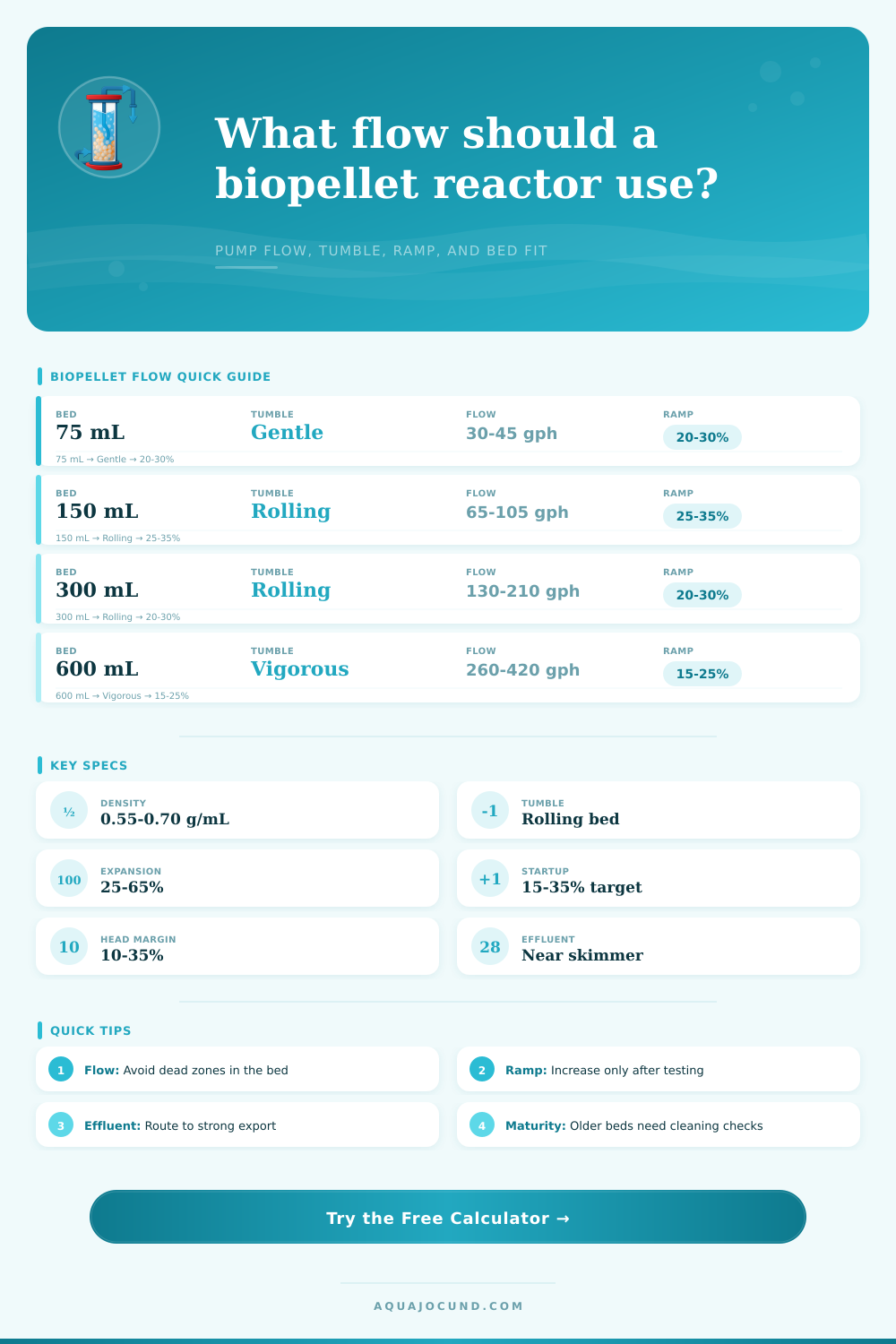
Size reactor pump flow from pellet volume, tank volume, nitrate target, tumble class, reactor diameter, pump head, effluent location, ramp schedule, and bacterial maturity.
| Pellet type | Bulk density | Base flow per 100 mL | Best tumble | Calculator note |
|---|---|---|---|---|
| Standard PHA pellets | 0.62 g/mL | 55 gph | Even rolling | Balanced choice for normal nitrate pressure. |
| Dense slow-release pellets | 0.70 g/mL | 66 gph | Strong rolling | Needs more lift because dense beads settle harder. |
| Soft fast-start pellets | 0.55 g/mL | 48 gph | Soft to standard | Start gently because fines and bacterial film appear quickly. |
| Micro reactor pellets | 0.58 g/mL | 45 gph | Soft rolling | Small beads move easily and can ride toward screens. |
| Large bead pellets | 0.66 g/mL | 72 gph | Strong rolling | Higher flow prevents slow corners in narrow reactors. |
| Nitrate/phosphate blend pellets | 0.60 g/mL | 54 gph | Even rolling | Watch phosphate trend before increasing the bed. |
| Mineral blend pellets | 0.68 g/mL | 63 gph | Even to strong | Use extra rinse and avoid compacting against sponges. |
| Mixed polymer pellets | 0.63 g/mL | 58 gph | Even rolling | Moderate density, good for mixed-size beds. |
| Inside diameter | Cross-section | Soft roll | Standard roll | Strong tumble |
|---|---|---|---|---|
| 2 in / 5.1 cm | 3.14 in² | 16-25 gph | 25-38 gph | 38-53 gph |
| 2.5 in / 6.4 cm | 4.91 in² | 25-39 gph | 39-59 gph | 59-83 gph |
| 3 in / 7.6 cm | 7.07 in² | 35-57 gph | 57-85 gph | 85-120 gph |
| 4 in / 10.2 cm | 12.57 in² | 63-101 gph | 101-151 gph | 151-214 gph |
| 6 in / 15.2 cm | 28.27 in² | 141-226 gph | 226-339 gph | 339-481 gph |
| System | Tank volume | Pellet bed | Reactor diameter | Working flow |
|---|---|---|---|---|
| Nano startup | 20 gal / 76 L | 60 mL | 2 in | 25-40 gph |
| 40 breeder mixed reef | 40 gal / 151 L | 140 mL | 2.5 in | 55-90 gph |
| 75 gal mixed reef | 75 gal / 284 L | 250 mL | 3 in | 95-160 gph |
| High nitrate correction | 90 gal / 341 L | 350 mL | 3 in | 120-190 gph |
| Large mixed reef | 150 gal / 568 L | 550 mL | 4 in | 210-340 gph |
| Heavy fish system | 220 gal / 833 L | 850 mL | 6 in | 340-540 gph |
| Adjustment | Calculator effect | Use when | Watch for |
|---|---|---|---|
| Cautious ramp | 15-20% starting bed | New reactor, high nitrate, sensitive reef | Bacterial haze or oxygen dip |
| Effluent to skimmer | Highest export confidence | Skimmer intake is nearby | Stable skimmer foam after changes |
| Low-flow effluent | Lower export confidence | Effluent sits in a quiet sump area | Film buildup or cyano response |
| New bacterial bed | Reduced immediate effect | Fresh pellets or dry restart | Delayed nitrate change |
| Clumpy mature bed | Higher flow demand | Pellets stick or channel | Dead pockets inside reactor |
So you buy a bag of pellets that claims zero phosphates and cleaner water. Because more is better, right? More biology mean better filtration, so you pack your reactor to the rim. You fire up the pump… and nothing happens! The pellets sits there at the bottom like a dead weight. What’s going wrong?
Most often it isn’t the media. What biopellet reactors require is not simply circulation but also motion. Specifically, they need tumbling action. Pellets must tumble for respiration to occur. They must respire for consumption to happen. To save you from doing the math (conversions & coefficients), the calculator above does all that for you.
How to Fix Biopellet Flow Problems
All you has to do is enter your pump specifications along with your reactor size. It’s an uncomplicated mechanism with no mercy. It has to move every single one of those tiny polymer beads so they are always bathed in fresh water. However, it must not moves them too vigorously or they will pack against the screens in a hard brick.
There has to be enough input to maintain fluid movement and oxygen from the water column to feed the bacteria which consume the nitrate via denitrification. The bacteria also use organic carbon provided by the pellet matrix. Enter the tumble class inputs, where the tool helps you understand what kind of flow will keep things going without causing the pellet bed to settle or pack up against the screen. This relationship between density and required flow is shown in the reference table on the page. As you can see, higher density equal greater gallons per hour requirement.
Reactor performance are silently killed by head loss. Most hobbyists look at max flow rating on a pump box and think “I’ll get that much flow into the line”. No you don’t. Before the water hits the pellets there’s vertical lift, tubing bends, sponges, valves and more, all stealing flow.
To deal with this, the calculator lets you enter your estimate of line losses + your pump head. As a good rule of thumb, fifteen percent is a pretty good safety margin, but if your reactor requires restrictive check valves or sits two feet off the ground relative to the sump return, that number goes up fast. You’re not buying flow, you’re buying residual pressure after the system has had its best shot at resisting it.
As for startup strategy, it’s important too. For example, many folks mistakenly flood their new reactor with a completely packed bed of pellets, which results in a bacterial haze and oxygen crash. Why? Because there’s no time for the biology to colonize the media. That is why maturity settings and ramp schedules is included in the tool. It recommends a conservative ten week ramp schedule which would of meant starting with a fraction of the total amount of pellets. Let the bacteria settle on the lesser charge. Monitor your phosphate and nitrate trends and when those look good, add more media.
Throwing everything in at once create an inability for your system to handle the oxygen and carbon demands, resulting in anaerobic pockets that produce harmful byproducts. Also consider placement of the effluent. Organic breakdown products are rich in the waste from the reactor. You want them exported immediatly. If you route that waste close to your skimmer intake, those compounds get mechanically removed prior to contributing to slime layers and algal growth in other parts of the sump. If you dump it into some low-flow corner, then all that bio work was different than nothing. So poor placement negates even perfect flow rate, hence why the tool flags this variable.
In short, running biopellets isn’t so much a chemistry thing as it is a mechanic’s job. You’re attempting to establish an environment that encourages bacterial growth in a way that they don’t suffocate one another. Sounds like science but really just comes down to observation. Are there any stagnant areas on the bottom or clear channels? Your flow is likely too low. Are pellets slamming into the top screen and going nuts? You probably have too much power for that particuler media.
Hydraulic principles are proven and the calculator provides a starting place. However, your eyes calibrate the final dial. Tweak till all the beads are dancing…not resting…and everything else should fall in line.