Biomedia Surface Area Calculator
Estimate gross SSA, protected bioactive area, TAN processing capacity, and flow contact margin for aquarium biomedia.
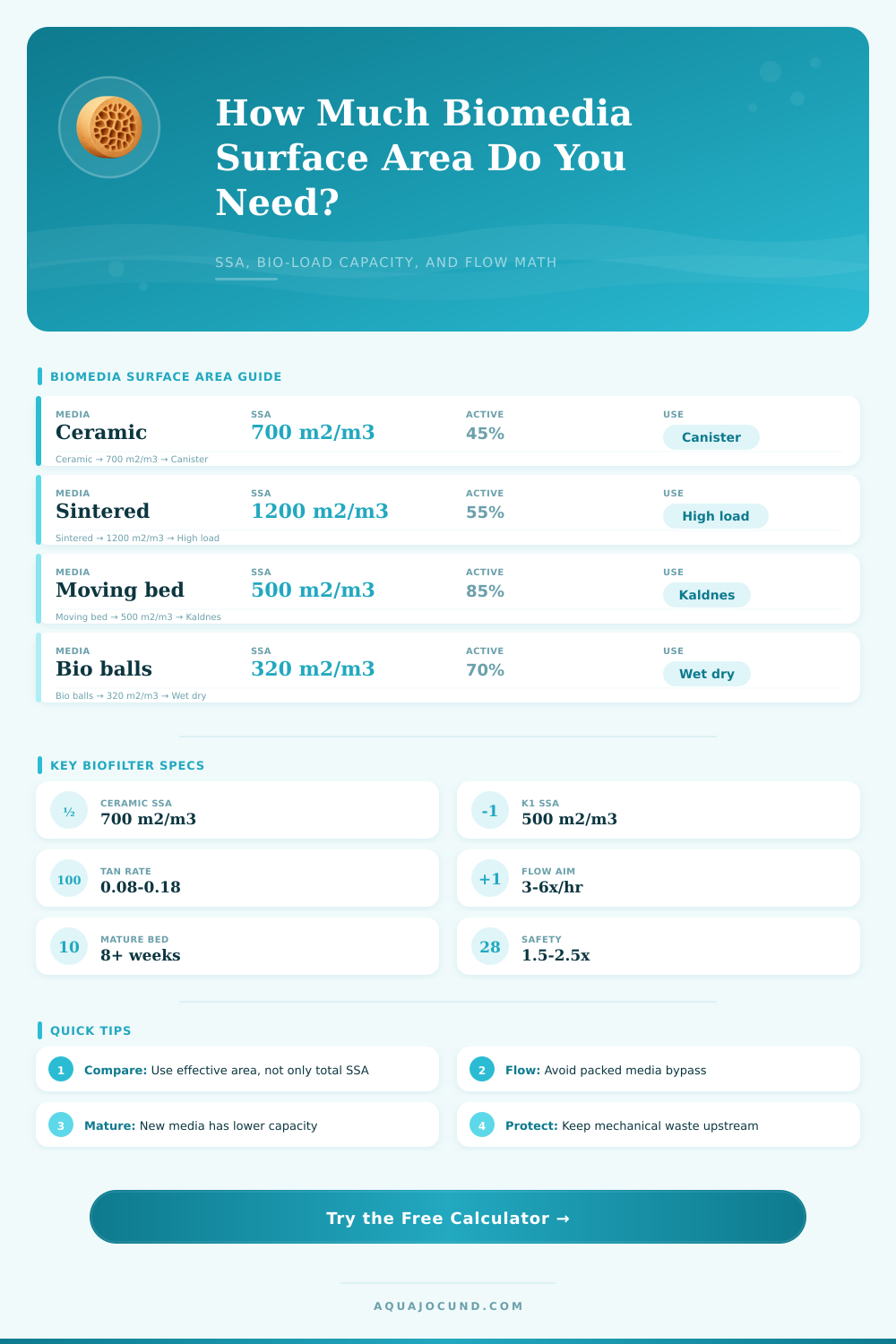
| Media Type | Total SSA | Protected Active Share | Void Space | Best Filter Use |
|---|---|---|---|---|
| Ceramic rings | 700 m²/m³ | 45% | 72% | Canister trays, HOB baskets |
| Sintered glass media | 1200 m²/m³ | 55% | 68% | Compact high-area canisters |
| Porous pumice stone | 850 m²/m³ | 50% | 64% | Low-flow sumps, baskets |
| Matrix style pebbles | 900 m²/m³ | 58% | 70% | Tray media with even flow |
| K1 moving bed media | 500 m²/m³ | 85% | 88% | Aerated moving beds |
| Bio balls | 320 m²/m³ | 70% | 92% | Wet dry towers, trickle sections |
| Reticulated foam mat | 600 m²/m³ | 65% | 85% | Sump dividers, sponge modules |
| Shower/trickle ceramic | 950 m²/m³ | 72% | 78% | High oxygen shower filters |
| Tank | Dimensions | Volume | Typical Media | Likely SSA Range |
|---|---|---|---|---|
| 10 gallon | 20 x 10 x 12 in | 38 L | 0.5-1.0 qt | 0.18-0.75 m² |
| 20 long | 30 x 12 x 12 in | 76 L | 1.0-1.5 qt | 0.35-1.30 m² |
| 29 gallon | 30 x 12 x 18 in | 110 L | 1.5-2.0 qt | 0.50-1.90 m² |
| 40 breeder | 36 x 18 x 16 in | 151 L | 2.0-3.0 qt | 0.70-2.80 m² |
| 55 gallon | 48 x 13 x 21 in | 208 L | 2.5-4.0 qt | 0.90-3.80 m² |
| 75 gallon | 48 x 18 x 21 in | 284 L | 4.0-6.0 qt | 1.40-5.70 m² |
| 125 gallon | 72 x 18 x 21 in | 473 L | 7.0-10 qt | 2.45-9.50 m² |
| Factor | Low Value | Normal Value | High Value | Calculation Effect |
|---|---|---|---|---|
| Biofilm maturity | 0.25 new | 1.00 mature | 1.12 enhanced | Scales active TAN rate |
| Temperature | 0.65 cold | 1.00 tropical | 1.08 warm | Adjusts nitrifier activity |
| pH / KH support | 0.70 soft acid | 1.00 stable | 1.08 buffered | Reflects alkalinity stability |
| Oxygen and debris | 0.62 poor | 1.00 good | 1.15 aerated | Rewards clean oxygenated media |
| Contact / bypass | 0.55 bypass | 1.00 forced | 1.12 trickle | Reduces area when water bypasses |
| Food Protein | Food Fed | TAN-N at 60% | TAN-N at 75% | Use Case |
|---|---|---|---|---|
| 32% | 1 g/day | 0.031 g/day | 0.038 g/day | Small community tank |
| 38% | 3 g/day | 0.109 g/day | 0.137 g/day | Medium tropical tank |
| 42% | 6 g/day | 0.242 g/day | 0.302 g/day | Cichlid or goldfish load |
| 45% | 10 g/day | 0.432 g/day | 0.540 g/day | Large display or grow-out |
| 48% | 20 g/day | 0.922 g/day | 1.152 g/day | Pond or heavy feeding |
Aquarium filtration depends on various variable to ensure proper function. The process of filtration depends on the amount of surface area in which beneficial bacteria can live. Beneficial bacteria is responsible for converting toxic ammonia into less harmful substance.
However, if the filter does not provide the beneficial bacteria with enough area to live inside the filter, then it wont be able to convert the ammonia that the fish waste releases. The area available to the beneficial bacteria do not necessarily have to be the total area within the filter. Some areas of the filter may become dirty and not allow for the beneficial bacteria to having access to the necessary amount of oxygen.
How Your Aquarium Filter Works
Some media products advertise that they contain a high amount of surface area for the beneficial bacteria, but the media manufacturer may advertise a usable amount of this surface area that is less than the total. Many people may have issue with their filtration system due to providing insufficient amount of the usable surface area for beneficial bacteria rather than the total amount of surface area within their filter. The environmental condition in which the aquarium is established will also impact the amount of ammonia that the beneficial bacteria can process.
If the parameters of the aquarium are not stable, such as the temperature or pH of the water, the filter will not be able to process the same amount of ammonia as it could if maintain in the ideal range. If the environment contains more or less oxygen than the water within the aquarium, the beneficial bacteria will process the ammonia at a higher or lower rate, respectively. The calculator allow you to enter various data about your aquarium and it’s filtration system.
You must enter the dimension of your tank, the type of filtration media that you use, the amount of filtration media in your tank, the feeding rate of your fish, and the environmental conditions of your aquarium. Based off this information, the calculator can estimate the gross and usable surface area of the beneficial bacteria in your filter. Additionally, the calculator also incorporates a safety factor in the case that your fish grow larger over time or that you feed them more frequent than when you use the calculator.
The maturity of the beneficial bacteria in your filter can impact the amount of ammonia that your filter can process. New filtration media will contain less mature beneficial bacteria than media that has been sitting in your filter for a longer time. Therefore, if you use the maturity setting in the calculator, you can see how much ammonia your media can process at this time compared to the future capacity of that same media.
When new tank are established, the high level of ammonia that can be detected are due to the immature state of the beneficial bacteria within the new tank. The flow of water through the media in your filter can also impact the function of your filter. If the water does not pass through the media at an appropriate rate, the beneficial bacteria will not be able to recieve the necessary amount of ammonia to process.
If the flow is too fast for the media in your filter, water may not pass through all of the media; this is known as channeling. The calculator allow for adjustment for the flow in your filter. Different media have different characteristics regarding the amount of surface area and the movement of water through the media.
For example, ceramic ring contain a medium amount of surface area but are extremely durable. Moving bed media contains less surface area for beneficial bacteria, but it is self-cleaning and allows for the transfer of more oxygen to the water. These two type of media can be compared using the information in the calculator to help determine which is best for your aquarium in relation to the type of fish that you wish to keep.
The actual amount of media in your filter may either be too small or too large when compared to the actual conditions of the aquarium. For instance, if you calculate the amount of food that your fish will eat per day in your tank, as well as the amount of media in your tank prior to the appearance of ammonia in your water test results, you can determine whether the amount of media that you have is appropriate. By ensuring that the amount of media in your aquarium is match with the amount of waste that your fish produce, the ammonia processing ability of your filter will last for a longer period of time.