Bioload To Filtration Ratio Calculator
Compare fish biomass, feeding rate, tank volume, bio media volume, turnover, media type, plant offset, and safety factor in one filtration ratio.
⚙Unit system and presets
🐟Bioload and filtration inputs
Estimate total live fish weight, not adult length.
Most adult fish are often near 0.5-2% daily.
Enter wet media volume with good flow, not empty filter chamber volume.
Credit only steady plant, algae, refugium, or harvestable biomass uptake.
Calculation breakdown
📊Filtration ratio reference
🧪Filtration media comparison grid
📋Bio media capacity factors
| Media type | Planning surface | Rate factor | Best calculator use |
|---|---|---|---|
| Coarse sponge block | 0.45 m²/L | 80 mg TAN-N/m²/day | Air sponge, canister tray, prefilter chamber |
| Ceramic rings | 0.30 m²/L | 70 mg TAN-N/m²/day | Canisters, sumps, hang-on chambers |
| Sintered glass media | 1.00 m²/L | 55 mg TAN-N/m²/day | High area media with clear prefiltration |
| Moving bed plastic media | 0.80 m²/L | 75 mg TAN-N/m²/day | Aerated reactors and fish room sumps |
| Wet/dry bio balls | 0.60 m²/L | 95 mg TAN-N/m²/day | Trickle towers and splash-exposed sump stages |
| Lava rock rubble | 0.25 m²/L | 60 mg TAN-N/m²/day | Budget rubble chambers with easy rinsing access |
| Matten foam sheet | 0.28 m²/L | 85 mg TAN-N/m²/day | Large slow-flow bio walls and fry systems |
| Live rock rubble | 0.35 m²/L | 65 mg TAN-N/m²/day | Marine sumps with detritus control |
📏Common tank planning examples
| Tank example | Typical biomass | Daily feed | Ratio target |
|---|---|---|---|
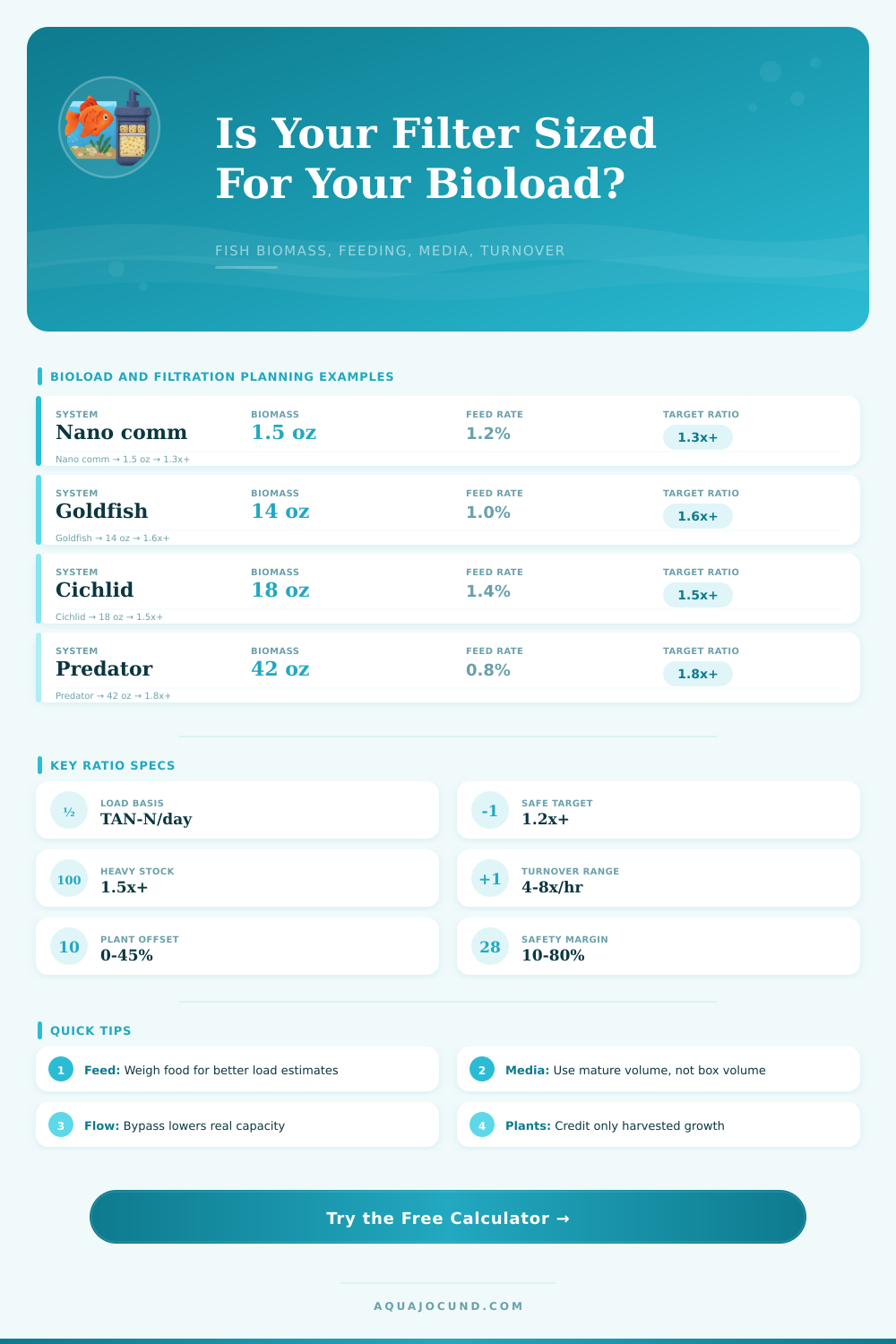
| 10 gal / 38 L nano community | 1-2 oz / 28-57 g | 0.4-0.8 g/day | 1.2x to 1.4x |
| 20 gal / 76 L planted community | 2-4 oz / 57-113 g | 0.8-1.8 g/day | 1.2x to 1.5x |
| 40 breeder / 151 L mixed fish | 5-9 oz / 142-255 g | 1.8-3.5 g/day | 1.3x to 1.6x |
| 55 gal / 208 L goldfish tank | 12-18 oz / 340-510 g | 3.5-6.0 g/day | 1.5x to 1.8x |
| 75 gal / 284 L cichlid display | 14-24 oz / 397-680 g | 4.5-9.5 g/day | 1.4x to 1.8x |
| 180 gal / 681 L predator system | 35-60 oz / 992-1701 g | 8-18 g/day | 1.6x to 2.0x |
🌀Turnover adjustment table
| Turnover | Capacity effect | Use this when | Planning note |
|---|---|---|---|
| Under 3x/hour | 0.76x to 0.91x | Low-flow planted, sponge only, gentle fry tanks | Do not assume all media is oxygenated equally. |
| 3-5x/hour | 0.93x to 0.97x | Normal community tanks and gentle canisters | Good if intake and output avoid dead zones. |
| 5-8x/hour | 0.97x to 1.03x | Most stocked displays and sump returns | Often the most stable planning range. |
| 8-12x/hour | 1.03x to 1.07x | Cichlids, goldfish, reef fish-only systems | Extra flow helps oxygen but does not replace media. |
| Over 12x/hour | 1.08x to 1.14x cap | River tanks and high-flow sumps | Watch bypass, noise, and fish comfort. |
🌱Plant and refugium offset guide
| Offset entered | Typical source | Calculator effect | Use with care when |
|---|---|---|---|
| 0% | Bare fish-only tank | No TAN-N load credit | Plants are absent or not growing. |
| 10-15% | Light planted display or small refugium | Small reduction to protected load | Growth is slow or trimming is rare. |
| 20-30% | Moderate planted tank, chaeto basket, algae screen | Meaningful offset after feeding load | Nutrients trend down between maintenance days. |
| 35-45% | Heavy plant mass, harvested refugium, mature scrubber | Strong offset, still capped by safety factor | Harvests are regular and growth is proven. |
| Over 45% | Specialized grow-out or export system | High credit, limited to 70% in the calculator | A crash or harvest delay would expose fish load. |
The majority of aquarium errors stem from a lack of understanding of weight in the tank. I have x gallons so I need a filter rated for that much.” “My fish are x long, so I’ll get them a canister/filter rated for that size.” Everything looks good until your water goes cloudy or your picky fish begin getting stressed. What’s wrong? Most often, it is not what we all tend to obsess about, the flow rate of the pump. More than likely it’s what is happening inside the tank itself, where the amount of biowaste being produced by your livestock do not match the bacteria’s capacity to handle it.
That’s where this calculator comes in, it moves away from unclear gallon-per-inch rules to actualy consider the system’s chemistry. This means we need to compare your aquarium’s ammonia producing capacity (bioload) to its filtration capacity (filtration). And the key number in this comparison is called the bioload to filtration ratio.
How to Use the Aquarium Calculator Correctly
Unfortunately, most people don’t think in terms of amount of “stuff” going into the tank so they use inches instead of grams/ounces when figuring out how many fish to fit in a tank. But the truth is we can’t standardize waste output without changing how we think about it: we must measure it by biomass, not size. So rather than thinking about individual fish sizes in inches (visual estimate), you’ll be asked for your entire fish population expressed in grams/ounces. That’s the baseline number for how much nitrogen is being produced.
Then you multiply that by how often you’re feeding them. Overfeeding and uneaten food cause major ammonia spikes. The tool lets you account for this by using the feed percentage slider to either assume you’re conservative with food or you really lay it on thick. Generally speaking most fish do fine eating less than 2% of their bodyweight per day but cichlids and goldfish frequently consume a lot more, moving the necessary filtration capacity in a big way.
Another important parameter is what bio media you have. While a filter containing sintered glass media will have a vastly different amount of surface area than one containing ceramic rings or some cheap polyfill, that’s taken into account as well. By assigning each media type certain surface area factors (i.e., specific surface area), the calculator know that while a 2″ deep column of media might look like a lot of volume, its actual usable surface area isn’t that great.
Which brings us to another point where most hobbyists overestimate. They think because their filter box is big that it must have high capacity, which means it can handle a ton of fish. However, if the media inside your filter is coarse sponge then even if you fill up the box, the detritus will clog it up and reduce its effective surface area…which is why the reference tables in the tool show the difference between things like moving bed media vs. Coarse sponge and why the latter may work better in a fry tank due to its forgiving nature whereas the former is more finicky about flow dynamics needed to function best.
Turnover (i.e., flow rate) plays a supporting but vital role in this equation. You want adequate turnover to deliver oxygen to the bacteria and carry away any ammonia laden water that may be nearby. Depending on how aggressive or sluggish your turnover is, the tool will set itself to adjust for the capacity it calculates. Too much turnover can result in path-of-least-resistance issues such as by-passing chambers, while not enough can cause anoxic pockets (dead zones) in which portions of the media are made ineffective. Most standard aquariums operate within a sweet spot around four to eight times the volume of their tank per hour. If your calculated flow is insufficient to accommodate the amount of media you’ve chosen, the calculator will alert you and you’ll have to up the pump or scale back your stocking accordingly.
This also brings up another issue that goes beyond simple filters: plant life. A heavily planted tank will offset at least some of the bioload by competing with bacteria for ammonia and nitrates. You can enter a percentage credit for having a refugium or plants in your tank, but it’s important to be realistic here. Only actively growing, frequently trimmed/removed plants are going to be a consistent nutrient sink. Dead plants aren’t doing anything except decorating your tank, they won’t help remove waste if they’re dormant. Giving too much credit to inactive green things can result in dangerously low estimates of filtration requirements.
To conclude. This calculator isn’t a promise. At best it’s a tool for making plans. It can help you calculate if you’re on the edge of your bacterial limit and need to upgrade, or if you have plenty of room left to grow your setup. More specifically, it allows you to measure the capacity versus waste relationship, and eliminate guesswork when deciding how many fish to stock. Use it to model scenarios. Add some extra plants and determine the new media volume needed to stay safe. Increase your filter size and figure out how much it will impact your buffer zone.
It’s not about clean water, it’s about parameter stability. Keeping your water parameters within the range where your fish remain healthy in the long run. Understanding the ratio means you no longer react to crashes; instead, you prevent them. This mindset is what makes the difference between a struggling tank and a thriving ecosystem.