🐟 Biofloc Tank Fish Capacity Calculator
Estimate stocking count, harvest biomass, feed demand, and aeration load for a biofloc tank.
Higher protein raises nitrogen load, so the calculator trims capacity above 32% protein.
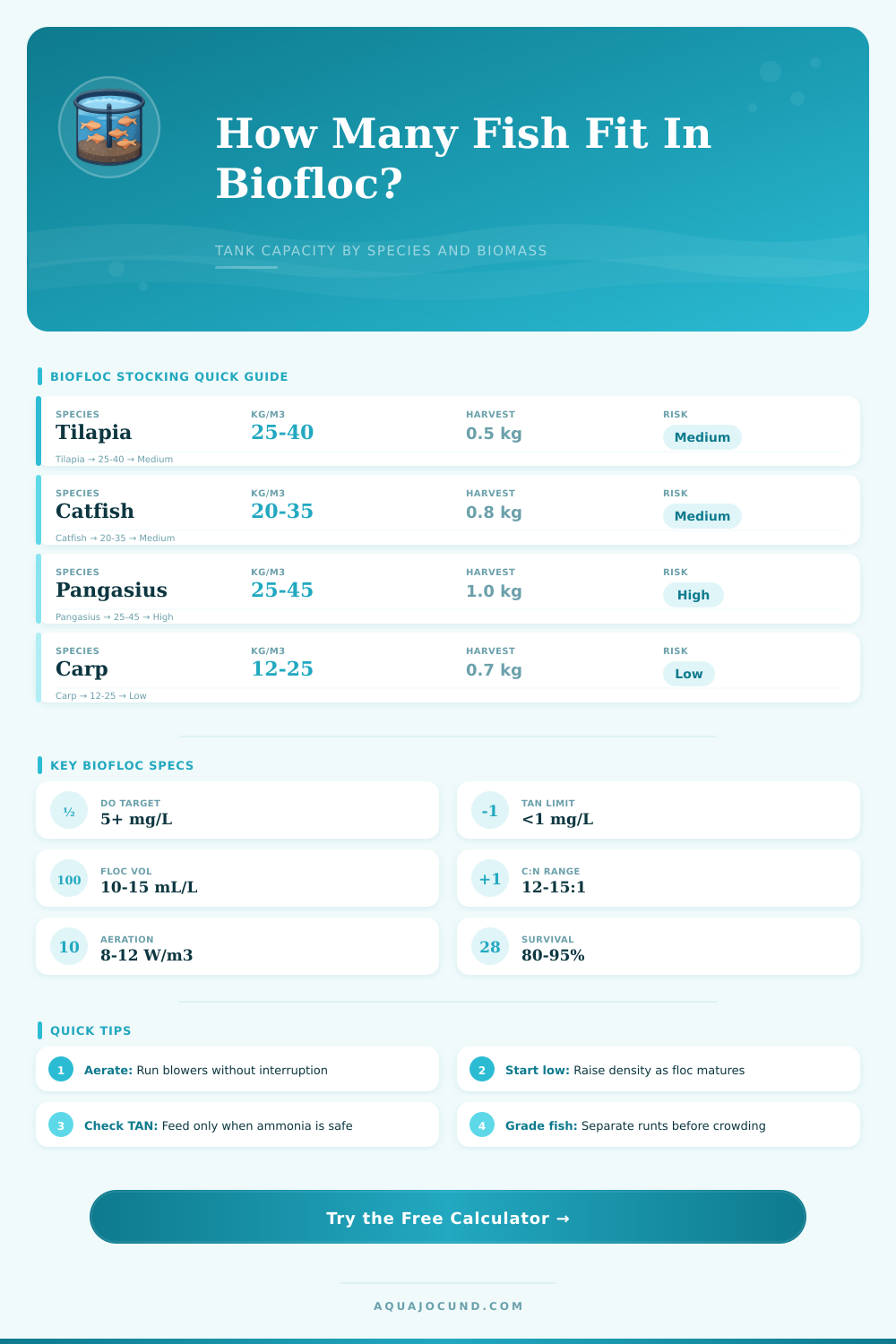
| Species | Conservative Density | Experienced Density | Typical Harvest Weight | Risk Level |
|---|---|---|---|---|
| Nile tilapia | 25 kg/m³ | 40 kg/m³ | 0.45-0.70 kg | Medium |
| African catfish | 20 kg/m³ | 35 kg/m³ | 0.6-1.0 kg | Medium |
| Pangasius | 25 kg/m³ | 45 kg/m³ | 0.8-1.2 kg | High |
| Common carp | 12 kg/m³ | 25 kg/m³ | 0.5-0.8 kg | Low |
| Barramundi | 15 kg/m³ | 28 kg/m³ | 0.8-1.5 kg | High |
| Koi or ornamental carp | 8 kg/m³ | 15 kg/m³ | 0.3-0.8 kg | Low |
| Pacific white shrimp | 3 kg/m³ | 6 kg/m³ | 18-25 g | Medium |
| Tank | Metric Size | Imperial Size | Working Volume | Tilapia Biomass Range |
|---|---|---|---|---|
| Backyard round | 2 m dia × 0.8 m | 6.6 ft dia × 2.6 ft | 2.5 m³ / 660 gal | 63-100 kg |
| Small tarpaulin | 3 m dia × 1.0 m | 9.8 ft dia × 3.3 ft | 7.1 m³ / 1,870 gal | 178-284 kg |
| Medium tarpaulin | 4 m dia × 1.2 m | 13.1 ft dia × 3.9 ft | 15.1 m³ / 3,990 gal | 378-604 kg |
| Rectangular raceway | 4 m × 2 m × 1 m | 13.1 ft × 6.6 ft × 3.3 ft | 8 m³ / 2,113 gal | 200-320 kg |
| Commercial round | 5 m dia × 1.2 m | 16.4 ft dia × 3.9 ft | 23.6 m³ / 6,230 gal | 590-944 kg |
| Factor | Conservative | Target Range | Capacity Effect | Check Frequency |
|---|---|---|---|---|
| Dissolved oxygen | Below 4 mg/L | 5-7 mg/L | Controls upper biomass | Daily, dawn first |
| Floc volume cone | Under 5 mL/L | 10-15 mL/L | Immature floc reduces load | 2-3 times weekly |
| Total ammonia nitrogen | Above 1 mg/L | Below 0.5 mg/L | Limits feed increase | 2-3 times weekly |
| Alkalinity | Below 80 mg/L | 100-180 mg/L | Stabilizes nitrification | Weekly |
| Suspended solids | Above 600 mg/L | 200-500 mg/L | Requires settling or exchange | Weekly |
| Harvest Biomass | Peak Feed at 2% | Suggested Airflow | Blower Planning | Operational Note |
|---|---|---|---|---|
| 50 kg | 1.0 kg/day | 60-100 L/min | Small linear blower | Keep spare stones clean |
| 100 kg | 2.0 kg/day | 120-200 L/min | 1/4 hp class blower | Use multiple diffusers |
| 250 kg | 5.0 kg/day | 300-500 L/min | 1/2 hp class blower | Backup power strongly advised |
| 500 kg | 10.0 kg/day | 600-1000 L/min | 1 hp or split blowers | Measure DO before feeding |
| 1,000 kg | 20.0 kg/day | 1200-2000 L/min | Redundant commercial blowers | Continuous monitoring preferred |
Biofloc crashes usually happen near harvest. Use the target harvest weight and survival rate to set the initial count, then raise feed only when oxygen, ammonia, alkalinity, and floc volume are stable.
Do not stock intensive densities without backup air. A mature biofloc tank depends on nonstop mixing, oxygen transfer, and solids suspension; outages can become dangerous quickly at high biomass.
A biofloc systems is a form of aquaculture that use bacteria to manage the wastes in the tank. It is important to understand that instead of simply being a tank for fish, a biofloc system is actualy a biological engine whose functioning rely upon the bacteria. The bacteria consume the ammonia in the tank and create clump of organic matter, or floc.
The fish in the tank consume these clumps of floc for protein. However, there is a limit to the amount of biomass that can exist within a biofloc system in relation to the amount of bacteria and fish that lives within the tank. The relationship between protein and nitrogen are directly related to the functioning of a biofloc system.
How a Biofloc Tank Works
If you provide feed containing a high percentage of protein to the fish, there will be an increase in the amount of nitrogen in the tank. As a result of the increased amount of nitrogen, there will be an increase in the amount of ammonia within the tank. Because the bacteria within the biofloc system must process all of the ammonia in the tank, an increase in the protein percentage of the feed for the fish will overload the bacteria if there are too many fish in the tank.
Thus, if you increase the percentage of protein in the feed, you must reduce the numbers of fish in the tank. Biofloc systems require aeration for two main reasons: to provide oxygen to the fish and to provide oxygen for the bacteria to break down the ammonia. Because both the fish and the bacteria requires oxygen, both of the species are competing for the available amount of oxygen in the tank.
If there isnt enough aeration provided to the tank, the oxygen levels will drop to a point at which both the fish and the bacteria will die due to lack of oxygen. Additionally, you must aerate the floc to prevent it from setting on the bottom of the tank; if it does settle on the bottom of the tank, the floc will release toxic gas due to lack of oxygen. The maturity of the floc within the tank can also impact the amount of biomass that should of be contain within the tank.
New biofloc tanks contain young floc, which cannot effectively process the amount of ammonia as mature floc. The mature floc in an established biofloc system contains a stable colony of bacteria that is effective at processing the waste of the tank compared to the younger, new floc. Thus, when using a new biofloc system, it is best to introduce fewer fish into the tank then if it were an established tank.
If there are too many fish in a new tank, the ammonia level will rise to the point of killing the fish. The different species of fish has different requirements within a biofloc system. For instance, tilapia are a hardy species that can easily eat the floc.
Other species, like barramundi, grow to high levels of biomass in the tank, yet require more oxygen than tilapia. Because each species have different requirements, you must alter the stocking density of fish based off the species of fish being raised in the tank. Finally, there must always be a safety margin create in the tank for unexpected events.
For instance, an unexpected event may be a power failure for the tank, which would prevent the aeration systems of the tank from functioning. If there is a safety margin for the tank, there will be more oxygen and more stability for the fish should one of these machine fail. Most failures in biofloc tanks occur when there is the greatest biomass of fish in the tank.
Thus, creating a safety margin will ensure that the ammonia and oxygen levels within the tank remain stably when there is an unexpected event.