Betta Tank Divider Calculator
Plan divider panels, compartment length, water volume per section, sight blocking, and gentle flow openings for divided betta tanks.
| Material | Typical Thickness | Flow Behavior | Divider Note |
|---|---|---|---|
| Perforated acrylic | 1/8 in / 3 mm | Controlled holes | Good balance of rigidity and visibility control |
| Plastic craft mesh | 0.04 in / 1 mm | High open area | Needs an opaque backing for persistent flaring |
| Glass panel | 1/8-1/4 in | Only edge gaps | Strong sight block when frosted or covered |
| Polycarbonate | 0.06-0.12 in | Drilled or slotted | Tough sheet for larger tanks |
| Foam divider | 1-2 in | Gentle through-flow | Excellent visual block with biological surface |
| Egg crate | 3/8 in cells | Very open | Requires mesh or screen overlay for bettas |
| Expanded PVC board | 1/8-1/4 in | Drilled or slotted | Opaque, light, easy to cut |
| Stainless mesh | 0.02-0.04 in | High open area | Use aquarium-safe grade and covered edges |
| Tank | Dimensions | Practical Sections | Divider Planning Note |
|---|---|---|---|
| 5.5 gallon | 16.25 x 8.5 x 10.5 in | 1-2 short-term | Very small bays; use only for limited plans |
| 10 gallon | 20.25 x 10.5 x 12.5 in | 2 | Classic two-betta divider footprint |
| 15 gallon | 24 x 12 x 12 in | 2 | Better swim length per side than a 10 gallon |
| 20 high | 24 x 12 x 16 in | 2-3 | Volume helps, length is still compact |
| 20 long | 30 x 12 x 12 in | 3 | Excellent length for equal compartments |
| 29 gallon | 30 x 12 x 18 in | 3 | More height; keep divider stable near the rim |
| 40 breeder | 36 x 18 x 16 in | 4 | Wide front-back panel needs stiffer material |
| 55 gallon | 48 x 13 x 20 in | 4-5 | Long run works best with repeated sight blocks |
| 75 gallon | 48 x 18 x 21 in | 5 | Large bays with strong divider support |
| 125 gallon | 72 x 18 x 22 in | 6 | Good display length with multiple panels |
| Opening Type | Typical Safe Size | Flow Role | Risk Check |
|---|---|---|---|
| Top gap | 0.13-0.25 in | Surface exchange | Cover jumping lanes and watch small bettas |
| Bottom gap | 0-0.13 in | Debris movement | Large bottom gaps invite squeezing |
| Side edge gap | 0-0.06 in | Fit allowance | Shim loose rails before adding fish |
| Round holes | 0.10-0.18 in | Measured cross-flow | Keep openings below adult head width |
| Mesh openings | Fine mesh | Broad gentle flow | Layer opaque screen if fish flare constantly |
| Planning Target | Comfort Range | Calculator Signal | Action If Low |
|---|---|---|---|
| Water per section | 5 gal ideal, 2.5 gal minimum | Section volume card | Use fewer compartments or a larger tank |
| Net swim length | 8 in minimum, 10+ in better | Swim length card | Reduce sections or divider thickness |
| Sight block score | 75% or higher | Flow / sight card | Add opaque film, plants, or foam |
| Open flow area | 6-12% for gentle tanks | Flow breakdown | Add holes slowly or improve filter split |
| Gap escape risk | Under 0.20 in | Status message | Close edges before livestock goes in |
Most of us betta keepers started out with one tank and wanted to have two (or more) fish living together. Usually that doesn’t go well, and you end up stressed. The solution is to use visual privacy and physical barriers to control aggression. That means blocking your fish’s sight line but also providing some degree of open space so water can move through.
Where there is a clear sight line between fish they are liable to be upset. To plan a divider means planning, with numbers, and not by guessing. Multiple panels will take up volume (minus their thickness). Length is lost too. Bettas need more than height; they require some room in front to move around. Even if the water’s clear being crammed up doesn’t make them healthy. This calculator handles that for you automaticly, so you don’t have to worry about making your divider feel like a prison instead of a home.
How to Make a Good Betta Tank Divider
The material you choose determines visibility and water flow. Clear acrylic offers no privacy, but it is durable. Opaque film or thick moss, sight lines blocked, but drilling holes creates controlled flow. The more clarity versus blocking on your score, the higher the stress for fish even if it means better filtration. Adjust that balance with tool of your choice.
Constant flaring suggests your plan has to much visibility. Stagnation is bad. Current, Bad (Strong = Bad) A slow-moving exchange are required. Remove waste without making it a river. Avoid big gaps in the top as they’re an invitation for the betta to leap from his compartment. Small, many flow holes is better than a few larger ones. It will provide a more uniform flow throughout the panel. The goal is a gentle exchange to avoid stress.
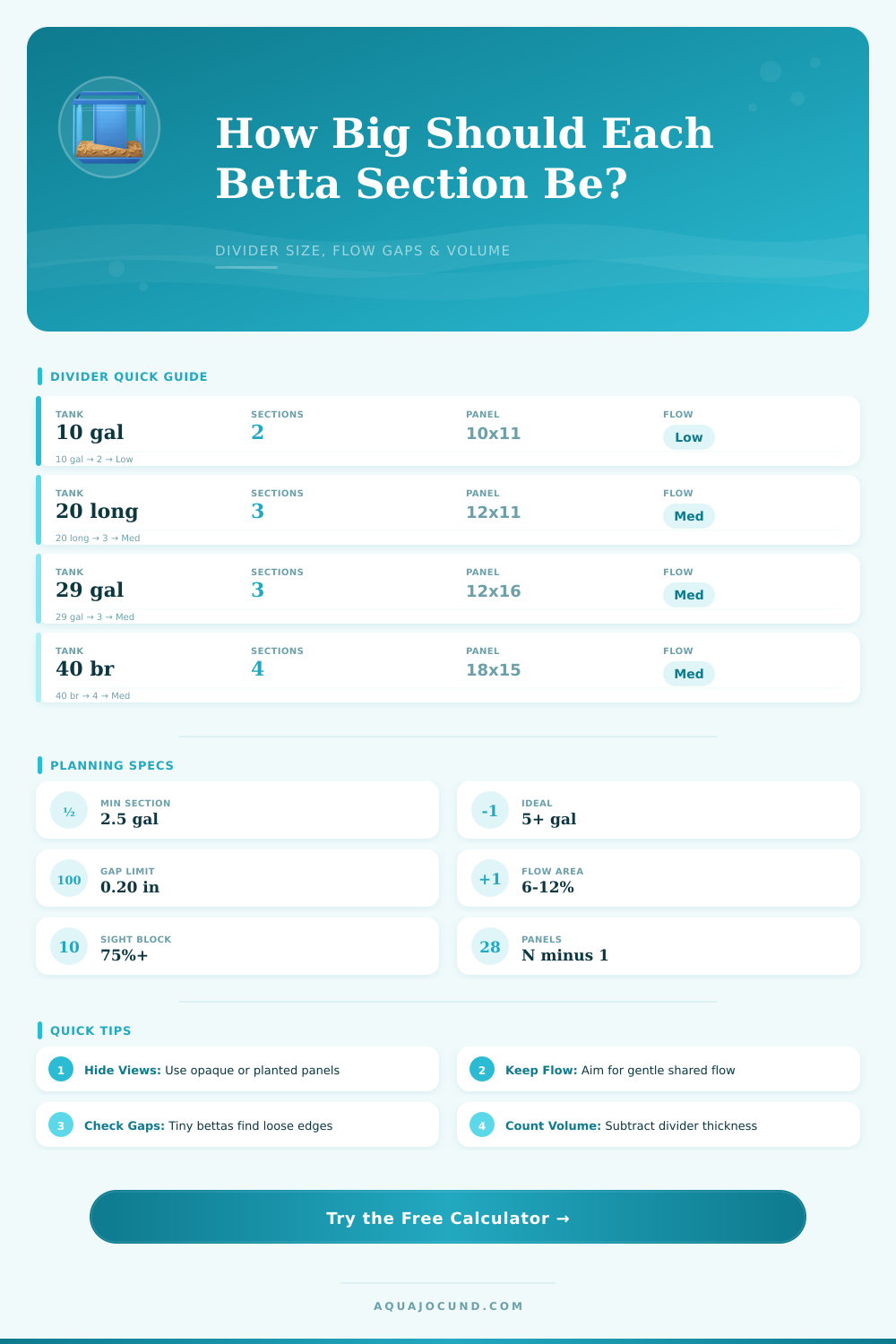
Strong flow is. The number depends on your tank size. If you’re okay with small compartment, a 10g divided in half is fine. Otherwise, bigger is better (more space to divide comfortabley). Use the reference table above for suggestions regarding three- and four-sections that work well within a given tank size.
Each compartment should of have at least five gallons of capacity for long term healthy operation. For short term quarantine purposes, you can get away with less. However, doing so will result in fast declining water quality. It takes time and accuracy. Measure twice, cut once. Test your divider in an empty tank first. Then add fish. Make sure no edges is sharp and there are no gaps big enough for any fish to slip through.
Think about how you can set up a tank so that the fish don’t realize they’re in the same tank at all. Gentle flow and the visual barrier help reduce stress. Colors becomes vibrant again and fish swim around actively. Solving the crowding creates a beautifull sight.