Betta Jar Shelf Count Calculator
Estimate how many jars fit on a shelf system, including rows, columns, vertical clearance, water weight, total rack load, and airline port count.
Rack Capacity Results
| Jar profile | Outside size | Volume | Empty weight |
|---|---|---|---|
| Quart glass jar | 3.6 in dia x 6.9 in | 0.25 gal / 0.95 L | 1.0 lb / 0.45 kg |
| Half-gallon glass jar | 4.4 in dia x 6.6 in | 0.50 gal / 1.89 L | 1.6 lb / 0.73 kg |
| One-gallon round jar | 6.0 in dia x 10.0 in | 1.00 gal / 3.79 L | 3.0 lb / 1.36 kg |
| One-gallon square jar | 5.5 x 5.5 x 8.0 in | 1.00 gal / 3.79 L | 2.5 lb / 1.13 kg |
| Two-liter square jar | 4.8 x 4.8 x 8.0 in | 0.53 gal / 2.00 L | 1.2 lb / 0.54 kg |
| Three-liter acrylic jar | 5.3 x 5.3 x 8.5 in | 0.79 gal / 3.00 L | 1.1 lb / 0.50 kg |
| Five-liter square jar | 6.4 x 6.4 x 9.5 in | 1.32 gal / 5.00 L | 1.8 lb / 0.82 kg |
| Two-gallon rectangular tub | 9.8 x 6.7 x 6.0 in | 2.00 gal / 7.57 L | 1.4 lb / 0.64 kg |
| Shelf size | Metric size | Example jar | Typical grid |
|---|---|---|---|
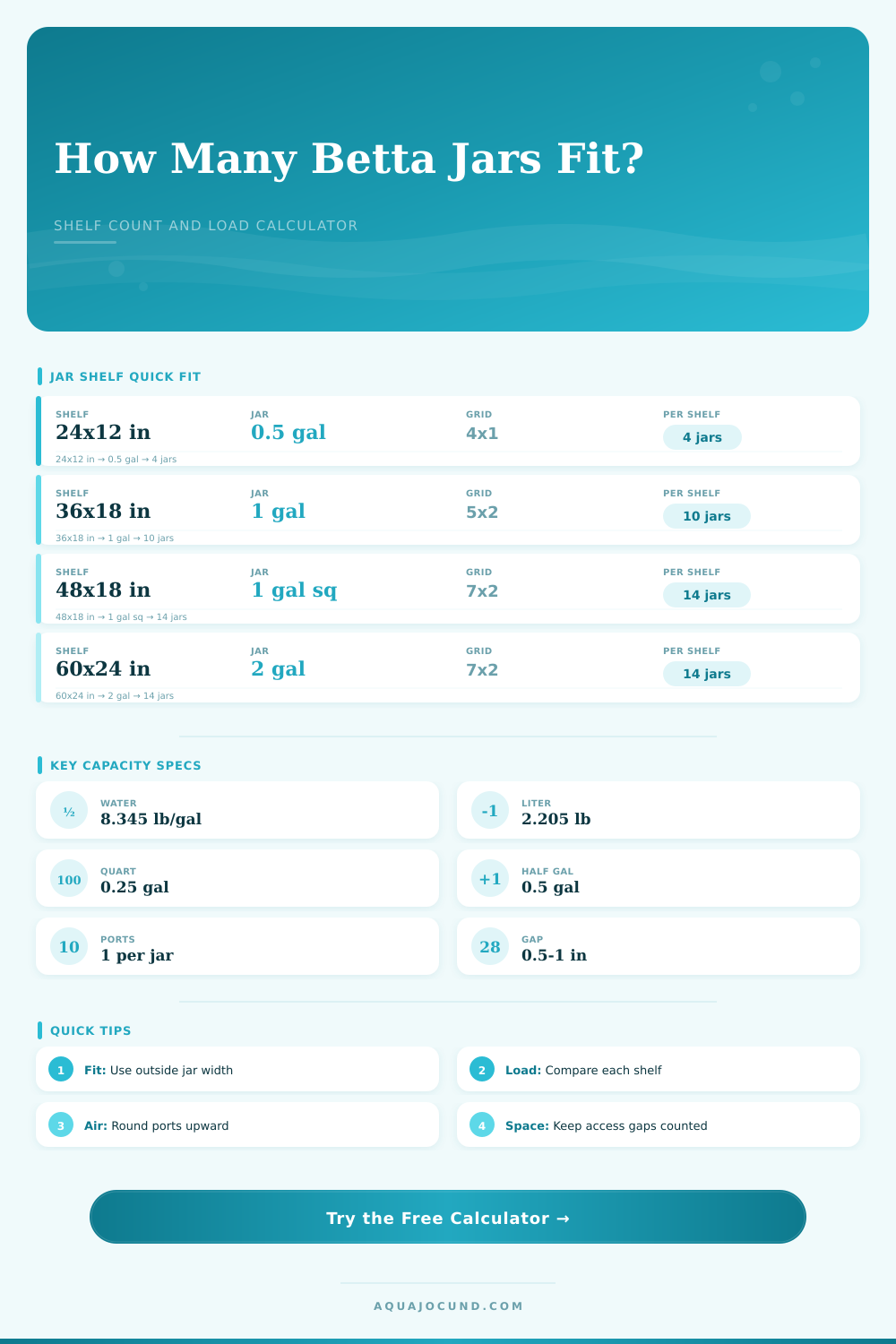
| 24 x 12 in | 61 x 30 cm | Half-gallon round | 4 columns x 1 row |
| 36 x 18 in | 91 x 46 cm | One-gallon round | 5 columns x 2 rows |
| 48 x 18 in | 122 x 46 cm | One-gallon square | 7 columns x 2 rows |
| 48 x 24 in | 122 x 61 cm | Five-liter square | 6 columns x 3 rows |
| 60 x 24 in | 152 x 61 cm | Two-gallon tub | 5 columns x 3 rows |
| 72 x 24 in | 183 x 61 cm | One-gallon round | 10 columns x 3 rows |
| Airline mode | Port rule | Formula | Output rounded |
|---|---|---|---|
| No airline ports | 0 ports | Jars x 0 | 0 manifold bars |
| One outlet per 2 jars | 0.5 port per jar | Ceiling(jars / 2) | Whole outlets |
| One outlet per jar | 1 port per jar | Jars x 1 | Whole outlets |
| Two outlets per jar | 2 ports per jar | Jars x 2 | Whole outlets |
| Use jar profile default | Profile value | Jars x profile ports | Whole outlets |
| Input | What it controls | Common range | Calculator effect |
|---|---|---|---|
| Side gap | Space between jars across width | 0.5-1.5 in | Changes columns |
| Row gap | Space between front and rear rows | 0.75-2 in | Changes rows |
| Front clearance | Unused front shelf strip | 1-3 in | Reduces depth |
| Top clearance | Open space above each jar | 1.5-4 in | Checks opening |
| Load allowance | Usable share of shelf rating | 60-100% | Caps jars by weight |
Typically it’s one betta in a bowl sitting on the windowsill. Then you get another fish. And before long, you have half-a-dozen containers taking up space.
Not the problem (it’s the physics). Glass is heavy and water is heavy. That nice, pretty wire shelving unit you got for the bedroom won’t give two hoots about your new hobby. A gallon of water are slightly heavier than 8 pounds. Add in weight of the filter, heater, gravel, and whatever’s in the jar, and you could of a tank that weighs as much as ten pounds or even more for every tank. With that many tanks (40 tanks) on three shelves, you’re not simply decorating your living space; you’re building a structure capable of supporting a load. Understand what goes into that calculation and use the calculator to run the math for you. Don’t let your floor collapse!
How to Set Up Your Betta Room Safely
The second big mistake is measuring the jar wrong (inside out). Most of us uses jars with handles sticking out, or rings or even thick labels; the outside footprint is the one you want, not the inside. That’s what takes up space on the shelf, and if you forget about all those inches, the jars won’t fit side by side. The tool requests the height and outside diameter because that’s what takes up real estate on the shelf. It also asks how much gap you leave between jars, and no, you can’t pack them like sardines. You need enough room to reach in and get a net around them. You also need space to clean the glass and change the water. A half-inch gap doesn’t sound like much, but multiply that by how many jars you’re trying to fit on a shelf, which is probably thirty-six inches wide.
Also, be aware that betta jars is usually taller than you’d think with airline tubing and lid included. You don’t want your shelf’s opening too narrow vertically; otherwise, you’ll need to remove the whole jar during a water change. This leads to broken glass and spilled water, a bad combination. To illustrate, the calculator will prompt you for both the jar height and the minimum vertical opening per shelf. It first ensures that the shelf can holds the weight of the jar and then checks if the jar will fit.
And then there’s the weight limit, where dream meets reality. Those wire shelves seem strong. They’re typically rated for two-hundred pounds (total), or maybe even just one-hundred pounds (per shelf). How are you supposed to know? The tool allows you to establish a load allowance, a safety margin. Metal fatigues, wood flexes, and wire sags; running your shelf right up to its maximum risk puts your stuff in danger. Using twenty percent less capacity gives you space for the shelf to flatten out, your jars to remain level… and level jars don’t topple over.
People also frequently forget about airlines when making their plan. To maintain movement and oxygenation of water, each container require an air stone. The calculator calculates the required number of airline ports for your set-up. Are there enough outlets coming from the manifold bar? Do you require extra lines? It may seem like small pipe work, but realizing halfway through that you don’t have enough ports is annoying.
If you don’t know, start with the presets, these will provide a starting point for commonly used jar sizes such as half-gallon on standard wire racks. Once you have that, adjust the numbers to fit your space exact, then measure twice. Always measure full jars, not empty ones; the former are heavier, and often narrower than too. That small difference may look insignificant on paper, but in reality, it’s the distinction between a clean line-up of tanks and a jigsaw puzzle you’ll never be able to complete.
A betta room isn’t something that can be built in a hurry. Building a betta room require precision and patience. It isn’t just about setting up a place for your fish to live; it’s about being careful with how fragile the containers is and how much weight they hold when filled with water. If you get the math correct, the fish will thrive, the shelves remain flat, and the room appears tidy. That’s what this is all about: a simple equilibrium. Respect the space, balance the load, and let the fish swim.