
Everyone knows them, those little plastic bagged pets found on your local hardware store shelves. But betta fish aren’t as simple as whats packaged in the box.
Betta fish, also known as labyrinth fish, is native to Southeast Asia. In fact, they has an organ that enables them to breathe atmospheric air right off the water’s surface. This give you an idea of their biology and completely changes how you care for them. Because they’re labyrinth fish, they require access to open water at all times. This holds true regardless of your tank size or filtration quality.
Different Types of Betta Fish and How to Care for Them
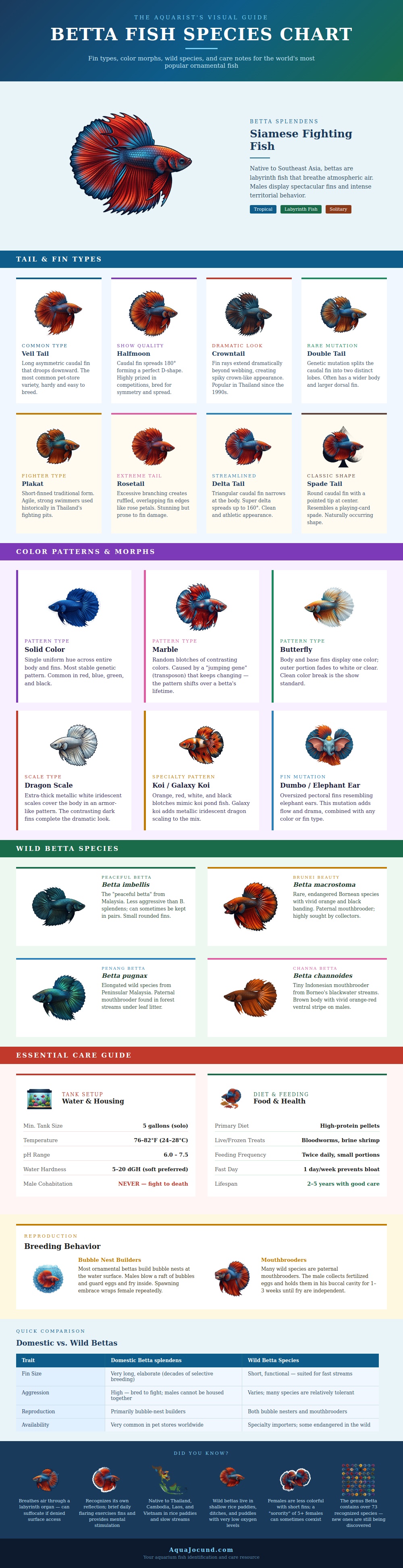
Today’s selection is broken down in visual guide above. The one most known by hobbyists are the Siamese fighting fish or *Betta splendens* in scientific terms. Because these were selectively bred for decades in Thailand, what used to be their natural short fins became elaborately shaped and colored displays. From the hardy and common classic Veil Tail to the dramatic Crowntail with its spiky fin rays, there’s something for everyone. Even rarer mutations exist such as the Double Tail that splits into two distinct lobes from a genetic split.
Based off fin size and fragility, each will need different care. In most cases, your decision will boil down to appearance vs. Durability. The Halfmoon betta has perfectly arched fins with a 180-degree spread that’s quite impressive when displayed. But those long rays can tears easily, especially if there’s significant flow or other elements (e.g., plants) with rough edges.
On the flip side, the Plakat (aka short fin) keeps their fins short & round near their natural state. These guys are tough as nails in a planted tank environment and they’re also good swimmers. For a low-maintenance fish, the Plakat is usually the wiser option since they sacrifice visual style for rugged durability.
But it’s more than the shape of their fins. The color patterns also has a story to tell. Marbles have a “jumping gene,” meaning the pattern on them will change in unpredictable ways over time. They may start out mostly blue, then gradually turn white and red with age. The variability is interesting and makes buying one a bit of a surprise. But it’s not so good if you’re trying to predict what your young will be like as a breeder. Specialty morphs such as the Dragon Scale betta has thicker, metallic iridescent scales (think: armor) that give them a special look. It all represents intricate genetics, which must be carefully bred to preserve.
Beyond your typical house betta species, you might want to consider exploring the wild ones too. As shown on the chart above, the wild betta types (e.g., *Betta imbellis*) is referred to as peaceful bettas. They’re not as territorial as their other aggressive cousins. They may even be kept in groups or pairs. Some such as *Betta macrostoma* and *Betta pugnax* are mouthbrooders, which means that the male will carry around the fertilized eggs in his mouth until hatching time.
Although the fry has a greater chance of surviving with this method of reproduction, certain tank conditions need to be met for them to engage in breeding behavior. Because the wild bettas tend to go towards acidic and soft blackwater tanks instead of the neutral pH tanks sold at stores, caring for them is much more difficult than regular pets.
No matter what species you choose, good care is the key. At a minimum, keep them in a five-gallon tank that gives them some space to claim territory and maintain stable water parameters. Avoid keeping multiple males; they’re very territorial and will kill each other. Maintain water temps around 76-82 degrees F to match their tropical roots and strengthen their immune system. Feed them a high-protein pellet diet and provide some live treats (e.g., bloodworms) to complement their carnivorous nature.
And lastly, keep in mind these fish are smart and know what’s going on around them. They’re self-aware and know what they see is themselves. They flare at mirrors for exercise, but not for too long or it stresses them out. Plants as visual barriers help lessen anxiety in smaller tanks.
If your goal is keeping a wild, tough individual or a show quality Halfmoon, the trick is still knowing how to respect the nature of the animal. Knowing the chart above removes the guessing game and puts you firmly within the area of informed fish keeping. When you match the fish to its nature, you create an environment where your betta thrives… transforming what was once just a tank into a living vibrancy of Southeast Asian water worlds.
