Balling Salt Quantity Calculator
Estimate reef Balling salts for alkalinity, calcium, magnesium, stock solutions, and sodium chloride-free balance salt.
| Recipe option | Alkalinity salt | Stock strength | Best fit |
|---|---|---|---|
| Classic balanced Balling | Sodium bicarbonate | 84 g/L alkalinity, 100 g/L calcium | Most mixed reefs and steady automated dosing |
| Carbonate alkalinity blend | Sodium carbonate | 53 g/L alkalinity, 100 g/L calcium | Low pH systems needing smaller alkalinity volumes |
| Gentle nano strength | Sodium bicarbonate | 42 g/L alkalinity, 60 g/L calcium | Small aquariums where each pump pulse matters |
| Concentrated reservoir mix | Sodium bicarbonate | 126 g/L alkalinity, 150 g/L calcium | Large systems with limited dosing container space |
| Parameter | Conservative daily change | Typical reef range | Calculator note |
|---|---|---|---|
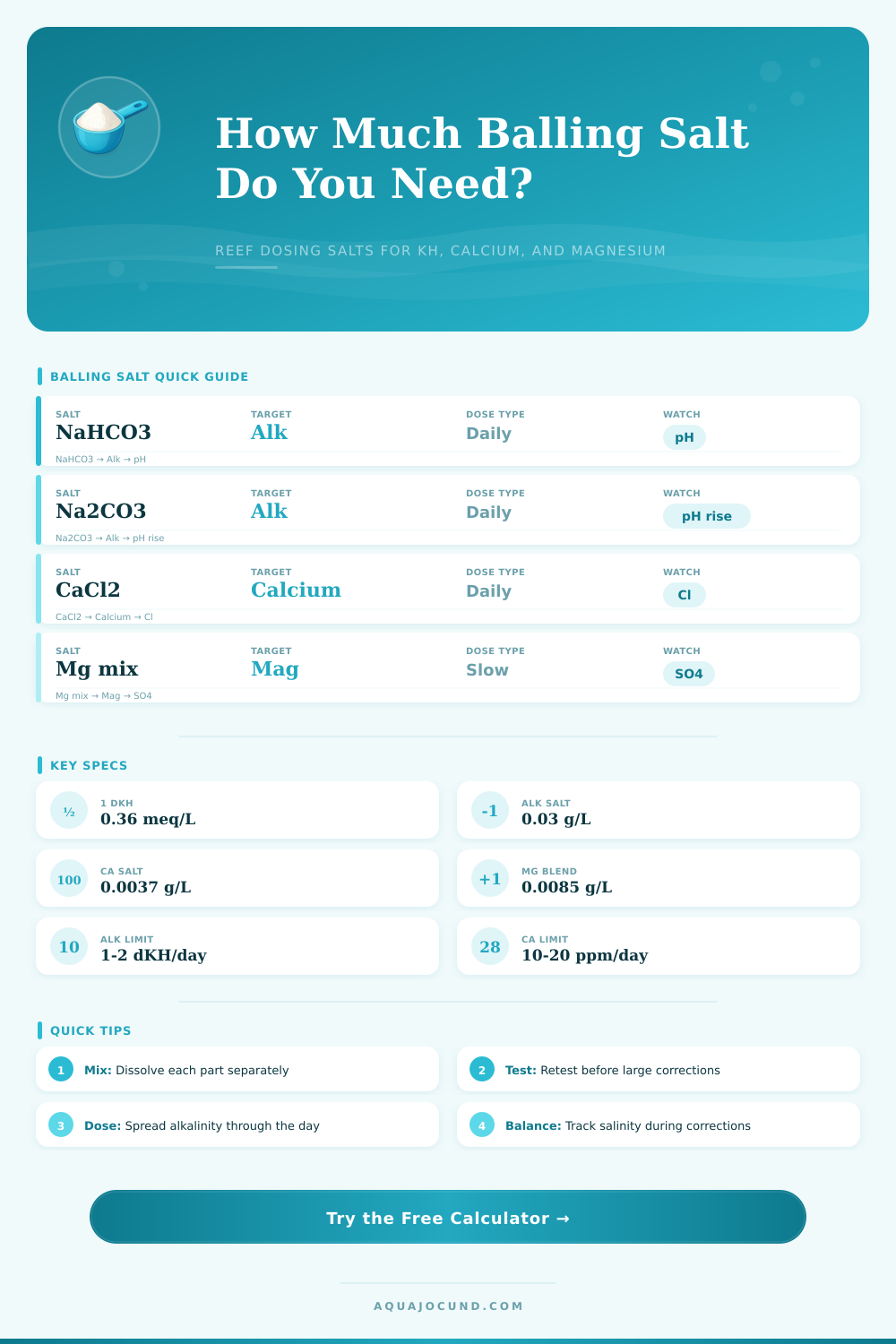
| Alkalinity | 1.0 dKH per day | 7.0 to 9.0 dKH | Spread the daily amount across many small doses. |
| Calcium | 10 to 20 ppm per day | 400 to 450 ppm | Correct calcium separately from alkalinity additions. |
| Magnesium | 25 to 50 ppm per day | 1250 to 1400 ppm | Magnesium corrections can be slower and less frequent. |
| Salinity | 0.001 SG per day | 1.025 to 1.026 SG | Large Balling corrections add ions and should be tracked. |
| Tank example | Typical net water | 1 dKH classic alk | 20 ppm calcium |
|---|---|---|---|
| 10 gal nano reef | 8.8 gal / 33 L | 12 mL stock | 24 mL stock |
| 40 breeder reef | 35 gal / 132 L | 47 mL stock | 97 mL stock |
| 75 gal display | 66 gal / 250 L | 89 mL stock | 183 mL stock |
| 180 gal SPS system | 158 gal / 599 L | 214 mL stock | 439 mL stock |
| Correction | Dry salt estimate | Classic stock estimate | Retest timing |
|---|---|---|---|
| Raise alkalinity by 1 dKH | 0.030 g NaHCO3 per liter | 0.357 mL per liter | After full mixing, often 2 to 6 hours |
| Raise calcium by 10 ppm | 0.0367 g CaCl2 dihydrate per liter | 0.367 mL per liter | After circulation clears the dosing area |
| Raise magnesium by 50 ppm | 0.426 g blended Mg salts per liter | 3.79 mL per liter | Next day for a steadier reading |
| Balance calcium chloride addition | 15% to 35% NaCl-free salt by CaCl2 weight | Mix as its own part | Check salinity before repeating |
Reef keeping would be easy if we could just add some fish and forget about it. But that’s not the case. Parameters shift. You notice something wrong and spend hours trying to understand what changed. Alk goes down in the morning. Ca drops after feedings. Mg…well that one changes over weeks.
That’s where the Balling method comes in. By having three different solutions, you’re able to address each parameter individually. This makes for tedious, error-prone math done by hand. Let the calculator do the hard work for you, then concentrate on biology rather than arithmetic.
How to Use the Balling Method Calculator
First, consider how much water you have in your tanks. That’s your actual water volume. This is the amount of water left after you account for things like sand, rock, and the sump. People underestimates how much difference this makes. For example, a 75 gallon display may only have 50 gallons of usable water. Dosing for 75 gallons will result in significant overdoses. The tool accounts for this by asking for displacement percentage. You need to get that correct so all other calculations below it will be correct too. It’s the basis for everything else.
The last option is alkalinity salts. Hobbyists generally use sodium bicarbonate (increases pH slowly) or sodium carbonate (more effective per pound but sharp increase in pH if overdosed). The calculation account for this difference by default. Pick a recipe potency based off how much pH you’re willing to deal with and your pump capacity. Gentle recipes are better for nanos where even tiny amounts make a big difference and you don’t want to shock the tank accidently. For large tanks, more potent mixes require less pumping time, saving energy and shelf space.
Patience is a virtue for calcium corrections. Adding too much calcium chloride all at once form solids where it touches alkalinity. To avoid this, the calculator distributes the correction out across several days. It also accounts for a balance salt portion. You may be thinking about another variable. Why?” That’s because adding calcium chloride adds chloride ions while not adding any sodium or magnesium. That throws off your ionic ratios and salinity over time. A little bit of balance salt offsets this drift. Now you don’t have to change water constantly while keeping things chemically clean.
Magnesium buffers calcium and alkalinity. When magnesium fall, other values like calcium and alkalinity get out of whack too. It’s difficult to keep them in line when magnesium isn’t there. This should of been corrected slowly. Keep that in mind as the tool also will suggest small amounts each day but spread out across more days. Don’t rush your magnesium. Let it catch up and then recheck before adding more.
Understand your water before you start calculating. The test kit is old? The samples are contaminated? How are you going to know your current levels without knowing those facts? All the difference in the world, use fresh reagent and clean cups. Fill in the fields with those verified numbers.
The output will tell you how much stock solution to add daily to bridge the gap between where you are and where you want to be. It does not tell you what your long-term consumption will look like; treat the result as a temporary correction plan. Once parameters stabilizes, measure actual consumption and adjust accordingly.
The reference tables serve as a fast check for common situations. They’ll confirm that you’re dosing in safe ranges. These doses are on the low end of what’s considered “safe” for daily dosing. If the tool tells you to adjust the alkalinity by more than two degrees per day, stop. That’s too aggressive for most livestock. It’s better to take longer and spread the load then stress the animals. Remember: We want to be stable, not speedy.
Be careful when mixing salts. You’ll need some reverse osmosis water to dissolve each component separately in its own respective container. Be sure to shake well until dissolved and be sure to label appropriately. Any cross-contamination will immediately ruin your solutions. Never let your calcium and your alk come into contact with one another, outside the tank.
This is what makes the Balling method so advantageous, it provides you with control beyond that of two-part dosers. Is all of this really necessary? It depends on your goal and what you keep. If you’re a high end coral person (SPS in particular) then yes, you’ll need exact parameters for them to survive. Fish and soft corals can deal with larger parameter fluctuations. Know your livestock before diving headfirst into the system. Keep it simple until you get comfortable and understand the basics. Add more variables later.
Once you grasp the ratios, the math is still the same. When you take out the guessing about daily volume and stock strength, that’s where the calculator come in to play. It takes complicated science and makes it something real. Plug in your figures, develop a strategy, then implement it coolly and deliberately. There’s no need for panic…
A healthy tank will come from steady, measured efforts. Perfect is the enemy of good, as they say. Prevent drastic swings with regular small doses. Use tools to keep you on track, but let the habit keep the water clear. Believe in the process just a bit more than each test result. Adjust slowly and recheck often. Observe how the corals react. That’s the real measure of success.