🐟 Bag Size to Fish Calculator
Estimate fish shipping bag size, water fill, oxygen headspace, and duration fit from fish size, count, and activity.
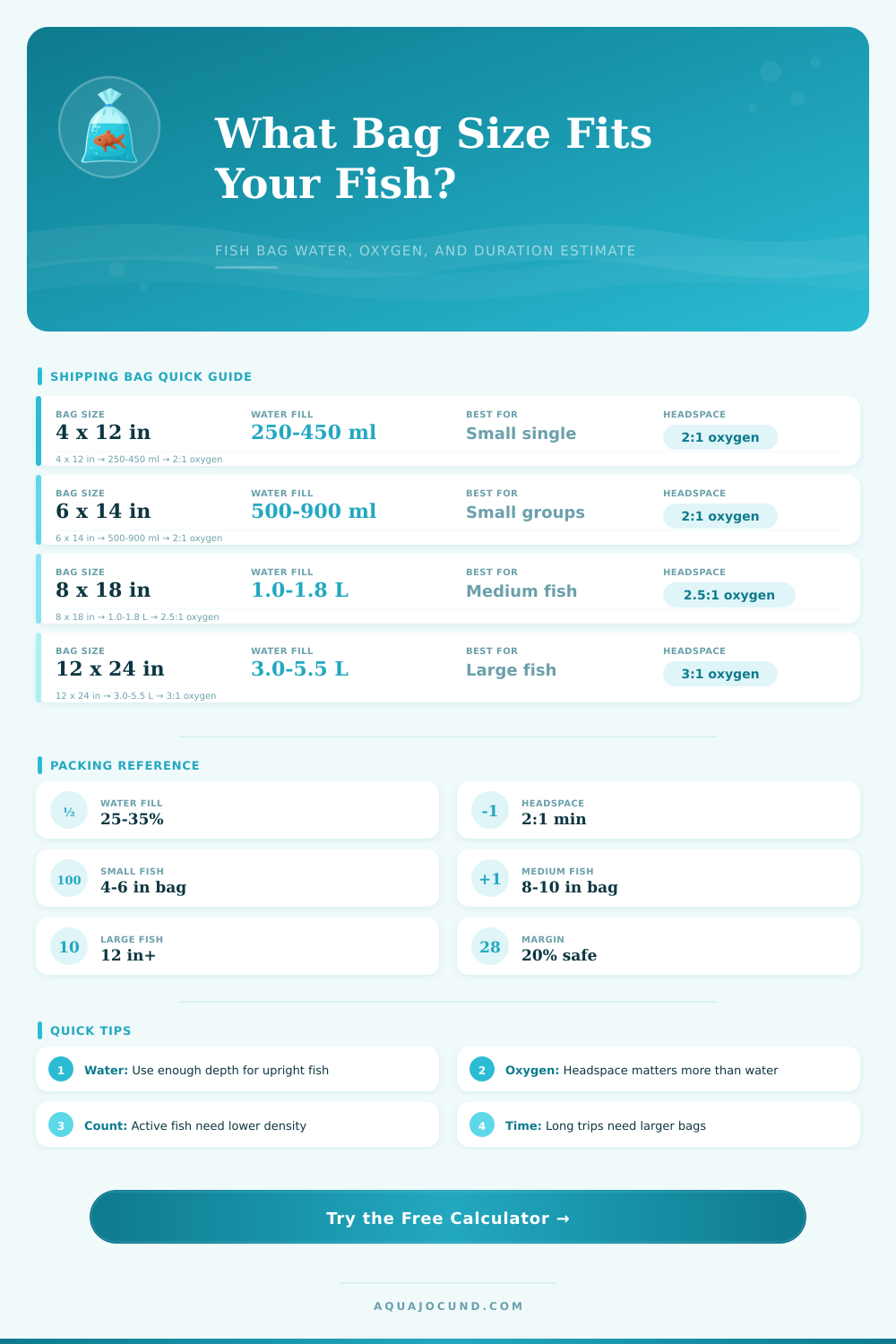
| Flat Bag Size | Approx Water Range | Common Fish Length | Typical Use |
|---|---|---|---|
| 3 x 8 in / 8 x 20 cm | 120-220 ml | Under 1 in | Fry, shrimp, snails |
| 4 x 12 in / 10 x 30 cm | 250-450 ml | 1-2 in | Betta, guppy, small singles |
| 5 x 15 in / 13 x 38 cm | 400-750 ml | 1-2.5 in | Small community groups |
| 6 x 14 in / 15 x 36 cm | 500-900 ml | 1.5-3 in | Standard retail fish bag |
| 8 x 18 in / 20 x 46 cm | 1.1-2.0 L | 3-5 in | Medium fish, short groups |
| 10 x 20 in / 25 x 51 cm | 1.8-3.2 L | 4-7 in | Large juveniles |
| 12 x 24 in / 30 x 61 cm | 3.0-5.5 L | 6-10 in | Large fish, pond juveniles |
| Fish Profile | Body Factor | Activity Oxygen Rate | Suggested Bag Ratio |
|---|---|---|---|
| Betta / gourami | Standard | Low to medium | 3x length, 2:1 oxygen |
| Tetra / rasbora | Slender | Medium to high | 3x length, lower group density |
| Corydoras / loach | Bottom dweller | Medium | Extra width and smooth bag corners |
| Angelfish / discus | Deep body | Medium | Taller bag and lower count |
| Goldfish / koi | Heavy body | High | Large bag, deep water, high oxygen |
| Shrimp / small invert | Tiny load | Low | Small bag with stable water volume |
| Example | Fish Load | Common Bag | Water Target | Oxygen Target |
|---|---|---|---|---|
| Single betta | 1 fish, 2.5 in | 4 x 12 or 5 x 15 in | 300-600 ml | 2:1 to 2.5:1 |
| Neon tetra group | 6-10 fish, 1.3 in | 6 x 14 or 8 x 16 in | 600-1400 ml | 2.5:1 |
| Cory pair | 2 fish, 2.25 in | 6 x 14 or 8 x 16 in | 700-1500 ml | 2.5:1 |
| Small angelfish | 1 fish, 4 in | 8 x 18 or 10 x 20 in | 1.2-2.5 L | 3:1 |
| Fancy goldfish | 1 fish, 5 in | 10 x 20 or 12 x 24 in | 2.0-4.5 L | 3:1 to 4:1 |
| Trip Type | Water Fill | Oxygen Headspace | Best Use |
|---|---|---|---|
| Local transfer | 22-28% | 2:1 | Short, stable trips |
| Same day shipping | 25-32% | 2.5:1 | Most small aquarium fish |
| Overnight shipping | 28-35% | 3:1 | Higher margin for delays |
| Large or active fish | 34-40% | 3:1 to 4:1 | Heavy oxygen demand |
- The calculator compares bag dimensions, practical fill volume, oxygen headspace, fish length clearance, and estimated oxygen demand.
- For fish with spines, hard rays, or sharp plates, use a larger bag or a liner even when the oxygen score looks acceptable.
- For mixed sizes, calculate with the largest fish and the total count in the bag.
- Increasing oxygen headspace usually adds more duration than increasing water fill past the fish's needed swimming depth.
- Warm water and very active species reduce the safe duration, so choose the next larger bag for long trips.
- Use lower counts per bag for schooling fish if the trip is long or the fish are recently fed.
If you’ve ever been on a dock when someone has had their fish bags out, they’re likely full but they’re also pretty empty, very little water in the bag. And the fish look like they might be sick or at least not doing well. Chances are it’s not because of poor water quality. It’s physics. More specifically, it’s a matter of gas-to-liquid ratio and the remaining space available to dissolve more oxygen before reaching its destination.
Enter the number of fish and the length of each one into the bag size calculator above, and it’ll do the math for you. You won’t have to guess about required headspace and overall volume anymore. Many people fall into the trap that bigger is better and more water means safer. But too much water decrease the oxygen content of air space inside the bag. Once you seal the bag, the only available breathable gas is what’s trapped in the air. You have no reserve capacity if your bag is full of water. A six by fourteen inch bag holding three guppies at maximum capacity will be very heavy with no reserve capacity.
How to Choose the Right Bag Size for Fish
To help understand this tradeoff, the tool shows how various fill percentages affect duration scores. This might be counterintuitive if you’re concerned with swim space, but it must be consider when assessing respiration limits. It all depends on species. While it can be a trap to think more water equals safety since excess water reduce available oxygen, some species are especially sensitive, such as a betta who lives her whole life sipping air from the surface, she require copious oxygen headspace even in a tiny volume. Similarly, tetras require more oxygen different than other species because they swim around a lot and traveling stresses them out, which makes them use even more. When you choose your profile, the calculator factors in those kinds of behaviors. Because it knows how rapidly that particular species would exhaust the dissolved oxygen within the volume, it calculates what it considers safe holding time accordingly.
That’s why the typical generic bag size chart doesn’t work in real world scenarios. According to length rules, a ten by twenty inch bag could contain five inches of fish. However, active cichlids on a warm day won’t make it nearly that far before they suffocate. And then there’s temperature. Warm water hold less dissolved oxygen than cold water. That’s just the way nature designed things. In July, when the orders is piling up, we tend to forget this little detail. As long as you’ve got a nice cool warehouse to pack them and your trip isn’t too far, sticking with regular fills is just fine. However, if you’re shipping overnight on a hot day, the same bag will be uncomfortably snug. Temperature bands help set your expectations based off this reality. While they don’t alter the bag size, they do impact what a bag can support across three hours or twelve.
Also consider body shape. Angelfish are deep bodied animals and prefer height over width. When confined in a flat bag, they must either compress their fins or swim sideways. This cause higher levels of stress and greater oxygen demands. The tool provides some guidance by including reference tables detailing popular combinations. For instance, slender swimmers should be paired with longer bags while deep bodied animal should go into taller bags. It’s not only about getting the animal in there but providing it with a posture that doesn’t cause a panic response en route.
A safety margin is greatly underestimated by many hobbyists. When using the calculator, you can choose between a “standard” setting (using all your space) or a more conservative setting (leaving some wiggle room to survive). That’s the distinction between having a pack that fits in just right vs allowing for some leeway. When shipping, there are variables outside of your control (traffic delays, customs hold etc.) and a 20% buffer could of been the difference between life and death. It is nothing but a few extra small bags per shipment, yet it’s cheap insurance.
At its core, successful shipping is all about balance. It is not just a stream of water, but also a closed ecosystem whose supply can’t be replenished during transit. The tool help you find the balance between having enough water to stay afloat and preserving your oxygen reserve, converting abstract fear into tangible data. That’s when you realize if your duration score falls below your desired trip time, you know precisely what to adjust. In most cases, you either reduce the number or upgrade to a bigger bag. Either way, the fish goes home alive. And at the end of a long voyage inside a sealed vessel, there is no other metric that really matters.