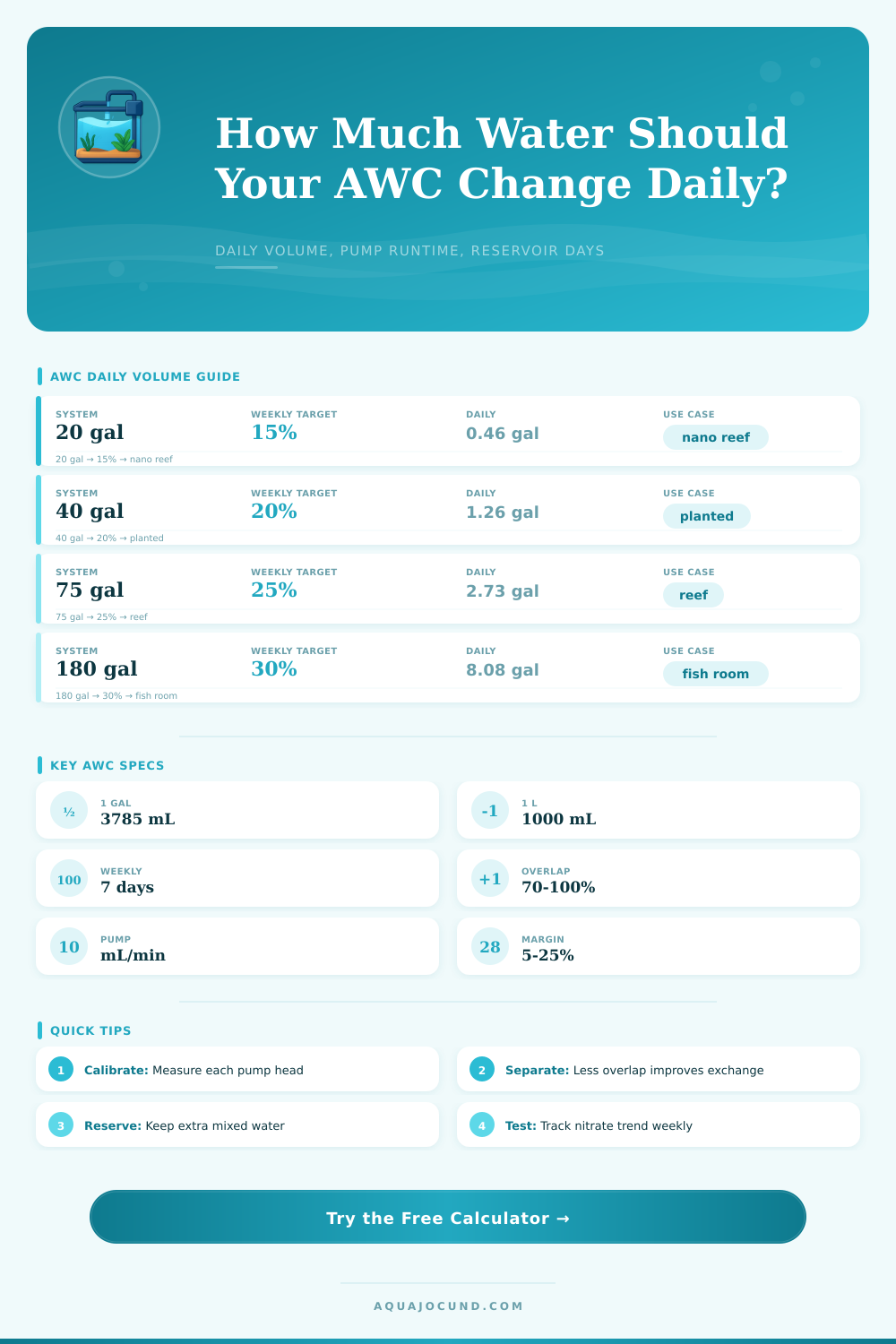
Auto Water Change Daily Volume Calculator
Plan daily AWC volume, pump runtime, effective weekly exchange, reservoir days, overlap loss, and nitrate trend from one calibrated setup.
Daily Auto Water Change Plan
| Weekly Target | Ideal Daily Exchange | Daily at 95% Efficiency | Planning Note |
|---|---|---|---|
| 10% | 1.49% per day | 1.57% moved | Light maintenance and stable low bioload tanks |
| 15% | 2.30% per day | 2.42% moved | Common nano reef or planted routine |
| 20% | 3.14% per day | 3.31% moved | Balanced weekly target for many displays |
| 25% | 4.04% per day | 4.25% moved | Higher feed, reef trace reset, or nitrate control |
| 30% | 5.00% per day | 5.26% moved | Heavy feeding or larger fish rooms |
| System Size | Metric Size | 20% Weekly Daily Volume | 30 Day Reservoir Need |
|---|---|---|---|
| 10 gal nano | 38 L | 0.31 gal / 1.2 L | 9.4 gal / 36 L before margin |
| 20 gal reef | 76 L | 0.63 gal / 2.4 L | 18.8 gal / 71 L before margin |
| 40 gal breeder | 151 L | 1.26 gal / 4.8 L | 37.7 gal / 143 L before margin |
| 75 gal reef | 284 L | 2.36 gal / 8.9 L | 70.7 gal / 268 L before margin |
| 120 gal display | 454 L | 3.77 gal / 14.3 L | 113 gal / 428 L before margin |
| 180 gal rack | 681 L | 5.65 gal / 21.4 L | 170 gal / 642 L before margin |
| Pump Rate | 1 L Runtime | 1 Gal Runtime | Good Fit |
|---|---|---|---|
| 20 mL/min | 50.0 min | 189.3 min | Very small continuous or nano systems |
| 50 mL/min | 20.0 min | 75.7 min | Most small dosing pump AWC heads |
| 100 mL/min | 10.0 min | 37.9 min | Medium displays with many daily events |
| 250 mL/min | 4.0 min | 15.1 min | Large tanks or short timed exchanges |
| 500 mL/min | 2.0 min | 7.6 min | Utility pump style batch AWC |
| Effective Daily Exchange | Effective Weekly Exchange | Approx Nitrate Control | When To Increase |
|---|---|---|---|
| 1.5% | 10.0% | Gentle dilution | Nitrate climbs faster than test noise |
| 2.3% | 15.0% | Moderate routine | High feeding or small skimmer reserve |
| 3.1% | 20.0% | Standard AWC target | Source nitrate is above zero |
| 4.0% | 25.0% | Stronger export | Coral or fish demand more stability |
| 5.0% | 30.0% | Heavy routine | Reservoir logistics become the limit |
When most of us started in this hobby we did a 10% weekly water change. It seems reasonable, after all, I can lift a bucket and swap out some water, right? Biology doesn’t follow your clock, though. Waste are produced each hour. It’s not waiting until Sunday morning. Parameters will change like crazy from one change to another when you leave it for a week. That stress shows itself as stressed livestock or algae blooms long before something kicks the bucket.
An auto water changer lessens this by converting one large occurrence into lots of small occurrences. How much is that supposed to be? Use the tool above to find out.
Why Auto Water Changers Are Better
First, because this calculator does the math for you, know how pump calibration works. Why do we ask? Because most DIY system fail here. The manufacturers post their maximum output in free air. In the real world, however, your pump has to fight tubing resistance and gravity. Running it at the rated number mean that you’re going to have a smaller volume exchange each day. This means you’re maintaining a tank containing less fresh water then desired. Get yourself a timer and graduated cylinder. Take actual measurements of what comes out off the line. That’s the only number that matters when you size your runtime.
Overlap efficiency means you want old water drained out before it has time to mix with fresh incoming water. This happen less as the intake and output points get further apart. Moving them a couple inches in high flow areas will impact the dynamic as well. So if you have both your drain and fill lines side-by-side in a sump, you’re going to suck that old water right back out without even mixing it into the tank. It’s moving water, not necessarily moving waste. That’s why separating these points can be so much more efficient.
The chart on the page show the different methods and how they compare. Drain First/Fill Later has almost perfect efficiency. Draining first and filling later is nearly perfect efficiency. A continuous system are very stable, though it is less efficient due to mixing issue mentioned above.
We overlook reservoir sizing until it’s too late. Maybe yours can handle five gallons/day from the pump. Sounds small, right? But times that by thirty days and you’re looking at a hundred fifty gallons of prepared water. Add a safety margin for priming loss or calibration drift, and that number grows quickly. Your reservoir goes dry at 2 AM on a Tuesday, so the system turns itself off. A whole week of changes lost. The nitrate trends right back to they’re starting point. Don’t let yourself get caught in that situation. Plan ahead and avoid those last minute dashes to the hardware store (or desperate top-offs with unconditioned water).
The final test is nitrate dilution. This assumes a value based off your source water and compares it to your existing levels. So if you have nitrates in your tap, then you’re not eliminating waste at the rate you believe. What you’re doing is replacing high-nitrate tank water with somewhat lower-nitrate tap water. Does the trend line indicate you’re winning (the nitrates are declining) or losing (you’ve plateaued)? A steady decline mean the system is working. A plateau means you need more biological activity than your exchange rate can manage for the bioload.
Auto water changes are life insurance for bad days. There will be days that you forget to change the water. With a small reserve of daily water changes, you don’t wreck the tank when you forget. The buffer is built into the routine and the parameters remains in a safe band. Maintenance becomes background support instead of a chore.
It takes some time to set it up correctly; you have to test and measure for a while, which might take an afternoon. However, after it’s going, there is no more work. No more “oh man, it’s Monday again” worries. Because the waste doesn’t get a chance to accumulate, your water remains clear. Every minute of calibration time would of been well worth that peace of mind.