Auto Feeder Portion Calculator
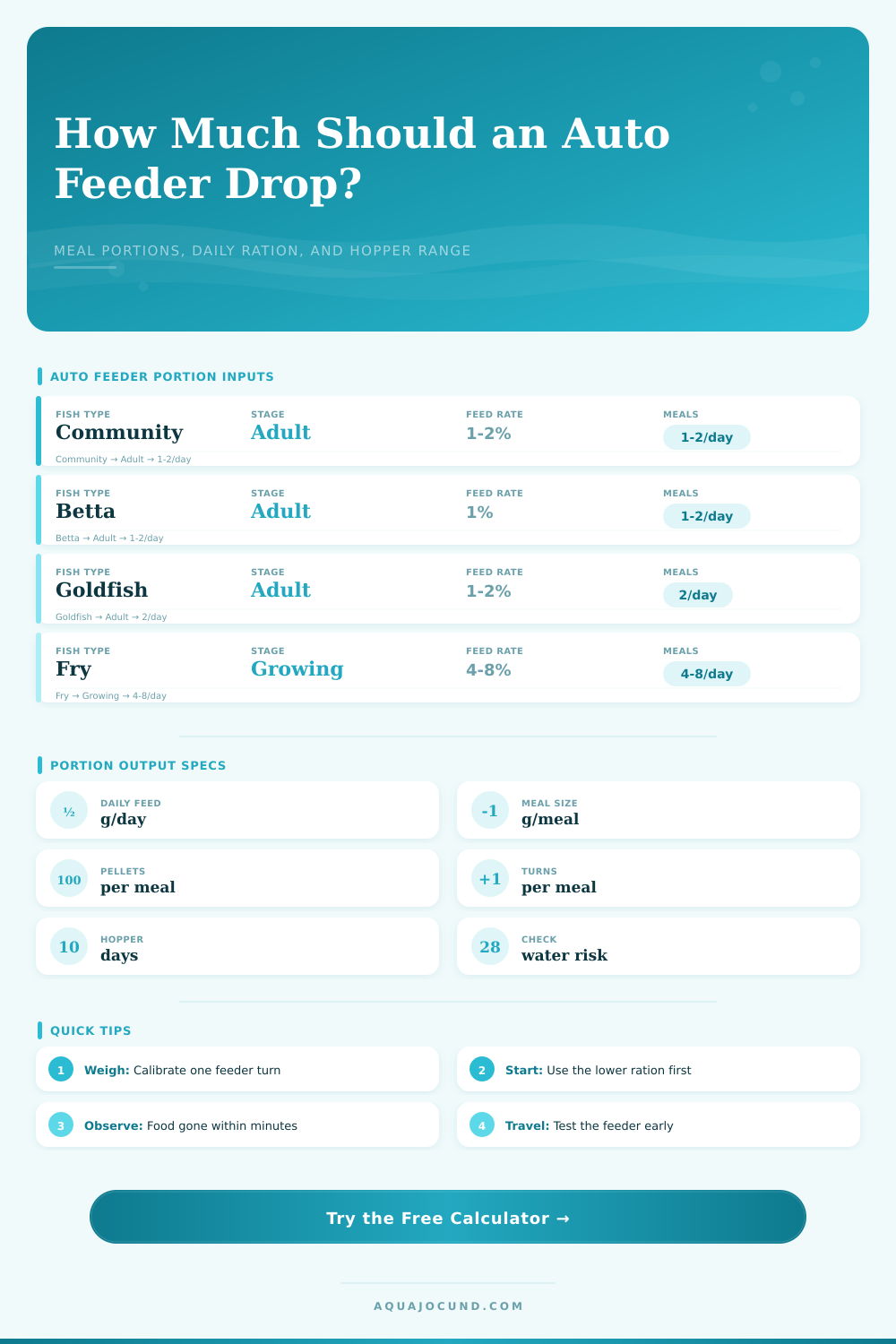
Set daily ration, grams per meal, feeder rotations, pellet count, and hopper range from livestock weight, feeding style, and calibration data.
Auto Feeder Portion Plan
| Food type | Typical turn weight | Count estimate | Best feeder use |
|---|---|---|---|
| Micro pellets, 0.5 to 1 mm | 0.04 to 0.08 g | 700 to 1200 per g | Rasboras, tetras, fry grow-out |
| Small floating pellets, 1 to 2 mm | 0.08 to 0.16 g | 300 to 700 per g | Community fish and bettas |
| Medium pellets, 2 to 3 mm | 0.16 to 0.30 g | 90 to 220 per g | Cichlids, goldfish, display fish |
| Crushed flake mix | 0.02 to 0.07 g | Loose flakes vary | Only if chute stays dry |
| Slow-sinking granules | 0.10 to 0.22 g | 180 to 450 per g | Midwater and bottom feeders |
| Broken algae wafer pieces | 0.25 to 0.60 g | 5 to 18 pieces per g | Large opening feeders only |
| Marine high-protein pellets | 0.08 to 0.18 g | 250 to 650 per g | Reef fish with low waste margin |
| Fish group | Adult maintenance | Growth ration | Auto feeder note |
|---|---|---|---|
| Betta, gourami, slow labyrinth fish | 0.8% to 1.2% | 1.5% to 2.5% | Small meals, avoid large dumps |
| Community tropical fish | 1.0% to 2.0% | 2.0% to 3.5% | Split into 2 meals when possible |
| Goldfish and coolwater omnivores | 1.0% to 2.0% | 2.0% to 4.0% | Lower feed in cool water |
| Cichlids and larger pellets | 1.0% to 2.2% | 2.0% to 4.0% | Use pellet size they swallow cleanly |
| Marine reef fish | 0.8% to 1.8% | 1.5% to 3.0% | Keep automatic dry feed conservative |
| Fry and tiny juveniles | 3.0% to 6.0% | 5.0% to 10.0% | Many tiny meals beat one large meal |
| Tank size | Typical dimensions | Water volume | Feeder planning use |
|---|---|---|---|
| 5 gallon betta | 16 x 8 x 10 in | 19 L | Very small portions, test first |
| 10 gallon nano | 20 x 10 x 12 in | 38 L | Good for 1 to 2 tiny meals |
| 20 gallon long | 30 x 12 x 12 in | 76 L | Schooling fish benefit from split drops |
| 29 gallon planted | 30 x 12 x 18 in | 110 L | Moderate bioload, stable ration |
| 40 breeder | 36 x 18 x 16 in | 151 L | Grow-out tanks need more meals |
| 55 gallon standard | 48 x 13 x 21 in | 208 L | Watch coolwater waste load |
| 75 gallon display | 48 x 18 x 21 in | 284 L | Large feeders should still split meals |
| 125 gallon display | 72 x 18 x 21 in | 473 L | Multiple feeding zones may be better |
| Condition | Adjustment | Reason | Calculator clue |
|---|---|---|---|
| Travel feeding | Reduce 15% to 30% | Less observation and fewer corrections | Choose conservative or travel ration |
| Cooler water | Reduce 10% to 35% | Metabolism and digestion slow down | Temperature factor lowers ration |
| Warm grow-out | Add 10% to 25% | Young fish convert small meals quickly | Growth push with more meals |
| New biofilter | Reduce about 10% | Ammonia handling margin is lower | Filtration maturity trims ration |
| Clumpy food | Reduce turn estimate | Moisture changes real portion size | Moisture risk adjusts usable drop |
With auto feeder portion calculator, you can see how many meal you’ll get per day and how much dry food you’ll use each day. You can also see how often feeders rotates and what your hopper range is. That makes measuring and verifying aquarium feeding easier.
Establishing an auto feeder seem like such a triumph. No more worrying about feeding your fish. Finally you can take a break from the tank for awhile. The problem however isn’t establishing the thing, it’s getting it calibrated. Most folks consider the feeder dial to be merely an on-off switch. That isn’t true. That dial is a precise piece of equipment. It needs to be calibrated propery to work properly. Knowing how the dial works can be the difference between a healthy tank and a cloudy mess.
How to Use the Auto Feeder Calculator
So, now you know how much food they need, let’s figure out the settings. Plug that info into the calculator and let it crunch the numbers for you. No more conversion math or coefficient guessing.
So what is the very first piece of information you must enter into the calculator? What’s the total live weight of your fish? It is not what size tank they live in. A 50 gallon tank full of tetras and corydoras are going to have vastly different feeding needs than one filled only with a lone betta. Guessing by eyeball is common. That’s where folks go wrong. It really does matter if you weigh out your food.
To make this work, you’ll need to calibrate the feeder. Count out number of times it rotates over a small container, then weigh out the contents. This yields your grams per turn value. You can’t do any of the other values without this value. Everything else would be pure guesswork.
So now you know how heavy your fish is. You also know what percent of that bodyweight you want them eating each day. This is usually 1, 2% of bodyweight per day for adult community fish, though bettas do better on lower percentages. Growing juvenile and fry can consumes much higher amounts, even as high as 10% of their bodyweight…but only when fed small, frequent meals.
This is where the tool come into play. It adjusts for these differences and it takes water temp into consideration. Fish are cold blooded. Their metabolic rates decreases in colder water. So if you’re feeding in a chilly room, the calculator will adjust its recommendation downward to prevent uneaten food from sinking and rotting on the substrate. Uneaten food causes most ammonia spikes in established tanks.
Then there’s practical stuff like hopper size. How long does it hold? When do I run out of feed and has to top off the feeder? Because you put in the daily amount, the calculator figures that into the output and tells you what it thinks the range is based off days. Great for vacation. If it says you’ve got three days worth of food, then you’ll know you should of set the dial or refill. Or plan accordingly.
It also helps with managing moisture. Moisture causes pellets to clump up in the hopper. Clumps obstructs the mechanism. Choosing a higher moisture risk setting adjust for that. This ensures the hopper life estimate accounts for that and isn’t too optimistic.
You are probably better off splitting your feeds instead of dumping one large amount on them. Most auto feeders offers more than one drop per day. With the calculator, you just divide the total daily ration into however many meals you want to do per day. It matches natural grazing behavior. The fish stay moving, which helps water quality too because it doesn’t shock them with a large single meal all at once. Notice the change in the portion size of each drop based on the meal count? This small adjustment improves water quality.
Don’t stop observing. While the calculator will give you a plan, your eyes will confirm it. Pay close attention to those first few drops. How does the food dissapears? Did it go fast… Then you’ve got a good portion. Does it linger as flakes… Turn down. Do the fish look hungry; turn up. Finding your sweet spot takes time. The tool will eliminate guessing at what your starting point should be. Then you can adjust for your own tank and livestock conditions.
Ultimately, however, automation is as much about consistency than it is about convenience. It prevents overfeeding when you are distracted and underfeeding when you are busy. You gain knowledge on how the feeder works and what it does… How it measures dry food per day, meal drops, feeder rotations, and hopper range. And this converts a dumb device to a key part of the husbandry regime that provides a clean tank with contented fish. It is a good drop by the ounce, rather than an uninformed guess.