Aquascape Wood Soak Time Calculator
Estimate how long aquarium wood should soak before it sinks reliably and reaches your tannin color target for the planned tank volume.
⚙Unit System And Presets
🪵Tank, Wood, And Soak Inputs
🪵Wood Type Comparison Grid
📊Wood Soak Reference Tables
| Wood Type | Typical Dry Density | Sink Behavior | Tannin Level |
|---|---|---|---|
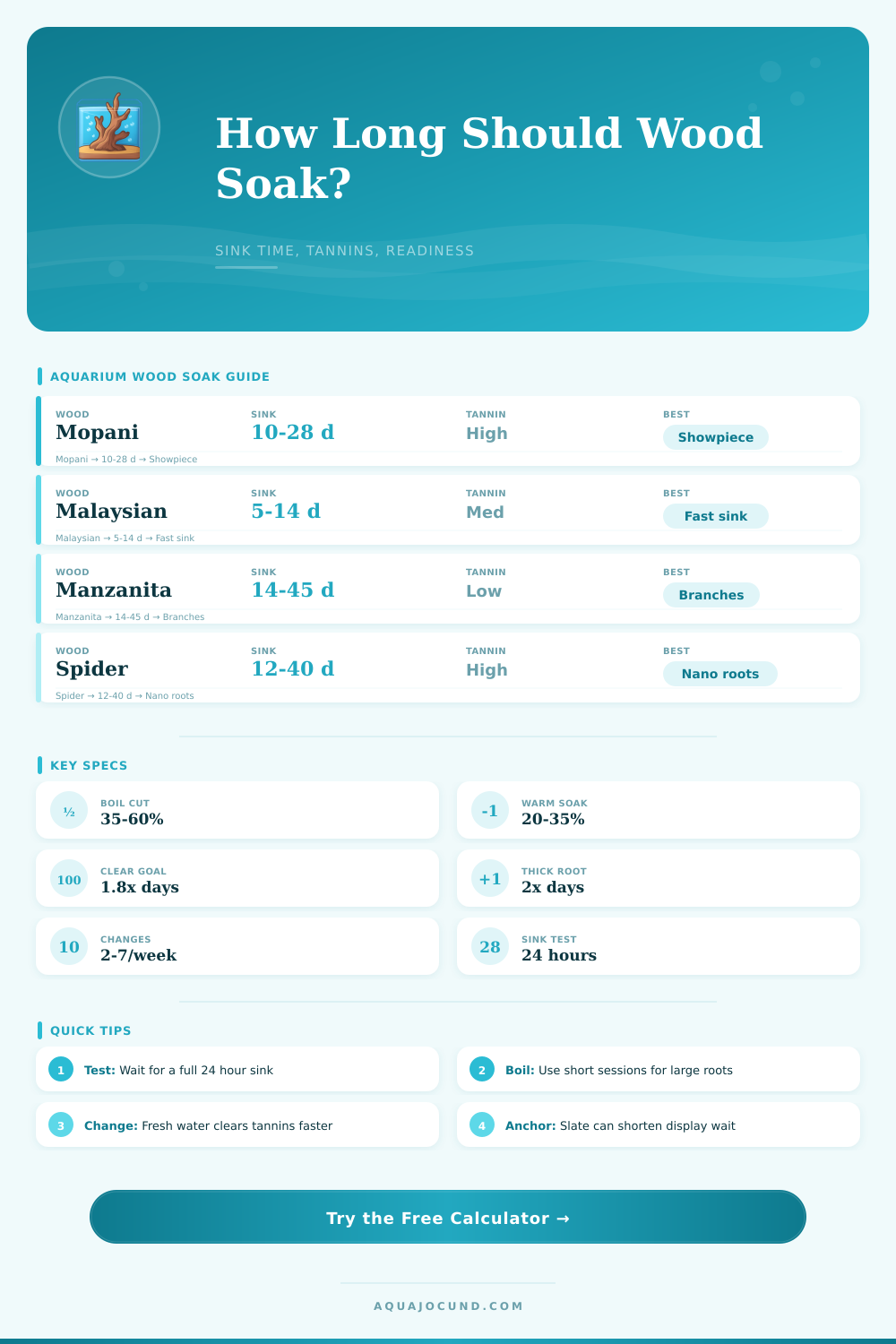
| Mopani root | 50-60 lb/ft³ | Dense pieces often sink after core saturation. | High, especially from cut surfaces. |
| Malaysian driftwood | 48-56 lb/ft³ | One of the faster natural sinkers. | Medium to high brown tint. |
| Manzanita branch | 40-50 lb/ft³ | Thin twigs sink early, thick bases lag. | Low to medium amber tint. |
| Spider wood | 28-38 lb/ft³ | Air pockets can keep branchy pieces buoyant. | Medium to high early tint. |
| Bogwood | 52-64 lb/ft³ | Often sinks quickly due to dense, aged fibers. | High but predictable. |
| Cholla wood | 16-24 lb/ft³ | Open structure wets rapidly. | Low to medium. |
| Red moor root | 30-40 lb/ft³ | Often needs a stone or slate anchor. | Medium to high. |
| Mangrove root | 44-56 lb/ft³ | Dense roots usually settle after soaking. | Medium to high. |
| Tank Size | Common Dimensions | Volume | Wood Soak Planning |
|---|---|---|---|
| 5 gallon nano | 16 x 8 x 10 in / 41 x 20 x 25 cm | 5 gal / 19 L | Small cholla or thin branch, tannins show quickly. |
| 10 gallon | 20 x 10 x 12 in / 51 x 25 x 30 cm | 10 gal / 38 L | One 0.5-1.5 lb piece can tint water strongly. |
| 20 long | 30 x 12 x 12 in / 76 x 30 x 30 cm | 20 gal / 76 L | Branchy roots need a full sink test before planting. |
| 40 breeder | 36 x 18 x 16 in / 91 x 46 x 41 cm | 40 gal / 151 L | Medium wood dilutes tannins better but thick bases lag. |
| 75 gallon | 48 x 18 x 21 in / 122 x 46 x 53 cm | 75 gal / 284 L | Large showpieces may need weeks for core saturation. |
| 125 gallon | 72 x 18 x 21 in / 183 x 46 x 53 cm | 125 gal / 473 L | Long roots can be anchored while tannins fade. |
| Soaking Method | Sink Effect | Tannin Effect | Best Use |
|---|---|---|---|
| Room temperature soak | Baseline waterlogging speed. | Slow, steady leaching with water changes. | Large pieces that cannot be heated. |
| Warm water bucket soak | Faster air release from pores. | Moderately faster tannin extraction. | Small to medium roots and branches. |
| Boil or simmer sessions | Strong short-term acceleration. | Heavy early tannin removal. | Pieces that fit safely in a pot. |
| Boil plus warm soak | Fastest practical method. | Best for light tint goals. | Dense roots, mopani, and bogwood. |
| Tannin Target | Water Look | Calculator Multiplier | Practical Meaning |
|---|---|---|---|
| Blackwater acceptable | Dark amber to tea brown | 0.65x | Safe for a blackwater look after sink test. |
| Tea colored tint | Noticeable amber | 1.00x | Balanced target for natural planted tanks. |
| Light amber tint | Pale yellow-brown | 1.45x | Needs repeated changes before display. |
| Nearly clear water | Minimal visible tint | 1.90x | Longest target, especially in small tanks. |
✅Calculation Tips
You bought some Mopani root online. You pictured this wood framing your foreground plants. So you dragged it home, dropped it in the tank, and now it’s floating there like a life raft for the past three weeks. The fish is confused. The plants are waiting. The water? Strong tea. Welcome to the classic aquascaping trap.
Wood doesnt just absorbs water; it fights back. Modeling sink time vs. The calculator above models tannin release rates. It lets you predict how long that fight will last so you can plan your hardscape on a schedule instead of holding your breath every day.
How to Prepare Aquarium Wood
How does it work? Simply put, trapped air is the enemy of all aquarium wood. Even a dense root has tiny air pockets inside that make it float until it become saturated enough to break surface tension. Each wood’s cellular makeup will affect how it behaves. Some sink quickly… Like mopani, though they can be very heavy and leach a ton of tannins. Others look fancy but contain trapped air (e.g., spider wood) so much so that it requires lots of time (i.e., several weeks) to settle out. Before submerging any wood, you must understand what enemy you’re up against.
Once you enter your tank volume and wood type, the tool figures out the rest. No need to remember density coefficient for each species out there.
A lot of folks don’t give much thought to how they soak their wood. While I know some people think boiling is the easy way out, it is if you’re careful about it. A brief simmer is quick tannin remover while still leaving the wood firm so that rot wont set in over time. Soaking cold will take longer but will be very gentle as nature does all the work on its own terms. For heavier stuff, a hybrid approach of boiling then warm soak seems to give best results if you need to hurry. The soaker looks at this combination. Just enter what you boiled it for and how often you changed water. It’ll calculate an estimated date when it should be ready.
If you change the water less often, the brown color will dilute more slowly. This means it will take longer for the wood to look natural in your tank. Surprisingly enough, tank size matter as well. With a single twig in a small nano tank, the water becomes dark, there’s just not much water to dilute those tannins. That same piece may appear invisible in a large breeder tank but it’s still leaking its color onto the gravel. Why do I ask for tank dimensions then? The tool calculates a dilution index which informs you if your wood is overpowering the water volume. In other words, if you’ve got a lot of wood (thick) and a small tank (little water), you’ll have to change more frequentley to get clear. Many people give up too soon or they end up over cleaning, ignoring this ratio.
That all depends on what kind of tannins you’re targeting. Do you want “blackwater” conditions, dark water meaning it’s healthy and safe (e.g., for shrimp or betta fish)? Or do you want crystal clear water… The kind of water found in competition style planted tanks? Those are two opposing objectives with two sets of approaches. You can specify how much tolerance you have to the “tea” color. Want to go with tea tint? Great! You just saved yourself weeks of effort. Need glass clear water? Okay, then you better change more frequentley, soak longer, etc. No wrong answer here… just whatever aligns with your idea of what looks best.
Most people start off by wanting clear water, since that way if the water gets discolored they worry about it. But that hesitation usually costs them months of wasted efforts. The quiet variable is thickness. Thin branches soak up from the outside in fast; thick roots take forever, because their cores are still bone-dry even after the bark has become damp. Don’t use an average width. The trick to figuring out how long it’ll be before that trapped air escapes is measuring the thickest section. Otherwise your estimate for soaking time will all go belly-up. When you can’t get exact and just want a ballpark figure, use the typical range on the reference table for your type of wood (on the page).
Should you use force or patience? Patience wins out in the end. A big chunk of dry wood wont boil away into nothing over night, even if you risk weakening its structure. You’re removing air from wood and replacing it with water, which has an established speed limit based off how heavy it is. Believe the estimations. Observe the sink test. Let the tannins settle naturaly… on their time schedule. Once that root sits quietly in the bottom of your tank, freed of all darkness, you’ll realize the wait was well worth it. You didn’t push nature… you respected it.