🌱 Aquascape Soil Quantity Calculator
Estimate active soil, cap layer, slope volume, settling allowance, and bag count for planted aquarium layouts.
✅ Soil Quantity Estimate
| Substrate type | Typical grain | Dry density | Best use |
|---|---|---|---|
| Standard aquasoil | 2 to 4 mm | 0.68 kg/L | General planted tanks, slopes, carpeting plants |
| Powder type soil | 1 to 2 mm | 0.78 kg/L | Foreground caps, small roots, fine detail work |
| Coarse planted substrate | 3 to 6 mm | 0.82 kg/L | Deep beds, larger stems, high flow layouts |
| Mineralized topsoil | Fine mix | 0.95 kg/L | Capped dirted tanks and low-tech plant beds |
| Lava soil blend | 4 to 8 mm | 0.55 kg/L | Bulk elevation under cosmetic top layers |
| Clay-based planted soil | 2 to 5 mm | 1.05 kg/L | Heavy root feeders and terraced backgrounds |
| Lightweight buffering soil | 2 to 4 mm | 0.58 kg/L | Shrimp tanks and soft-water aquascapes |
| Tank | Footprint | Suggested slope | Soil before settling |
|---|---|---|---|
| 5 gal cube | 16 × 8 in / 41 × 20 cm | 0.8 to 2 in | 2.9 L / 3.1 qt |
| 10 gallon | 20 × 10 in / 51 × 25 cm | 1 to 2.5 in | 5.7 L / 6.0 qt |
| 20 long | 30 × 12 in / 76 × 30 cm | 1 to 3 in | 11.8 L / 12.5 qt |
| 29 gallon | 30 × 12 in / 76 × 30 cm | 1.2 to 3.5 in | 13.9 L / 14.7 qt |
| 40 breeder | 36 × 18 in / 91 × 46 cm | 1.2 to 4 in | 27.6 L / 29.2 qt |
| 55 gallon | 48 × 13 in / 122 × 33 cm | 1.2 to 4 in | 26.6 L / 28.1 qt |
| 75 gallon | 48 × 18 in / 122 × 46 cm | 1.5 to 4.5 in | 42.5 L / 44.9 qt |
| 125 gallon | 72 × 18 in / 183 × 46 cm | 1.5 to 5 in | 74.5 L / 78.7 qt |
| Layout style | Volume factor | Why it changes | Planning note |
|---|---|---|---|
| Flat carpet bed | ×1.00 | Even substrate across the tank floor | Best for shallow, simple foreground layouts |
| Nature aquarium slope | ×1.18 | Extra depth is used to lock in rear elevation | Common for 1 to 4 inch front-back slopes |
| Iwagumi mound field | ×1.12 | Mounds around stones need extra contouring soil | Subtract hardscape footprint before calculating |
| Dutch terrace rows | ×1.08 | Terraces add raised planting lanes | Use separators when the back exceeds 4 inches |
| Island or river path | ×0.75 | Open sand paths reduce planted soil coverage | Pair this with open footprint percentage |
| High back berm | ×1.28 | Rear retaining banks need more material | Use supports for steep slopes over 4 inches |
To determine how much soils to order for your planted tank, you must consider two factors: how well the plant will root and how the planted tank is to look. Using too little soil will make it difficult for the plants to proper root into the substrate. Using too much soil will waste the soil you purchase.
The aquascape soil quantity calculator will help you to find the amount of soil that you need for your planted tank. Using the calculator will allow you to create your planted tank plans before you purchase the soil. The length and width fields will allow you to determine the area that your soil will cover.
How to Calculate Soil for Your Planted Tank
You will also need to consider the open footprint percentage of your planted tank. The open footprint percentage account for the amount of area that will be taken up by items such as sand, driftwood, and stones. If your planted tank contain sand paths, the open footprint percentage will be lower.
If your planted tank includes driftwood and stones, the open footprint percentage will be higher. Based off the open footprint percentage, the soil quantity calculator will adjust the amount of soil for your planted tank to ensure that you dont purchase more soil than you requires for your planted tank. The depth fields for the front and back of the planted tank will allow you to define the slope of the soil in your planted tank.
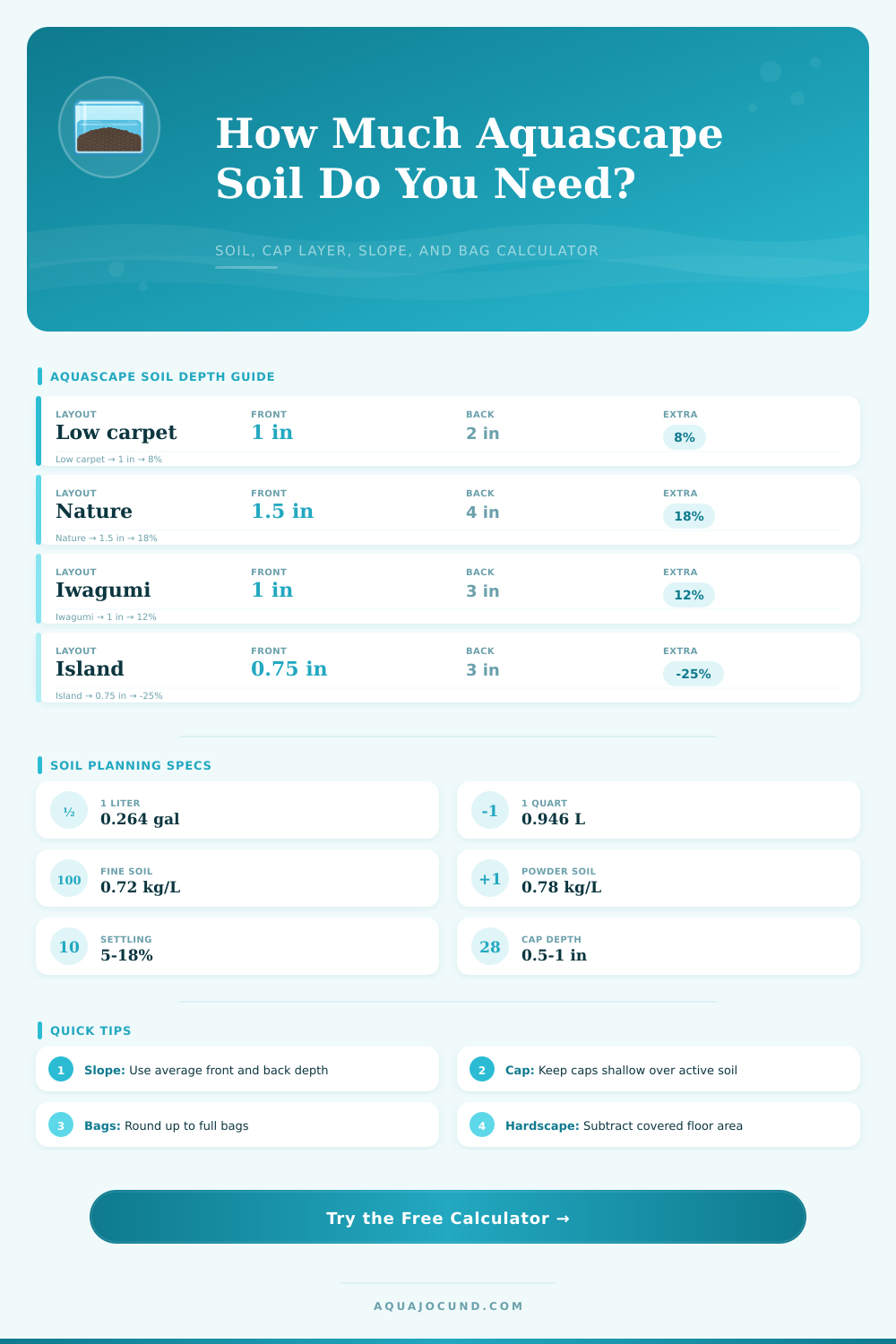
For instance, if you would like your planted tank to have a carpet effect with one inch of soil at the front of the tank and two inches of soil at the back of the planted tank, you can define those depths in the soil quantity calculator. More soil may be required for nature-style tanks. The soil quantity calculator treats the soil as a trapezoid since this shape allow for proper slopes in the planted tank.
The calculator will then multiply the volume of soil that is calculated by a layout factor. For instance, if your planted tank contains a high back berm, more soil will be required for this than for an island style planted tank. Island planted tanks have more open paths in the planted tank than do berms.
A cap layer of sand or gravel will sit on top of the active soil. Many aquascapers add a cap layer of sand or gravel to ensure that their planted tanks have a more pleasing cosmetic appearance. The calculator will calculate the volume of the cap layer separately from the active soil since the bag sizes for the cap layer may differ from the substrate.
The cap layer is usually between one-half inch and one inch deep since too deep of a cap layer will prevent the exchange of gas and light to the active soil. Since sand is heavier than aquasoil, the weight of the sand and aquasoil will be calculated to determine the total weight of soil that will be required for the planted tank. You must consider the settling allowance of the aquasoil for your planted tank.
Aquasoil will settle into the planted tank after the addition of water. Powder-type aquasoil will settle more than granule-type aquasoil. Deep slopes will settle more than flat aquascape beds.
Allowing for settling will ensure that your soil does not drop to a depth that you intend after the settling of the soil in the planted tank. Using the calculator, you can determine how many bag of soil you will need to purchase. The bag size and rounding fields will calculate the total liters of soil that you will need and provide options for how many bags of soil you will need to purchase.
It is better to round up on the bags of soil that you require since you can always remove excess soil from your planted tank. The type of soil that you choose to use will impact the total weight of the soil that you purchase. Standard aquasoil granules are used for most types of slopes.
Powder-type aquasoil will pack more tightly than granule-type soil and is used for areas that require fine detail. Each type of soil has a different weight, which will impact the total weight of your planted tank. Reference the type of soil tables to determine the weights of each type of soil.
The total weight of your planted tank is important to ensure that the stand that supports your planted tank can support that total weight. While the estimates for different sized planted tanks may help to provide an idea of the amount of soil for your planted tank, your specific hardscape and the type of plants that you would like to use may impact the amount of soil that you require. By using the soil quantity calculator before you go shopping for your planted tank soil, however, you can ensure that you have a good idea of the amount of soil that is required for your planted tank.
By using the soil quantity calculator before you shop for your planted tank soil, you can help to manage your budget. If you calculate the soil requirements incorrectly, you could end up purchasing extra bags of soil than you require. You may also end up under-ordering the soil for your planted tank.
The aquascape soil quantity calculator will remove the guesswork involved in determining how much soil you will need for your planted tank. With the information that the soil quantity calculator can provide, you can focus your efforts on planting your tanks and adding the hardscape features that you envision for your planted tank.