Aquascape Rock Displacement Calculator
Estimate rock mass, submerged displacement, usable water loss, layout footprint, buoyancy-adjusted load, and contact pressure before placing hardscape.
⚖Unit System
📐Tank And Rock Inputs
🪨Rock Type Comparison
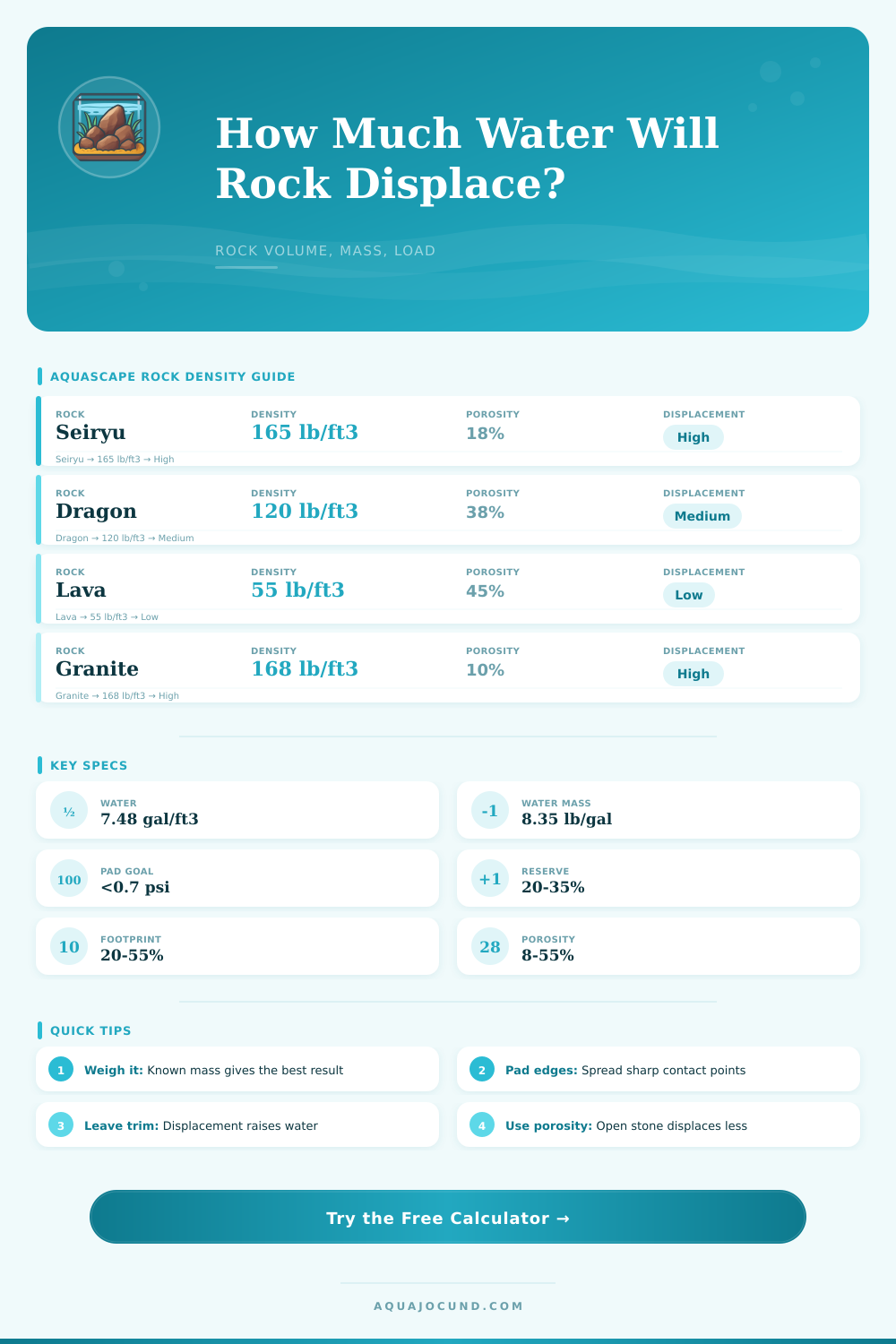
📊Density And Displacement Data
| Rock Type | Bulk Density | Solid Factor | Use In Calculator |
|---|---|---|---|
| Seiryu / limestone | 165 lb/ft³ / 2.64 g/cm³ | 0.82 | Dense iwagumi groups and ridges. |
| Dragon stone / ohko | 120 lb/ft³ / 1.92 g/cm³ | 0.62 | Pocketed layouts with many open voids. |
| Lava rock | 55 lb/ft³ / 0.88 g/cm³ | 0.55 | Light porous stone or biological media rock. |
| Slate ledge | 175 lb/ft³ / 2.80 g/cm³ | 0.88 | Flat shelves with narrow contact edges. |
| Granite river stone | 168 lb/ft³ / 2.69 g/cm³ | 0.90 | Dense rounded river or stream layouts. |
| Basalt / black mountain | 188 lb/ft³ / 3.01 g/cm³ | 0.84 | Heavy dark stone with high glass load. |
| Petrified wood stone | 150 lb/ft³ / 2.40 g/cm³ | 0.78 | Layered pieces with moderate pores. |
| Dry reef rock | 75 lb/ft³ / 1.20 g/cm³ | 0.48 | Open marine rock with large internal voids. |
📏Common Tank Reference
| Tank | Dimensions | Bottom Area | Typical Rock Displacement |
|---|---|---|---|
| 10 gallon | 20 x 10 x 12 in / 51 x 25 x 30 cm | 200 in² | 0.5-1.8 gal / 1.9-6.8 L |
| 20 long | 30 x 12 x 12 in / 76 x 30 x 30 cm | 360 in² | 1.2-3.8 gal / 4.5-14.4 L |
| 40 breeder | 36 x 18 x 16 in / 91 x 46 x 41 cm | 648 in² | 2.5-7.0 gal / 9.5-26.5 L |
| 75 gallon | 48 x 18 x 20 in / 122 x 46 x 51 cm | 864 in² | 4.0-11.0 gal / 15.1-41.6 L |
| 125 gallon | 72 x 18 x 21 in / 183 x 46 x 53 cm | 1296 in² | 6.0-17.0 gal / 22.7-64.4 L |
🛡Footprint And Load Guide
| Layout Footprint | Coverage | Displacement Behavior | Load Note |
|---|---|---|---|
| Narrow island | 15-25% | Small volume loss, taller average height | Watch point pressure under peaks. |
| Iwagumi group | 30-45% | Moderate displacement with dense stone | Use broad pads under main stones. |
| Ridge wall | 45-60% | High displacement and lower open swimming volume | Spread contact along the ridge base. |
| Cichlid stack | 50-70% | Very high water reduction in large tanks | Use grid or mat under stacked rock. |
| Bottom Panel | Conservative Pad Limit | Best Match | Calculator Meaning |
|---|---|---|---|
| 5 mm / 3/16 in glass | 0.45 psi | Nano tanks | Keep contacts wide and padded. |
| 6 mm / 1/4 in glass | 0.70 psi | Common small and mid tanks | Good baseline with flat pads. |
| 10 mm / 3/8 in glass | 1.10 psi | Large rimmed tanks | Moderate reserve for dense stone. |
| 12 mm / 1/2 in glass | 1.60 psi | Heavy displays | Still avoid direct sharp edges. |
| Acrylic bottom panel | 1.25 psi | Acrylic aquariums | Protect from dents and scratches. |
✅Calculation Tips
Filling your tank can be one of those times when the dreaded “oh shit” moment arrives. You realize you forgot about displaced water volume. After all those hours of rock arrangement and ridge construction… Slowly the water creeps up… Rocks don’t move…. And then the overflow overflows… onto your floor. A physics lesson learned too late from any tutorial. It’s a mathematically challenging intuitive problem.
To begin with, we visualize a three-dimensional object, like a rock, as if it were two-dimensional. That jagged lump of dragon stone appear huge but a lot of it is empty space. There are air pockets, holes, and other open structure. When placed in the aquarium it displaces far less water then it appears to. Conversely, seiryu limestone is solid. Seiryu limestone looks solid because it is. It pushes water out quite a bit farther than an equal amount of dragon stone for example.
How to Calculate Rock Displacement in Your Tank
As long as you know what each input represents in real world terms and have enough familiarity with the rock types available and their properties (as well as the size of your tank) then the math are done for you. The calculator does the rest. First is the footprint. It is not the footprint of the biggest rock. Total projected shadow of all rocks on bottom glass. Pile the rocks three deep? Same footprint as laying them flat. Why? Because it’s the underwater volume that matters, or rather the displaced volume (i.e., footprint x average height).
Most folks underestimate average height and overestimate footprint. They reason that if the stone isn’t big, there can’t be much displacement. Wrong. A tall ridge of tiny stones has the same displacement as a shallow layer of small stones spread across the same area. Your aesthetic intent doesn’t matter to geometry.
And then there’s the issue of porosity and density. Lava rock floats for one reason: it’s packed with gas bubbles that was trapped when it erupted from the volcano. Even though lava and granite may take up the same amount of space in your tank, a cubic foot of lava doesn’t weigh nearly as much as a cubic foot of granite. As you can see on the page, the reference table make that clear. Bulk density makes all the difference.
Solid factor accounts for the porosity of the stone. In other words, the calculator will adjust to estimate amount of real rock material (vs. The empty space contained within the stone. That’s important because water will eventually fill the voids if the stone is immersed, but right now we’re concerned about initial displacement, water being pushed out of the way by volume of the rock outside.
Another variable is the strength of glass. Thin glass will be cracked over time under pressure from heavy stones concentrated at small contact points. The tool calculates the pad pressure (which causes the cracking) in pounds per square inch. This is the total weight of all the rocks divided by surface area of your felt feet or leveling pads. When this figure reach too high a level, the structure is at risk for failure no matter how good it looks. Wider pads spread out the load and dramatically reduce pressure. It’s elementary engineering. Sharp edges dig in. Force is distributed across broad surfaces.
Don’t fill it up, plan ahead. Don’t fill your tank all the way to the top. Allow yourself some space (an inch or two) above where you want your water level to be. That space provides a cushion when you add substrate, rocks, etc. Otherwise, there’s nowhere else for that extra water to go except over the edge.
Also, using the calculator lets you know exactly how much usable swimming space you have left. The calculator displays your percentage volume loss, so you’ll know how many gallons less water you’re working with. Fewer gallons means quicker temperature changes and a quicker build-up of waste products. It’s more than “fitting in the rocks”. It’s about maintaining the ecosystem within the reduced volume.
When placing the first time, go slow. If possible, weigh your largest rocks. Because a rock’s shape can’t be predicted or figured out, known mass always wins over estimated volume. After getting it laid out, test its stability. Gently push on your major pieces. Adjust the pads until they holds still. The weight of the water will only amplify any instability.
In the end, an understanding of our physical limitations is just as important in aquascaping as our creativity. Whether we make the rocks appear like a Japanese mountain range doesn’t matter to the rocks. All they care about is being supported and having some place for the water to go. Measure twice, calculate once, and make allowances for the inevitable rise. That would of kept both your feet on the floor and your hobby fun.