Aquascape Hardscape Weight Calculator
Estimate stone and wood weight, water displacement, bottom glass contact pressure, pad loading, and safety margin before the layout goes in the tank.
⚖Unit System
📐Tank And Hardscape Inputs
🪨Hardscape Material Comparison
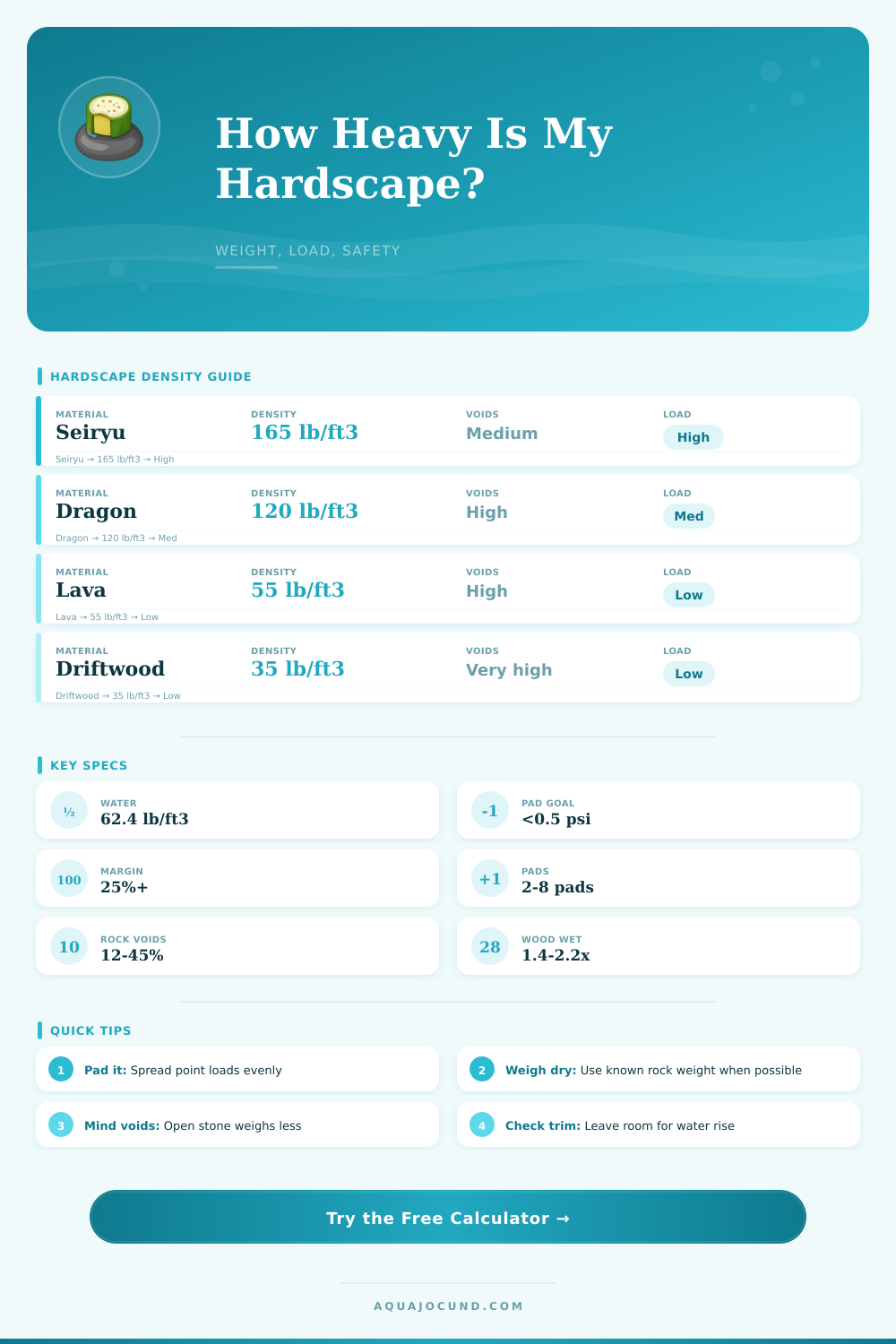
📊Density And Load Reference
| Material | Density | Solid Factor | Wet Factor | Best Calculation Use |
|---|---|---|---|---|
| Seiryu / limestone | 165 lb/ft³ / 2.64 g/cm³ | 0.82 | 1.00x | Dense iwagumi piles and ridge layouts. |
| Dragon stone / ohko | 120 lb/ft³ / 1.92 g/cm³ | 0.62 | 1.05x | Open stones with many pockets and edges. |
| Lava rock | 55 lb/ft³ / 0.88 g/cm³ | 0.55 | 1.15x | Porous biological rock stacks. |
| Slate ledges | 175 lb/ft³ / 2.80 g/cm³ | 0.88 | 1.00x | Flat shelves where edge padding matters. |
| Granite river stone | 165 lb/ft³ / 2.64 g/cm³ | 0.86 | 1.00x | Rounded boulders and stream-style bases. |
| Basalt / mountain stone | 188 lb/ft³ / 3.01 g/cm³ | 0.84 | 1.00x | Heavy dark stone with compact footprints. |
| Mixed driftwood | 35 lb/ft³ / 0.56 g/cm³ | 0.38 | 1.80x | Root tangles and broad wood structures. |
| Manzanita branches | 45 lb/ft³ / 0.72 g/cm³ | 0.32 | 1.45x | Branchy scapes with open water gaps. |
🧪Common Tank Load Bands
| Tank | Footprint | Bottom Area | Moderate Hardscape | Heavy Hardscape |
|---|---|---|---|---|
| 10 gallon | 20 x 10 in | 200 in² | 8-18 lb stone | 18-28 lb stone |
| 20 long | 30 x 12 in | 360 in² | 18-35 lb stone | 35-55 lb stone |
| 40 breeder | 36 x 18 in | 648 in² | 35-70 lb stone | 70-110 lb stone |
| 75 gallon | 48 x 18 in | 864 in² | 55-105 lb stone | 105-165 lb stone |
| 125 gallon | 72 x 18 in | 1296 in² | 85-165 lb stone | 165-260 lb stone |
🛡Contact Pad And Glass Guide
| Contact Setup | Total Pad Area | Best Use | Load Note |
|---|---|---|---|
| Two small feet | 4-8 in² | Small wood or light lava | Can create high point pressure. |
| Four foam pads | 16-32 in² | Most medium stone groups | Good baseline for glass tanks. |
| Egg crate base | 60-180 in² | Large cichlid or reef rock | Spreads load across a wide footprint. |
| Full mat under hardscape | 150+ in² | Heavy ridges and stacked rock | Best for reducing local pressure. |
| Bottom Panel | Conservative Pad Limit | Use With | Calculator Meaning |
|---|---|---|---|
| 5 mm / 3/16 in glass | 0.45 psi | Nano tanks | Keep point loads very broad. |
| 6 mm / 1/4 in glass | 0.70 psi | Common small to mid tanks | Use pads under sharp rock. |
| 10 mm / 3/8 in glass | 1.10 psi | Large rimmed tanks | Moderate hardscape margin. |
| 12 mm / 1/2 in glass | 1.60 psi | Heavy displays | Still avoid narrow stone edges. |
| Acrylic bottom | 1.25 psi | Acrylic aquariums | Protect against dents and scratches. |
✅Calculation Tips
In your mind’s eye, you imagine a perfectly composed aquascape. Then you pick up that first rock. Physics is the critic. Your art doesn’t matter to glass. Glass only cares that it cannot handle pressure.
Many aquarists know that tanks are not indestructible box. If you focus weight on sharp edge, glass fails. After entering your tank dimensions and rock type, the calculator do the math. It prevents guesswork… Will a jagged stone settle harmlessly in substrate or crack bottom panel? Weight isn’t just about the amount, but how it is spread across glass surface. Twenty pounds of slate sitting on two narrow corners may be more precarious then a hundred pounds of river stone dispersed over a larger base.
How to Keep Your Fish Tank Safe
Consider contact area. Enter average height and type of hardscape material. The tool then calculates water volume and factors in density. The densities is all over the place. Limestone is dense. Seiryu stone will weigh down your hand. But lava rock is lightweight as it has gas bubbles created during its volcanic eruption ages ago. This distinction make a difference if you’re loading a ten-gallon nano tank compared to a one-twenty-five gallon display.
Wood provides more variables regarding weight and mass. New driftwood, for example, will sink quickly but become heavier as it absorbs water over months. In fact, it get almost twice as dense in some instances. The calculator takes this into account with its wet factor, depending off what type of material you choose. That way, if your wood soaks for a few weeks, you won’t underestimate what it’s going to weigh when fully cured.
Remember, water has weight too. This also impact the amount of substrate you have once you start placing plants. It will change displacement, which affects your fill line. Longevity means safety margins. But it’s not paranoia; it’s safety margin. If a fish kicks the substrate and exposes a covered point load, or if you move rocks while cleaning, you would of a 25% safety margin that allows some wiggle room.
The page reference table clearly displays conservative maximums for various glass thicknesses. Quarter inch glass is standard, but that has a hard limit on point pressure. Calculate psi, get close to that limit? Add pads! Egg crate plastic, silicone pads, foam squares… they spreads out the load enough to maintain low stress.
Consider geometry of your tank. Rectangular boxes (like most fish tanks) have very different stress points than a bowfront, which has more curved glass. To give you a realistic estimate of how much water is in your tank, as opposed to a rough guess from labeled gallons, the tool will account for this difference and adjust to match. Nominal =/= real size. I know that a 29g breeder is a lot smaller than what it says, but it still has a big footprint that can accommodate heavy stone if done properly. Measure your internal dimensions every time; don’t trust the manufacturer’s label.
The most common errors involve vertical stacks of rock without sufficient base support. That’s why tall ridges are so impressive…until you upgrade a filter, do a water change, etc., and half the ridge collapse. Everything stays stable if you keep its center of gravity low and maintain wide contact points with the surface.
The calculator will confirm whether your design can be physically supported prior to spending money on fancy wood or stone. It translates intuition into data. Good taste is still required, but not blind guesses regarding structure.
In conclusion, aquascaping is a mix of engineering and art. When your hardscape holds up, your plants do too. When the pressure is distributed evenly across glass, it stays unbroken and clear. Spend a minute running some of these numbers. You might avoid having to start over completely. A good foundation lasts longer so the beauty can be enjoyed more longly.