Aquarium Winter Heating Load Calculator
Estimate winter heater load, installed-watt margin, thermostat runtime, and daily kWh from tank volume, temperature gap, cover style, insulation, and heater watts.
Your winter heating estimate
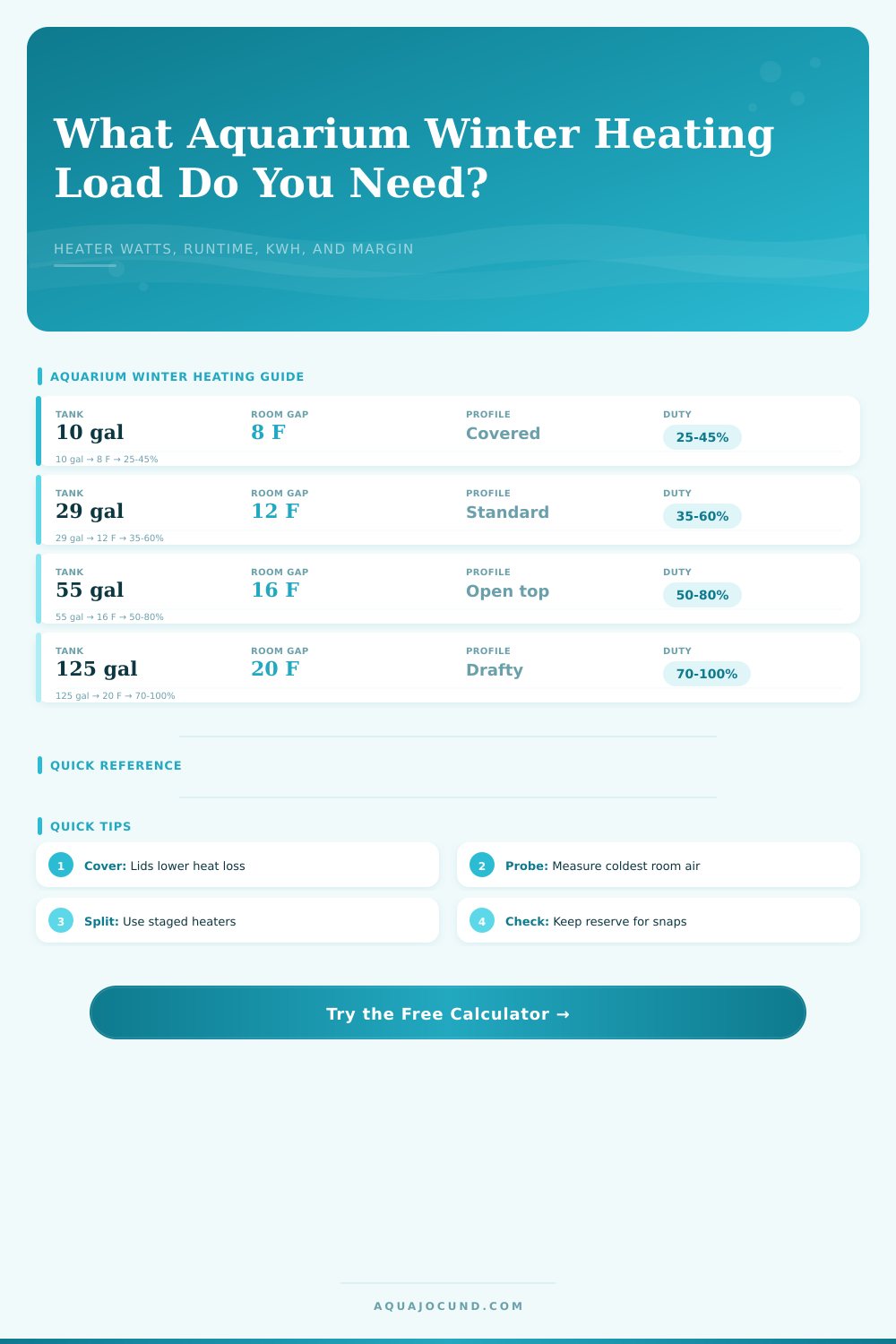
| Heat-loss profile | Model factor | Typical aquarium | Winter note |
|---|---|---|---|
| Tight lid or insulated hood | 0.24 W/gal/F | Covered freshwater tanks | Lowest evaporative loss, best for cold rooms |
| Glass lid with small gaps | 0.30 W/gal/F | Community tanks and breeders | Good baseline when only feeding gaps are open |
| Standard canopy or partial lid | 0.38 W/gal/F | Most indoor displays | Balanced default for mixed room conditions |
| Open top, calm surface | 0.58 W/gal/F | Planted and rimless tanks | Evaporation becomes a major heat path |
| Rimless or reef surface flow | 0.72 W/gal/F | Reef cubes and frag tanks | Surface agitation raises winter heat demand |
| Drafty room or fan-cooled surface | 0.86 W/gal/F | Utility rooms, garages, cooling fans | Use a strong reserve and verify with a thermometer |
| Common tank | Dimensions | Metric size | Volume | Typical winter load |
|---|---|---|---|---|
| 10 gallon | 20 x 10 x 12 in | 51 x 25 x 30 cm | 10 gal / 38 L | 30 to 75 W |
| 20 long | 30 x 12 x 12 in | 76 x 30 x 30 cm | 20 gal / 76 L | 75 to 150 W |
| 29 gallon | 30 x 12 x 18 in | 76 x 30 x 46 cm | 29 gal / 110 L | 100 to 200 W |
| 40 breeder | 36 x 18 x 16 in | 91 x 46 x 41 cm | 40 gal / 151 L | 150 to 250 W |
| 55 gallon | 48 x 13 x 21 in | 122 x 33 x 53 cm | 55 gal / 208 L | 200 to 350 W |
| 75 gallon | 48 x 18 x 21 in | 122 x 46 x 53 cm | 75 gal / 284 L | 250 to 500 W |
| 125 gallon | 72 x 18 x 21 in | 183 x 46 x 53 cm | 125 gal / 473 L | 400 to 800 W |
| Insulation factor | Multiplier | Best match | Calculation effect |
|---|---|---|---|
| Foam back and sides, covered top | 0.72x | Winter-prepped tanks on exterior walls | Reduces steady heat load in the model |
| Back panel insulated | 0.85x | Standard tanks with rear foam board | Useful when only one side faces cold air |
| No added insulation | 1.00x | Most living-room aquariums | Neutral baseline for winter planning |
| Thin glass, exposed sides | 1.12x | Nano tanks, stands with open backs | Raises load for more exposed glass |
| Open stand or cold wall nearby | 1.25x | Basement and utility-room tanks | Accounts for cool air around the tank |
| Unheated utility space exposure | 1.40x | Garage-like winter locations | Use with conservative reserve settings |
| Output | Formula basis | Unit | How to use it |
|---|---|---|---|
| Required heat load | Volume x temperature gap x profile x insulation x reserve | W | Minimum steady heater output for winter conditions |
| Calculated duty | Required watts divided by installed watts | % | Shows how hard the heater group must cycle |
| Runtime | Duty percentage x 24 hours | hours/day | Approximate on-time during similar winter air |
| Daily kWh | Installed watts x selected duty x 24 / 1000 | kWh/day | Electrical energy used by the heater group |
| Heater margin | Installed watts minus required heat load | W | Reserve available for colder nights or recovery |
When it gets cold outside, there’s a good chance your room will cool down too. Suddenly, you’ll see less activity from your fish. That scares people. What happened? They fear their heater isn’t working propery. So they purchase a second heater.
It is a good way to fix nothing or make things worse. Most of the time, it’s not an issue of total wattage; rather it’s one of how efficientlly the tank holds heat. If you understand this dynamic, the eco-system remain stable. If you can forget what anyone says, then understanding how to keep water warm is easy.
Why Your Fish Tank Loses Heat
There are 3 variable that affect the heat lost from the tank. The first variable is water volume. The second variable is temperature difference between the room and the tank. The third variable is how much surface area are exposed.
The faster a tank loses heat, the quicker it go down. So an open top tank will lose heat faster due to evaporation. A covered tank will not lose as much heat because it’s slower to conduct heat away. This also cools the tank down faster. The calculator does this for you and you will no longer have to guess at set-up time.
First, people look at the maximum capacity listed on heater box. What you see is that number. What you do not see is what is needed. That number is what is safe for the biggest tank, not the smallest load the heater can handle efficientally.
Sizing heaters strictly by volume results in oversized equipment. This equipment short-cycles. Short cycling beats up the thermostat and causes temperature spikes which stress fish far worse than gentle warmth. You want a heater that have a moderate duty cycle where it’s on just long enough to heat up the water but not fighting a losing battle with the room air.
Insulation plays a big role here. For example, a tank on an exterior wall loses more heat than a tank in an interior corner. Insulating the stand lowers that heat loss load. This is a cheap solution, it saves you money on electricity. It prolongs life of your heater.
How do covers affect energy consumption? As seen in the reference tables, a snug-fitting cover can reduces heat loss by almost half. Little change… But it cuts down on expenses each day.
Secondly, consider duty cycle. Running the heater hard for several week puts the heater under stress. Why? Because the heater require a buffer. That’s why there’s an input on the calculator called reserve margin.
By adding some additional capacity to your heat load, you’re guaranteeing the heater can handle another temperature drop. This avoids the heater hitting its max in the middle of a storm. Reserve margin is your bad-weather safety net.
The hallway thermostat does not accurately reflect your room temperature. Cold spots occur at windows, and air moves. Measure the air immediately beside the tank glass. This is the temperature that matters for the calculation. When the surrounding air is cooler, it means your heater must work harder.
The variance is accounted for in the tool. You can input the lowest temperature you expect and be prepared for the worst case. Worst-case scenarios test the system.
Winter heating of an aquarium is all about keeping the heat. Retaining the existing heat is less expensive then making more heat. Insulate the tank’s sides and cover the top. Check your margins ahead of time before it gets cold. These measures provides enough reserve to keep the system stable.
How do you know? If they’re healthy they swim around without much effort. That means environment is fine.