⚡ Aquarium Watts Per Gallon Calculator
Compare rated device watts, real duty cycle, heat contribution, and daily energy density.
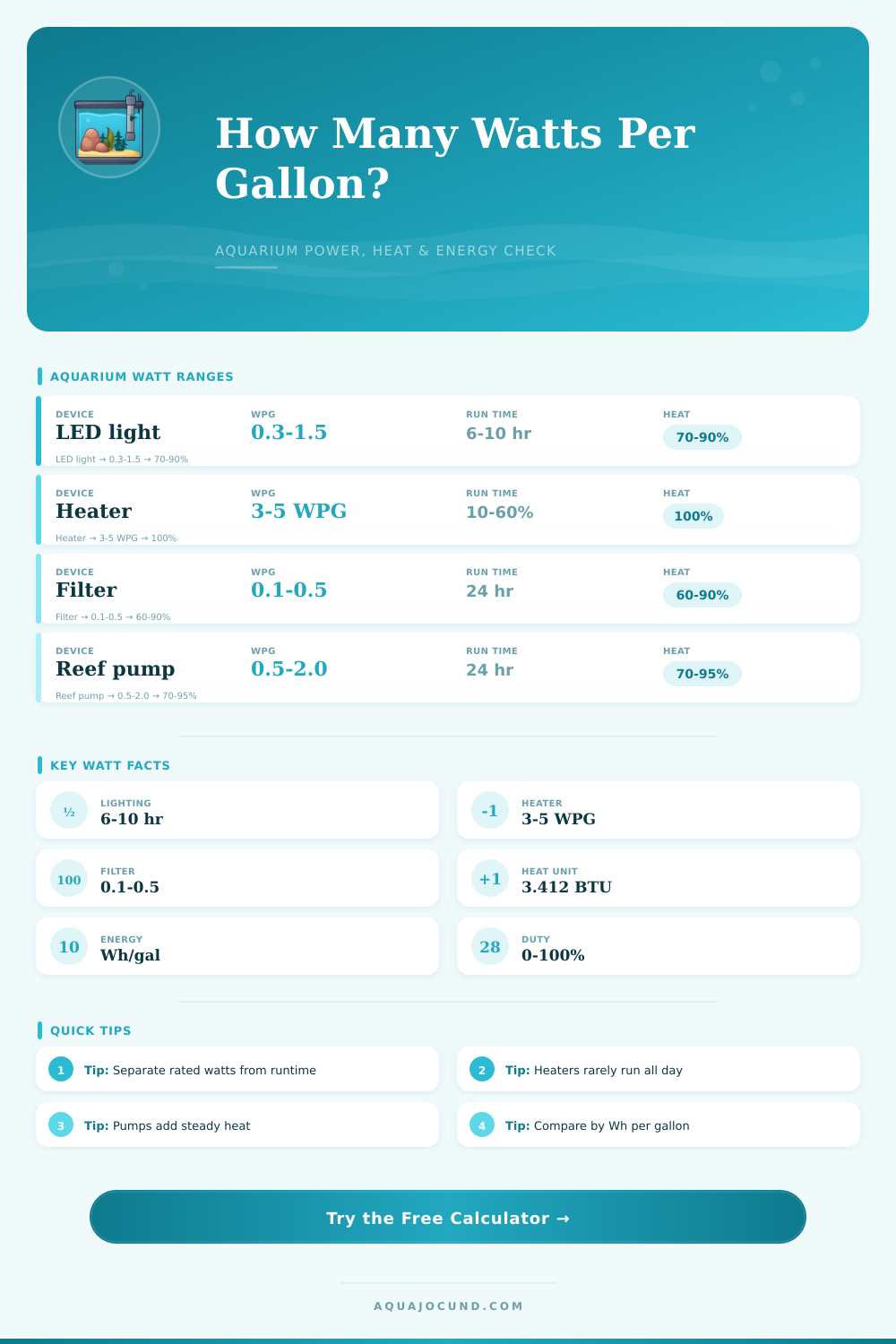
| Category | Typical Rated W/gal | Runtime or Duty | Heat Contribution | Best Use in Calculator |
|---|---|---|---|---|
| Freshwater LED lighting | 0.3-1.0 W/gal | 6-9 hr/day | 60-85% to water | Compare light-only intensity separately from heater rating. |
| High-light planted LED | 0.8-1.8 W/gal | 6-8 hr/day | 65-90% to water | Use photoperiod to avoid overstating the daily energy load. |
| Aquarium heater | 3-5 W/gal rated | 10-60% duty | Nearly 100% | Rated W/gal sizes the heater; duty cycle estimates real load. |
| Filter or return pump | 0.1-0.5 W/gal | 24 hr/day | 60-95% to water | Small watts matter because pumps run continuously. |
| Reef flow and skimmer | 0.5-2.5 W/gal | 24 hr/day | 50-95% to water | Add wavemakers, return pump, skimmer, and refugium light as extra load. |
| Tank Size | Common Dimensions | Heater Range | Light Range | Filter/Pump Range |
|---|---|---|---|---|
| 5 gal nano | 16 x 8 x 10 in / 41 x 20 x 25 cm | 15-25 W | 3-8 W | 2-5 W |
| 10 gal | 20 x 10 x 12 in / 51 x 25 x 30 cm | 25-50 W | 6-15 W | 4-8 W |
| 20 gal long | 30 x 12 x 12 in / 76 x 30 x 30 cm | 75-100 W | 12-30 W | 6-15 W |
| 29 gal | 30 x 12 x 18 in / 76 x 30 x 46 cm | 100-150 W | 18-45 W | 8-20 W |
| 40 breeder | 36 x 18 x 16 in / 91 x 46 x 41 cm | 150-200 W | 24-70 W | 12-30 W |
| 55 gal | 48 x 13 x 21 in / 122 x 33 x 53 cm | 200-300 W | 30-90 W | 15-35 W |
| 75 gal | 48 x 18 x 21 in / 122 x 46 x 53 cm | 250-400 W | 45-130 W | 20-50 W |
| 125 gal | 72 x 18 x 21 in / 183 x 46 x 53 cm | 400-600 W | 75-250 W | 35-120 W |
| Tank Profile | Average W/gal | Daily Wh/gal | Lighting W/gal | Interpretation |
|---|---|---|---|---|
| Quarantine / hospital | 0.20-0.80 | 5-19 | 0.10-0.50 | Simple equipment, heater duty drives most energy. |
| Fish-only freshwater | 0.25-1.00 | 6-24 | 0.30-0.80 | Moderate light and continuous filtration. |
| Low-tech planted | 0.35-1.20 | 8-29 | 0.50-1.10 | Light is important but photoperiod limits daily energy. |
| High-light planted | 0.60-1.80 | 14-43 | 1.00-2.20 | Lighting and circulation both shape the load. |
| Cool-water goldfish | 0.10-0.70 | 2-17 | 0.20-0.70 | Often no heater, but strong filtration may run all day. |
| Soft coral reef | 0.80-2.40 | 19-58 | 1.00-3.00 | Lighting, return pump, and skimmer add continuous load. |
| High-flow SPS reef | 1.20-3.50 | 29-84 | 1.50-4.00 | Higher light and flow make heat management important. |
In order to calculate the energy consumption of an aquarium, it is first necessary to understand the difference between the rated power of a device and the actual power that it use during a given time period. Many use the concept of watts per gallon to compare the energy efficiencies of different aquarium. However, the watts per gallon figure is only accurate if the number of hours that the equipment within the aquarium run is also accounted for in that calculation.
The equipment in the aquarium, such as the heater, lights, and filtration systems will all contribute to the energy use of the aquarium. The heater has a rated wattage value that indicate how much power the device is designed to use. However, the heater may not reach its rated wattage due to the fact that the heater will turn off when the aquarium reach its target water temperature.
How to Calculate Aquarium Energy Use
The period during which the heater is running is referred to as its duty cycle. The same is true of the filtration system; it is constantly running, so its duty cycle last for many hour. Additionally, the lighting within the aquarium also has a duty cycle; the lights will only be on for a certain number of hour per day.
It is necessary to calculate the duty cycle of each piece of equipment; the duty cycle will indicate the actual power that each piece of equipment will use. In addition to the energy that the aquarium’s equipment uses, another of the main results of the consumption of energy is the production of heat. All of the energy that the heater uses will be converted to heat in the water.
Additionally, some of the energy from both the lights and filtration system will also become heat in the water. However, the amount of heat that the lights and filtration system release will depend upon whether the lights and filtration system are place into the aquarium or place above the water. Additionally, the temperature of the room in which the aquarium is located and the rate at which the water in the aquarium evaporates will affect how much heat the aquarium retain.
An aquarium that retains more heat will require less running time from the heater. Another factor that will impact the energy consumption of the aquarium is the type of aquarium that is to be established. For example, a freshwater aquarium that contains only freshwater fish will require less energy than a reef aquarium.
Reef aquariums require more light to provide to the 珊瑚 and the fish that reside within the reef aquarium. Additionally, reef aquariums require more water circulation than freshwater aquariums. Similarly, planted aquariums also require more energy than freshwater aquariums; in this case, the lights must provide the appropriate amount of light to the plants.
Thus, the photoperiod of the lights is one of the most important variables for these aquariums. Each of the different types of aquariums will have different energy requirement. Therefore, it is possible to calculate the energy requirements of the aquarium in comparison to these different aquarium types.
Another factor to consider is the actual volume of water that exists in the aquarium. The aquarium may have a nominal rating for the amount of water that the aquarium can hold; however, the actual amount of water is less than the nominal value due to the amount of space that the substrate and rocks take up within the aquarium. If you calculate the volume of the aquarium using the nominal value rather than the actual water volume, the watts per gallon rating will be underestimate.
Therefore, it is important to calculate the actual water volume in the aquarium; the actual water volume will determine how much heat and light is require to provide proper care for the inhabitants of the aquarium. Finally, it is also important to ensure that the calculated power and heat output of the aquarium is appropriate for the life within it. For instance, some types of fish can tolerate changes in water temperature while other types of corals requires the water to have a steady temperature and water flow.
Thus, while the watt per gallon calculator can determine the average power usage of the aquarium, it is also essential to observe the aquarium to ensure that the water is staying within a stable temperature. Overall, then, the watts per gallon calculation is a helpful measure of the power usage of an aquarium; however, in order to make certain calculations regarding the energy use of the aquarium (and its resulting cost and heat output), it is essential to use the duty cycle calculation as well as the actual water volume of the tank.