💧 Aquarium Water Hardness Converter
Convert GH and KH between ppm CaCO3, dGH, and meq/L, then compare your water to species target bands.
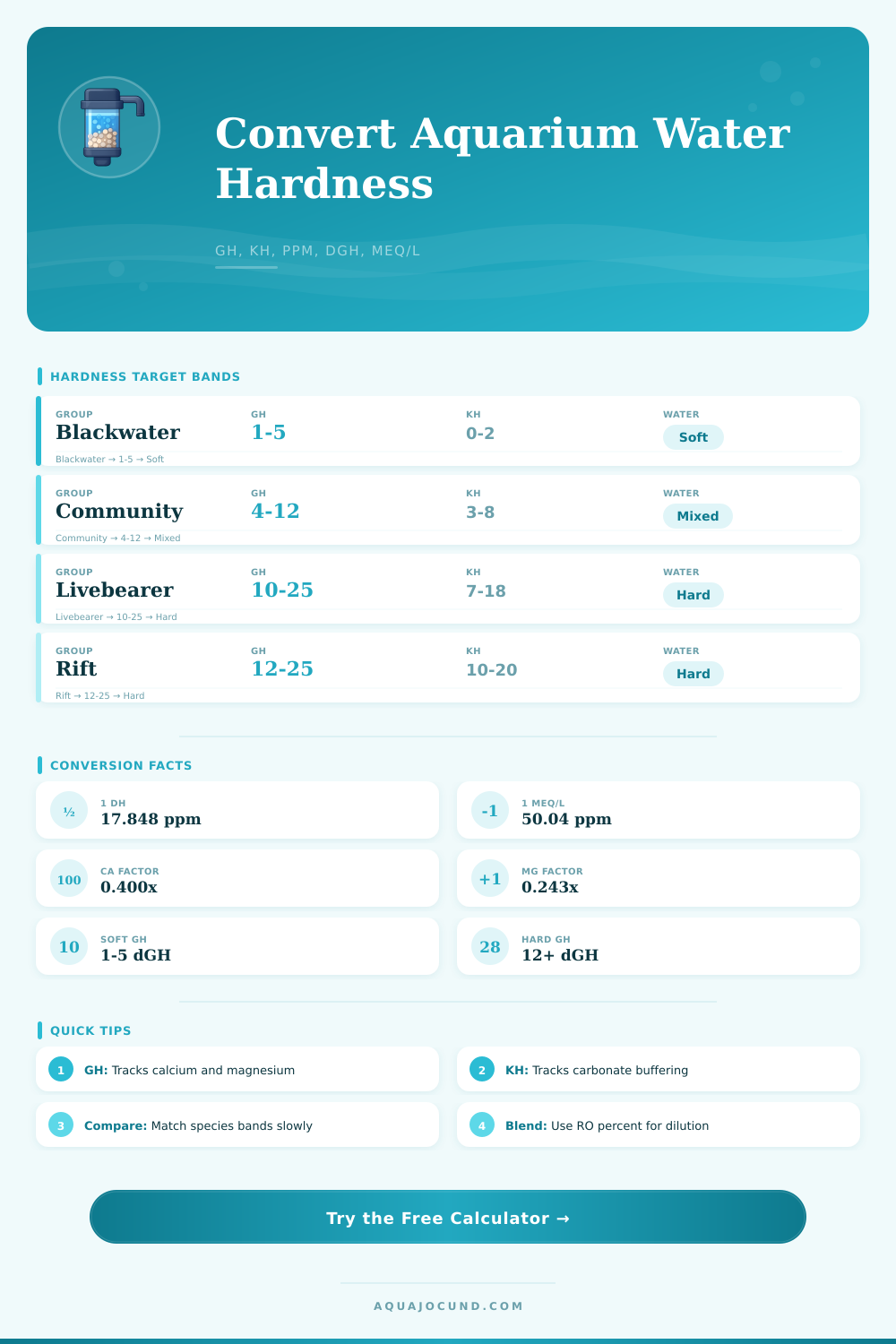
| Species Group | GH Target | KH Target | ppm CaCO3 Range | Typical Use |
|---|---|---|---|---|
| Soft Blackwater Fish | 1-5 dGH | 0-2 dKH | 18-89 ppm GH | Discus, wild tetras, rasboras |
| Betta and Gourami | 3-10 dGH | 2-6 dKH | 54-178 ppm GH | Labyrinth fish and soft community tanks |
| General Community | 4-12 dGH | 3-8 dKH | 71-214 ppm GH | Tetras, danios, corydoras, barbs |
| Planted CO2 Tank | 3-8 dGH | 2-6 dKH | 54-143 ppm GH | Plant growth with stable carbonate buffer |
| Caridina Shrimp | 4-6 dGH | 0-2 dKH | 71-107 ppm GH | Crystal and bee shrimp remineralized RO |
| Neocaridina Shrimp | 6-12 dGH | 2-8 dKH | 107-214 ppm GH | Cherry shrimp and hardy dwarf shrimp |
| Goldfish | 5-19 dGH | 4-12 dKH | 89-339 ppm GH | Moderate to hard buffered water |
| Livebearers | 10-25 dGH | 7-18 dKH | 178-446 ppm GH | Guppies, mollies, platies, swordtails |
| Malawi Cichlids | 12-25 dGH | 10-20 dKH | 214-446 ppm GH | African rift lake aquariums |
| Tanganyika Cichlids | 14-30 dGH | 12-22 dKH | 250-535 ppm GH | High mineral rift lake aquariums |
| Reading | ppm as CaCO3 | dGH or dKH | meq/L | Hardness Class |
|---|---|---|---|---|
| Very Soft | 0-53 ppm | 0-3 dH | 0-1.06 | RO blend or blackwater range |
| Soft | 54-107 ppm | 3-6 dH | 1.08-2.14 | Soft community and planted tanks |
| Moderate | 108-214 ppm | 6-12 dH | 2.16-4.28 | Most community aquariums |
| Hard | 215-321 ppm | 12-18 dH | 4.30-6.42 | Livebearers and hard-water fish |
| Very Hard | 322+ ppm | 18+ dH | 6.44+ | Rift lake cichlid style water |
| Basis | Best For | Approx Factor | Applies To | Calculator Note |
|---|---|---|---|---|
| CaCO3 equivalent | Lab style comparison | 1.00x | GH or KH | Shows pure CaCO3-equivalent grams |
| Calcium chloride dihydrate | Raising calcium GH | 1.47x | GH | Adds calcium without KH |
| Magnesium sulfate heptahydrate | Raising magnesium GH | 2.46x | GH | Adds magnesium without KH |
| Potassium bicarbonate | Raising KH with potassium | 2.00x | KH | Common planted-tank buffer |
| Sodium bicarbonate | Raising KH only | 1.68x | KH | Useful for carbonate buffering |
| Commercial GH remineralizer | RO water GH rebuild | 1.20x | GH | Approximate; verify the label |
| Commercial KH buffer | RO water KH rebuild | 1.30x | KH | Approximate; verify the label |
| Tank | Dimensions | Volume | 10 ppm Change | 20 ppm Change |
|---|---|---|---|---|
| 5 Gallon | 16 x 8 x 10 in | 19 L | 0.19 g CaCO3 eq | 0.38 g CaCO3 eq |
| 10 Gallon | 20 x 10 x 12 in | 38 L | 0.38 g CaCO3 eq | 0.76 g CaCO3 eq |
| 20 Long | 30 x 12 x 12 in | 76 L | 0.76 g CaCO3 eq | 1.51 g CaCO3 eq |
| 29 Gallon | 30 x 12 x 18 in | 110 L | 1.10 g CaCO3 eq | 2.20 g CaCO3 eq |
| 40 Breeder | 36 x 18 x 17 in | 151 L | 1.51 g CaCO3 eq | 3.03 g CaCO3 eq |
| 55 Gallon | 48 x 13 x 21 in | 208 L | 2.08 g CaCO3 eq | 4.16 g CaCO3 eq |
| 75 Gallon | 48 x 18 x 21 in | 284 L | 2.84 g CaCO3 eq | 5.68 g CaCO3 eq |
| 125 Gallon | 72 x 18 x 22 in | 473 L | 4.73 g CaCO3 eq | 9.46 g CaCO3 eq |
General hardness in an aquarium consist of two different measurements: General Hardness (GH) and Carbonate Hardness (KH). GH measures the amount of calcium and magnesium in the aquarium water, both of which is necessary for fish and invertebrates to develop healthy shell and bones. KH measures the amount of carbonates in the aquarium water, which are necessary to prevent the pH of the water from change if acids or bases enter the aquarium water.
Because each of these measurements indicate different components of the water, the two measurements may change in different way. Therefore, you must track each of these measurements separate for maintaining the aquarium water. Each aquarium water measurement have specific levels for different types of fish and invertebrates.
How to Test and Adjust GH and KH in Your Aquarium
For instance, fish that originate from soft water blackwater stream require low levels of both GH and KH in their water. In contrast, Rift lake cichlid fish requires high levels of both GH and KH in their water. Even shrimp require specific levels of GH and KH in their water, with different group of shrimp requiring different levels.
To ensure that the water in the aquarium maintains the proper GH and KH levels for the inhabitants of that aquarium, test kit can be used to measure the current levels of each of the two components of the aquarium water. The test kits will provide measurements of both GH and KH in either degrees or parts per million. Degrees are used as an estimate of the amount of GH and KH in the water for quick measurements.
Parts per million provide a more detailed reading of the amount of GH in the water, which can be used to more precise calculate the amount of product to add to the water to desired levels of GH and KH. A converter can help determine the amount of GH and KH in parts per million from the degree readings from the test kit, and it can also estimate the amount of calcium and magnesium in the water (even though the calculation is not as accurate than a laboratory analysis of the water). This estimation is helpful in making small adjustments to the GH and KH levels in the water.
The amount of water in the aquarium must also be considered when changing the GH and KH levels of the water in the aquarium. For instance, a GH level of ten degrees will require a different amount of product to be added to a five-gallon aquarium than it will require for a seventy-five gallon aquarium. In addition to the volume of the aquarium, a calculator can also estimate the percentage of water to be changed and the amount of grams of product that should be added to the aquarium.
Using such a calculator will allow the aquarium owner to more easy avoid adding too much product to the aquarium water. The GH and KH levels in the aquarium can be adjusted independently of one another through the addition of certain products. For instance, adding calcium chloride to the aquarium will raise the GH but will not change the KH levels.
Adding sodium bicarbonate to the aquarium will raise the KH but will not change the GH levels. Because each of these products can be used independently of one another, the aquarium owner can control the ratio of GH to KH levels in the aquarium. This is useful for establishing aquariums that require, for instance, moderate level of GH and low levels of KH, or high levels of both GH and KH.
It is important to understand that you should not attempted to change the GH and KH levels to a single number within the aquarium. Instead, most fish and invertebrates is comfortable within a specific range of GH and KH levels. The range indicates the variety of GH and KH levels that the animal can safely exist within.
Using a converter to determine where the current GH and KH levels are within the desired range allows the aquarium owner to determine if the current levels are close enough to the target levels for the inhabitants of the aquarium. Aquarium water that is prepared through the use of reverse osmosis (RO) water will have almost no GH and almost no KH. Thus, you will need to add minerals to RO water to ensure that the GH and KH levels is to those that are desired.
Using a calculator, it is possible to determine how much hard tap water to dilute with RO water to achieve the desired GH and KH levels, and how much minerals to add to RO water to achieve the desired levels of GH and KH. The levels of GH and KH in the source water for the aquarium may change over time due to seasonal change in the water or changes in the municipal water treatment plants that provide the water to the aquarium. Because of the possibility of changes in the GH and KH levels in tap water, it is recommended to test the GH and KH levels in the aquarium every few weeks.
Additionally, keeping a log of these measurements allows the owner to see if the GH and KH levels is changing. Using a converter whenever the aquarium water is tested will update the GH and KH levels and allow the owner to continue to track the levels of the two components in the aquarium water. One of the goals of introducing a hardness test tool into the aquarium is to use those numbers to take certain actions within the aquarium.
For instance, the GH and KH levels can be adjusted through the addition of specific products. However, it is still important to also observe the fish and plants within the aquarium. The levels of GH and KH change slow in most aquariums that are established.
Thus, the changes to GH and KH can also be made slow. Slow changes to the GH and KH levels will minimize the stress placed upon the fish and invertebrates in the aquarium. Additionally, using a converter will allow the owner to focus upon the health of their fish and plants rather than performing the calculation required to adjust the GH and KH levels of the water.