Aquarium Water Bill Calculator
Estimate the monthly water bill for aquarium water changes, RO waste water, evaporation top-off, utility rate, and sewer multiplier.
💧Monthly aquarium water use
Use finished replacement water, not tank size.
Set 0 for tap-only systems, 100 when both changes and top-off are RO.
A 3:1 ratio sends 3 gallons to drain for each 1 gallon kept.
Use 1.00 when sewer equals the water charge, 0.00 when sewer is not billed.
Optional allowance for tiered rates, taxes, credits, leaks, or shared household rounding.
Bill Breakdown
⚙Key bill factors
📊Comparison grid
📋Reference tables
| Water use profile | RO share default | Waste default | How the calculator treats it |
|---|---|---|---|
| Tap water, no RO waste | 0% | 0:1 | Monthly source gallons equal finished aquarium gallons. |
| Tap changes, RO top-off only | Top-off only | 3:1 | Water-change gallons are tap; top-off gallons create RO drain water. |
| Efficient RO for all water | 100% | 1.5:1 | All finished aquarium water is counted as RO product water. |
| Common RO for all water | 100% | 3:1 | Useful default when actual RO drain flow has not been measured. |
| High-waste RO for all water | 100% | 4.5:1 | Models cold water, low pressure, or conservative restrictor setups. |
| Mixed tap and RO planning profile | 50% | 2.5:1 | Only the RO share creates drain water; all finished water still counts. |
| Aquarium size | Example change | Monthly changes | Finished water per month |
|---|---|---|---|
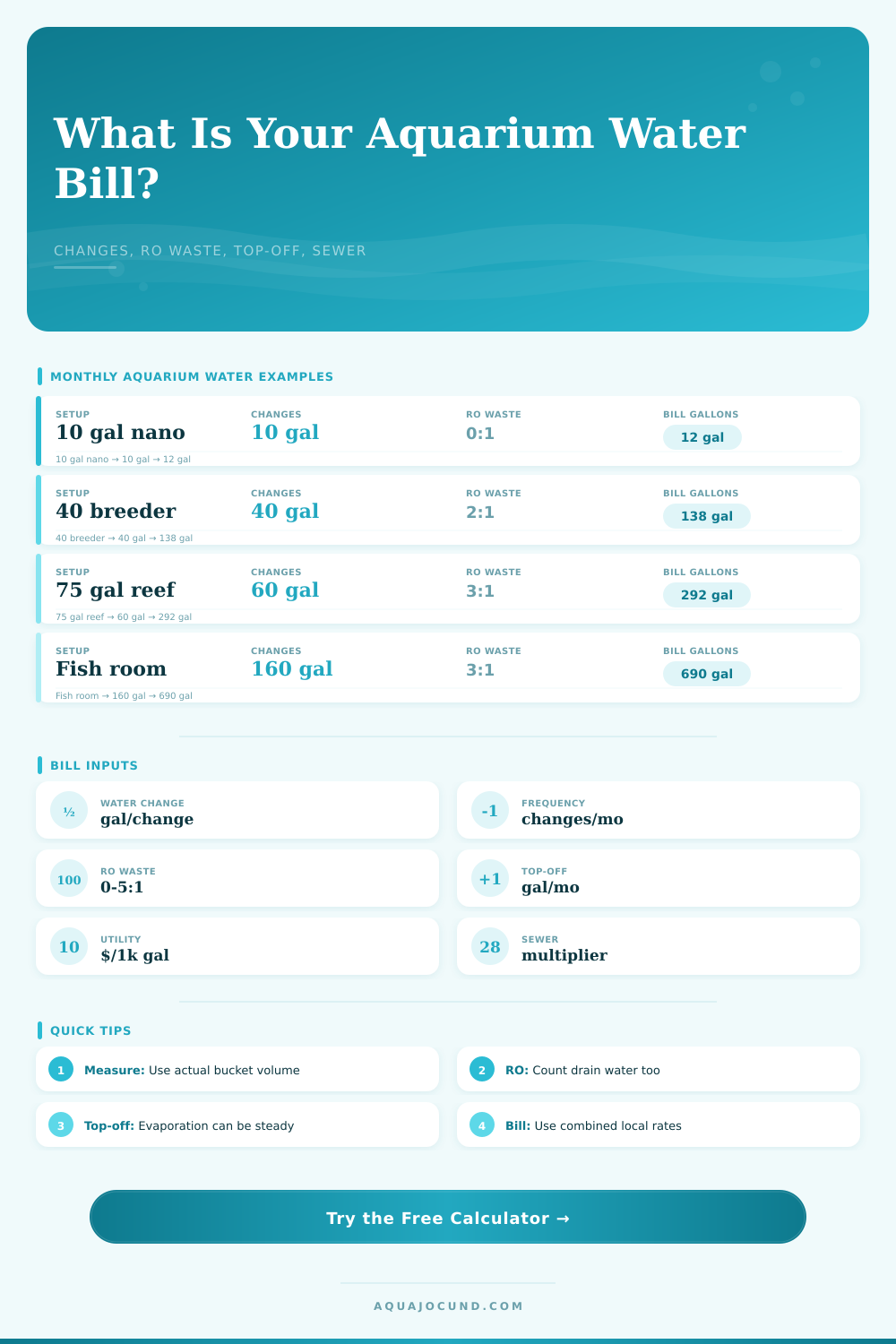
| 10 gal nano | 2.5 gal x 4 | Weekly | 10 gal plus top-off |
| 20 long planted | 8 gal x 4 | Weekly | 32 gal plus top-off |
| 40 breeder | 10 gal x 4 | Weekly | 40 gal plus top-off |
| 75 gal reef | 15 gal x 4 | Weekly | 60 gal plus top-off |
| Fish room rack | 40 gal x 4 | Weekly | 160 gal plus top-off |
| RO waste ratio | Source gallons for 10 gal product | Drain gallons | Bill effect |
|---|---|---|---|
| 0:1 | 10 gal | 0 gal | Tap-only water use; no RO drain water. |
| 1:1 | 20 gal | 10 gal | Efficient RO still doubles billed source gallons. |
| 2:1 | 30 gal | 20 gal | Often realistic for warm water and good pressure. |
| 3:1 | 40 gal | 30 gal | Common planning value for home RO systems. |
| 4:1 | 50 gal | 40 gal | Standard restrictor or cold-water scenario. |
| 5:1 | 60 gal | 50 gal | High source-water use; measure real output if possible. |
| Bill component | Formula | Input that moves it | Planning note |
|---|---|---|---|
| Change water | Gallons per change x changes/month | Bucket size and schedule | Use real refill volume after displacement, not display-tank label. |
| Top-off water | Monthly evaporation replacement | Tank cover, heat, airflow | Top-off may be small per day but steady over a full month. |
| RO waste water | RO product gallons x waste ratio | Waste ratio and RO share | This water is billed by the utility even though it goes to drain. |
| Water charge | Total gallons / 1,000 x utility rate | Local rate and source gallons | Enter the marginal water rate from the bill when tiers apply. |
| Sewer charge | Water charge x sewer multiplier | Sewer multiplier | Use 0 when sewer is not billed against water usage. |
💡Bill calculation tips
Pull out your monthly utility bill. Scan it. Notice the line item for sewage/water service? Yeah, it’s not too bad. At least it wasn’t until you realized you used a reverse osmosis system and siphoned gravel around every other week for the last month to top off for evaporation. Ahh, the hobby tax. Why isn’t it considered a regular household expense?
Most aquarists don’t realize just how much water their tanks consumes, particularly if filtration adds to this amount. It does. If you’re like most hobbyists, you monitor amount of water entering the tank (i.e., what you put in). You never think about amount of water exiting the tank…down the drain.
How to Save Money on Your Water Bill
There are two types of water flowing during each water change. There’s the finished water that supports your corals and keeps your fish healthy. And there’s the source water required to produce that finished water. That includes all the stuff your filtration unit reject.
If you’re using tap water alone, the math is simple. You have a bucket, you take out some old water, then you add fresh water. What’s inside the bucket is what costs you money. If you’re using a reverse osmosis membrane, however, the image shifts. Membranes pushes water past a barrier that captures impurities. By design, these devices are inefficient. For every gallon of clean product water they create, they flush away a good bit of reject water.
Know your own waste ratio. For example, some systems is highly efficient these days; they may waste one and a half gallons for every gallon retained. Older systems and those running under lower water pressures may have an efficiency rate of only 1/3rd (three to four gallons of waste for every gallon of product).
After entering your filtration type and how often you change, the calculator take care of the rest. No need for anyone to guess at the right conversions and coefficients. See actual price you pay per gallon of the water that didn’t make it into the tank.
That’s important; the utilities don’t charge you based on what you put in the tank, but rather the amount of total water that you pull from the main. Even though it immediately vanishes down the drain, that water still costs you the same as what’s in the tank.
There’s also an element of hiddden consumption through evaporation. Perhaps you use RO water or distilled water to top off your tank every day or every couple of days. That half-cup each time doesn’t seem like much. Multiply that by 30 and you’ve added up to several gallons in a month just from topping off. If your air flow is significant and you have a heated tank, then that top-off alone could amount to multiple gallons per month. Add that to larger water changes once a week. Soon, you will be adding a lot more water each month.
The tool accounts for this continuous water loss as part of the overall volume. It may be small, but it does matter if you want to maintain predictability in your expenses.
Then there’s the added twist of the sewer bill. In many towns, they base their sewer fee on the amount of water used and presume if it goes in, it comes back out. So you’re paying them for water you don’t send down the pipe! They may give credit for reused (or greywater) use, but some will have a flat multiplier on their bills. Half the battle is knowing how your area does this.
The more your sewer bill is based off your consumption of RO water, the bigger the savings you get by conserving water. This is not just for the environment, but also to control one of the factors that drives most of the cost. You can see comparison of different set ups on the page via their reference table. For example, a high-waste RO system for a large reef setup can easily double or even triple your expense while a small nano tank with tap water may only increase your bill by under a dollar. Efficiency and volume are what make the difference.
To help reduce this cost, you can divert your reject water for other use around the house (i.e., plant watering or toilet flushing). This reduces your overall cost of keeping the hobby and helps turn your waste into a resource.
One way to get an accurate measure of actual volume in your buckets is to actually measure it instead of making a guess based off the size of your tank. The labels on the tanks do not account for decor and substrate displacement so they will overestimate. The more accurate you are at the start, the easier the rest of your planning would of been.
There are countless reasons that your water bill may vary, but knowing how aquarium uses the water allows you to control it. It helps you view it as more than some mysterious penalty charged to you and instead see it as a representation of the efficiency with which your system operates. Trim those expenses considerably by adjusting your RO ratio. Optimize your change frequency. Account for evaporation… Whatever the case may be.
Ultimately, don’t try to cut out water use entirely. Instead, learn everything there is to know about it. Know exactly where each gallon is going. Make better decisions about your set up when you have that clarity. That’s how a maddening line item becomes something you can manage, and thus keep your aquatic life thriving.