💧 Aquarium Water Aging Time Calculator
Estimate when prepared water is ready for a water change after disinfectant, aeration, pH, and temperature checks.
✅ Water Readiness Estimate
| Profile | Typical Disinfectant | Default ppm | pH Drift | Calculator Assumption |
|---|---|---|---|---|
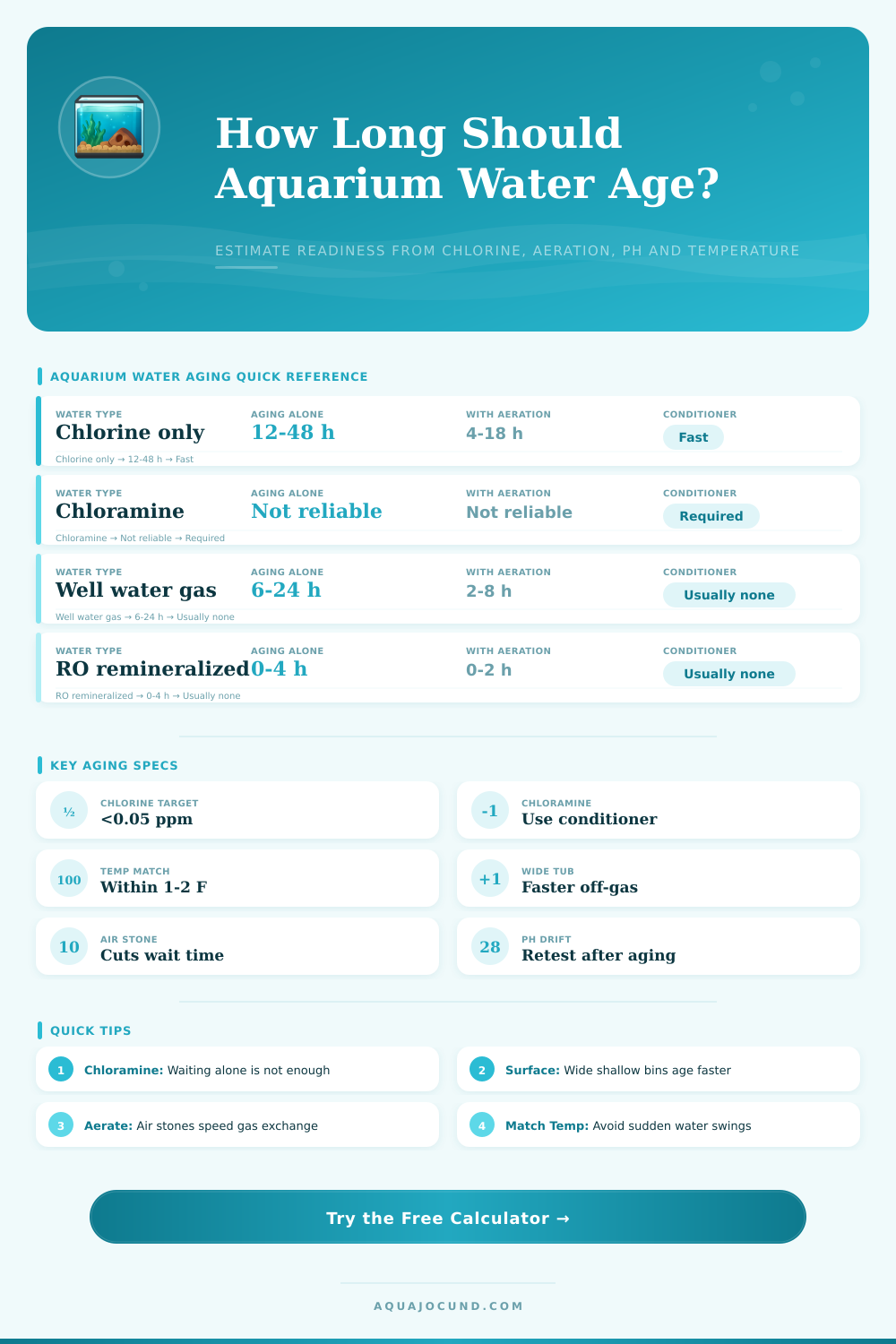
| City tap - chlorine only | Free chlorine | 2.0 | Low | Waiting can work if open and aerated |
| City tap - chloramine | Chloramine | 2.5 | Low | Conditioner required for readiness |
| High chlorine tap | Free chlorine | 4.0 | Low | Longer wait if no conditioner |
| Soft tap with dissolved CO2 | Free chlorine | 1.5 | Moderate | pH may rise after aeration |
| Hard alkaline municipal water | Chloramine | 2.0 | Low | Conditioner plus temp match |
| Well water with trapped gas | None | 0.0 | Moderate | Aerate for gas and pH stability |
| RO or DI remineralized | None | 0.0 | Very low | Mixing and temperature dominate |
| Stored rainwater or cistern water | Usually none | 0.0 | Variable | Stability check matters more than chlorine |
| Prepared Volume | Metric Equivalent | Typical Container Surface | Chlorine Aging Range | Best Use |
|---|---|---|---|---|
| 5 gal bucket | 18.9 L | 110 sq in / 710 cm² | 8-24 h | Small top-offs |
| 10 gal bucket pair | 37.9 L | 220 sq in / 1419 cm² | 10-30 h | Nano water changes |
| 20 gal tote | 75.7 L | 360 sq in / 2323 cm² | 8-24 h | Medium tanks |
| 32 gal mixing bin | 121 L | 520 sq in / 3355 cm² | 8-24 h | Reef mixing |
| 40 gal breeder tub | 151 L | 648 sq in / 4181 cm² | 6-18 h | Wide shallow aging |
| 55 gal barrel | 208 L | 415 sq in / 2677 cm² | 18-48 h | Large stored water |
| 90 gal stock tank | 341 L | 1100 sq in / 7097 cm² | 8-24 h | Large water changes |
| Aeration Setting | Free Chlorine Effect | pH Off-Gas Effect | Temperature Mixing | Use When |
|---|---|---|---|---|
| Still water | Slowest | Slow | Slow | Small chlorine-only changes |
| Occasional stirring | Slightly faster | Modest | Modest | Bucket prep without pump |
| Gentle air stone | Good improvement | Good | Good | Most water-change containers |
| Strong air stone | Fast | Fast | Fast | pH drift or larger volume |
| Powerhead ripple | Fast | Fast | Very good | Mixing salts or minerals |
| Vigorous aeration | Fastest | Fastest | Very good | Emergency prep after conditioner |
Aquarium water changes is essential to maintaining the health of fishes and invertebrates in the tank. Aquarium water changes are the best way to maintain the health of fishes and invertebrates over time. Many individuals may believe that water from tap is ready to be used in the aquarium as soon as they place it in a bucket or an tote.
However, water in these containers contain a specific chemical composition that must stabilize before it can be added to an aquarium. The time required for this water to stabilize is based off four main factors: disinfectants, temperature, and surface area. A primary reason for aging water is to allow for the removal of the disinfectants that is added to the water in municipal drinking water supplies.
How to Prepare Water for an Aquarium
Municipalities often add free chlorine to the drinking water to ensure that the water is safely to drink. Free chlorine gas dissipates from the water if the water is left open to the air and if the movement of the air stirs the water. However, the rate of dissipation of the free chlorine gas is slow unless the water has a large surface area in which to dissipate and the water has movement created by the air movement.
Many cities has switched to using chloramine as an alternative to free chlorine. Unlike free chlorine, chloramine does not dissipate on its own. The chemical bonds of the chloramine require a chemical conditioner to be broken.
If you dont add the conditioner to the water prior to placing the water into the storage container, the chloramine will remain in the water even after sitting for many days. When chloramine is in the water, it can lead to the irritation of the gills of fish. Another important factor to consider with water changes is the temperature of the water.
Fish are very sensitive to change in the water temperature in their tank. Therefore, before adding water to the aquarium, you should ensure the temperature of the prepared water is similar to the temperature of the water in the aquarium. You can use a calculator to determine if the temperatures of the prepared water and the aquarium water are similar enough to use without additional treatment.
Should you find the prepared waters temperature and the aquarium waters temperature differ, heat may need to be added to the prepared water or circulation may be used to allow the prepared water to reach the same temperature as the aquarium water. The rate at which the gases in the prepared water leave the water will impact the pH of the prepared water after it is stored in the containers. A third factor that relates to the preparation of the water for the aquarium is the surface area of the container in which the water is prepared and the aeration of the container.
A container with a wide surface area and a shallow depth will hold more of the water’s surface area than a tall and narrow container. The surface area of the water will allow for gas exchanges between the water and the air. You can add an air stone to the container that is holding the prepared water.
However, the air stone will only allow for gas exchange if the container is open to the air. Therefore, a container that has both more surface area and more aeration will allow the prepared water to reach stability faster than a container that includes less of both these factor. Another important factor to consider when performing water changes is the effect that water changes have upon the pH of the water.
The water from the tap may contain carbon dioxide that is dissolved in the water. When the dissolved carbon dioxide leaves the water, the pH of the water will rise. A change in the pH level of the water may be harmful to some of the inhabitant of the aquarium.
Therefore, if using the prepared water to maintain a stable pH in the aquarium, you can perform calculations to account for the change in pH that will occur in the prepared water. These calculations will ensure that the estimate for when the prepared water is ready to be added to the aquarium is accurate according to the species that live in the tank. Depending on the size of the aquarium and the type of water change that is to be performed, the preparation of the water will take more or less time.
For instance, changing the water in a small aquarium will take more time to prepare than changing the water in a large reef tank. The time required to prepare the water will depend upon the type of disinfectants that are used, the required temperature of the water, and the amount of surface area to which the water will be exposed to the air. Not all water changes are performed the same way.
Each variable can change the necessary preparation of the water prior to adding it to the aquarium. The water that is prepared for the aquarium is not the same as the water that is safe for the aquariums inhabitants. The water that is safe in the aquarium is water that has been appropriately treated for disinfectants, is of an appropriate temperature, and has reached a stable pH.
In order to prepare the water for an aquarium, therefore, it is necessary to check the source of the water, ensure the water has the necessary conditions to reach stability, and allow time for the water to reach stability prior to adding it to the aquarium. You should of checked the water first.