Aquarium Wall Mount Bracket Load Calculator
Estimate wet tank weight, bracket load, wall-anchor tension, and safety margin before placing an aquarium on wall-mounted supports.
Bracket Load Estimate
| Support profile | Planning rating | Typical arm | Calculator use |
|---|---|---|---|
| Light steel shelf bracket | 80 lb per bracket | 8 to 10 in | Nano tanks only with solid fastening |
| Medium angle bracket | 125 lb per bracket | 10 to 14 in | Small rectangular tanks on studs |
| Heavy triangular bracket | 250 lb per bracket | 14 to 18 in | Longer shelves with multiple supports |
| Welded steel support | 350 lb per bracket | 16 to 24 in | Large shelf frames checked by rating |
| Continuous cleat rail shelf | 60 lb per foot | 8 to 12 in | Light loads spread across many fasteners |
| Wall profile | Planning shear | Tension behavior | Load note |
|---|---|---|---|
| Wood studs with lag screws | 250 lb per bracket | Good if centered | Use pilot holes and real stud contact |
| Plywood backer over studs | 180 lb per bracket | Good when tied to studs | Spreads support across bracket layout |
| Brick or block masonry | 200 lb per bracket | Varies by anchor and block | Avoid weak mortar-only fastening |
| Solid concrete wall | 350 lb per bracket | Strong with rated anchors | Check embedment and edge distance |
| Drywall anchors only | 25 lb per bracket | Poor sustained load | Not suitable for wet aquarium support |
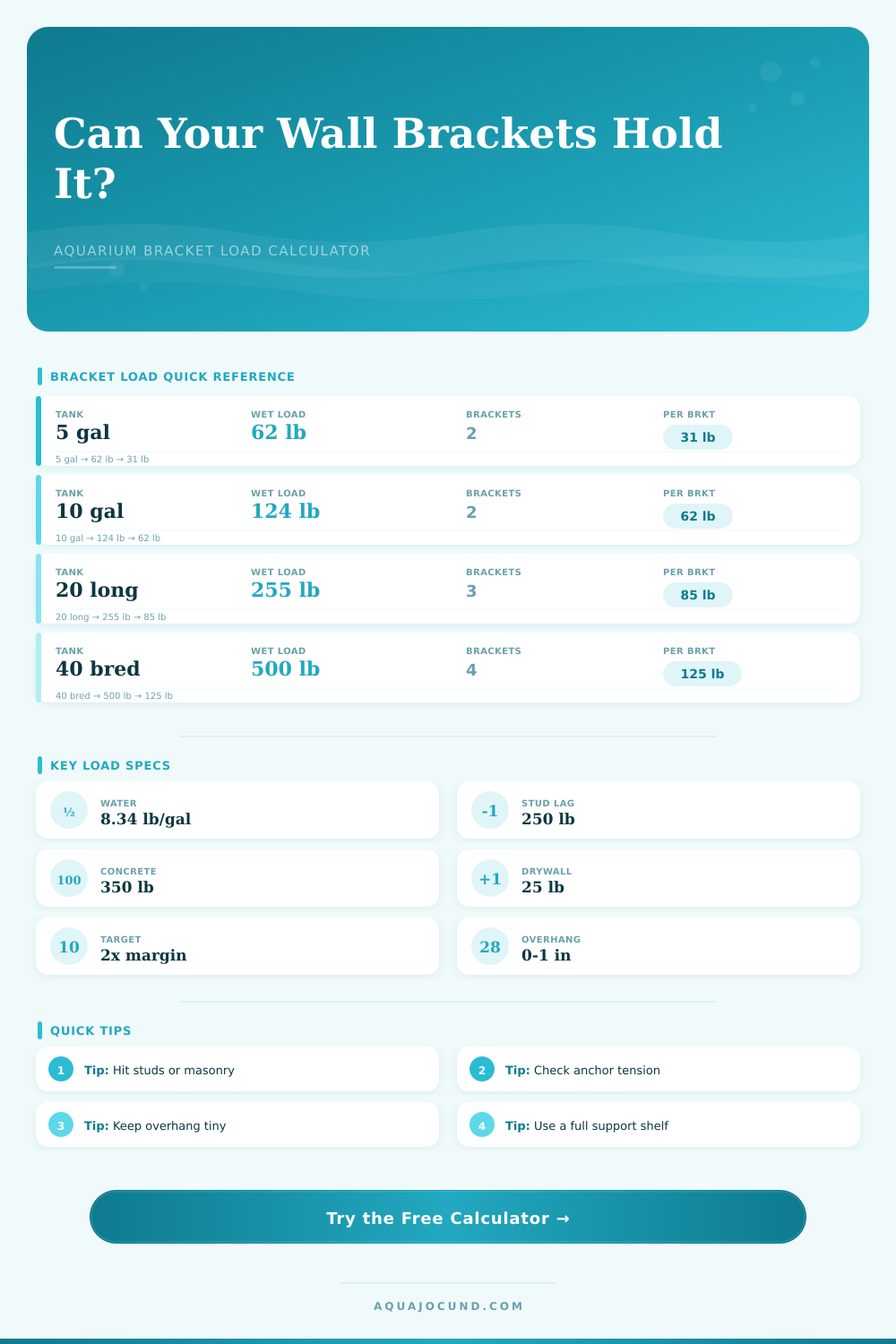
| Tank size | Outside dimensions | Estimated wet load | Typical bracket plan |
|---|---|---|---|
| 5 gal rectangle | 16 x 8 x 10 in / 41 x 20 x 25 cm | 55 to 70 lb / 25 to 32 kg | 2 supports into studs or masonry |
| 10 gal rectangle | 20 x 10 x 12 in / 51 x 25 x 30 cm | 105 to 130 lb / 48 to 59 kg | 2 to 3 supports with full shelf |
| 20 long | 30 x 12 x 12 in / 76 x 30 x 30 cm | 220 to 280 lb / 100 to 127 kg | 3 heavy supports, no front overhang |
| 29 gal rectangle | 30 x 12 x 18 in / 76 x 30 x 46 cm | 310 to 370 lb / 141 to 168 kg | 3 to 4 heavy supports only |
| 40 breeder | 36 x 18 x 16 in / 91 x 46 x 41 cm | 460 to 540 lb / 209 to 245 kg | 4 plus structural verification |
| Check | Formula basis | Good target | Why it matters |
|---|---|---|---|
| Per bracket shear | Design load divided by adjusted support count | Below rating | Compares vertical load to bracket and wall rating |
| Load center | Half tank width plus overhang | Near wall | Longer projection multiplies anchor pullout force |
| Bracket moment | Per bracket load times load center | Below profile | Captures leverage on the wall plate |
| Upper anchor tension | Moment divided by vertical anchor spacing | Below anchor rating | Top fasteners see the strongest pull |
| Full shelf support | Shelf covers full tank footprint | No rim gaps | Prevents point loading and uneven glass stress |
A wall-mounted aquarium is neat. It makes your tank a design feature. It frees up floor space. It’s a clean, moddern way to hang an aquarium. But it also make drywall into a structural engineering challenge. No matter how much you love your fish, gravity will pull things down consistantly. When your hardware fail, the outcome is ruined flooring and a flooded room.
The calculator above will run the math for you, and you definitely want to know what those numbers mean before picking up that drill. People often assume their tank weight are also equal to their bracket load. But average weight of water is about 8 and a half pounds per gallon. That is your starting point.
Wall-Mounted Aquarium Safety Guide
Now remember, you’re not just hanging water. Depending off how it’s constructed, the glass/acrylic will have different weight. For example a rimmed glass tank spreads out some of the weight of the glass onto the tank frame with its metal edging. Frameless low-iron display tanks puts nearly all their mass on the bottom panel. Then there is the wet load of everything else such as sand, gravel, rock, filters, etc., and a canopy add to the overall wet load. All of this can easily double what water alone weighs. Remember the tool consider all of this. You can enter weight of your equipment and substrate depth to recieve a more realistic total.
Now we get into leverage. Here’s where most DIY shelving goes awry. Since tanks weighs something, they create a turning force against the wall. And the further the bracket stick away from the wall, the greater is the tension the top anchors must resist. The tension increases sharply if you have any part of your tank hanging over edge of the bracket, even by an inch or two. The table on the page describe the effect of bracket type and anchor spacing on this leveraged force.
Are your anchors resisting shear? Or tension? Lag screws in wood studs work great for tension forces. Drywall anchors in plastic don’t. Don’t trust drywall anchors with sustained wet loads. Water has constant pressure which can eventualy loosen weaker fixtures.
Knowing your wall type is as important than knowing your tank weight. Double the load you expect to be in there and that’s your minimum safety factor. It takes into account all the dynamic loads, such as water flow and clean glass. It also consider material fatigue and installation error. If the calculator returns a negative number or red flag, don’t skip it, strengthen the wall by adding more support points or moving them closer together. Don’t skimp on the wall.
Locate a stud? Easy. Locate a decent masonry anchor? That’s harder. Concrete is better than brick which is better than hollow block. Know what kind of wall you’re putting your tank on? Just as much as you need to know how heavy it will be.
So what is the result? Building a wall mounted aquarium take time. It needs precision. You need to use right materials. And it requires that you should of have a healthy respect for physics. Visualize the loads in the tool, test your anchors against the type of wall, and make sure your safety factor is solid. If things look tight, take a step back. Build yourself a strong stand. Both your fish. And your floor, will thank you.