Aquarium UV Contact Time Calculator
Estimate chamber dwell seconds, UV dose, treated turnover, bypass loss, and max flow from UV wattage, chamber volume, sleeve clarity, target dose, and lamp age.
💡UV chamber and target
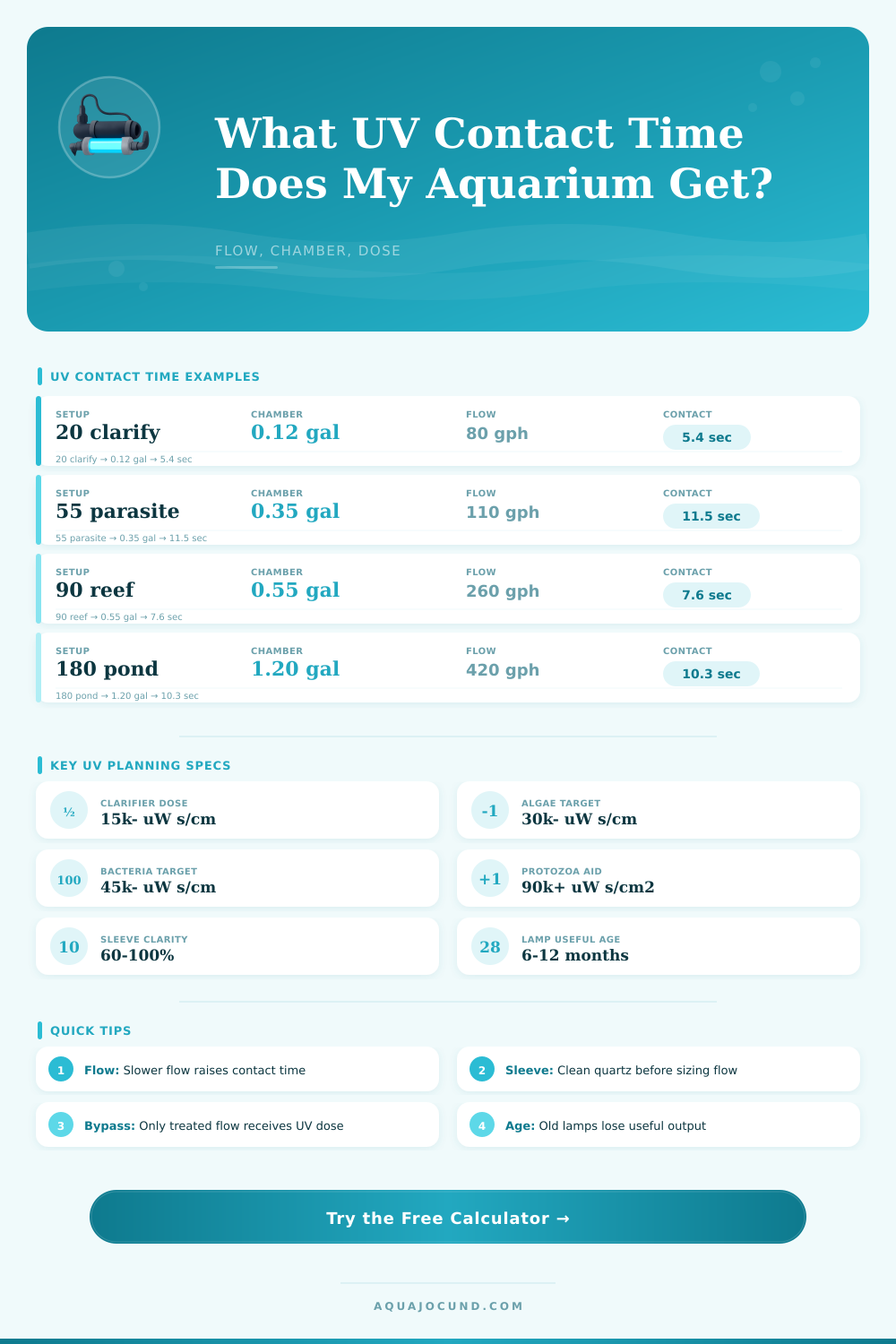
UV dose is irradiance multiplied by contact seconds.
Low-pressure aquarium lamps often convert about 25-35% of electrical watts to germicidal UV-C when new.
🚰Flow, volume, clarity, and turnover
Use measured flow after head loss, elbows, valves, and prefilter restriction.
Calculation breakdown
UV application comparison grid
📊UV sizing markers
🔍UV application comparison
Clarifier polish
Best for haze and suspended algae control where high turnover matters more than very high single-pass dose.
Algae reduction
Uses a stronger dose while keeping enough treated flow to cycle display water several times each day.
Bacteria reduction
Needs slower flow or a larger chamber because target dose climbs faster than normal clarifier sizing.
Parasite aid
High-dose planning is flow-limited and should be treated as reduction support, not a cure or quarantine replacement.
📋Reference tables
| Target class | Dose range | Flow priority | Typical use |
|---|---|---|---|
| Clarifier polish | 15,000-30,000 uW s/cm² | High turnover | Haze, mild green water, visible polish |
| Green water and algae | 30,000-45,000 uW s/cm² | Balanced flow and dose | Suspended algae reduction |
| Bacteria reduction | 45,000-75,000 uW s/cm² | Moderate flow | Water column bacterial pressure |
| Protozoa parasite aid | 90,000-120,000 uW s/cm² | Slow flow | Reduction support for free-swimming stages |
| High-dose parasite aid | 150,000+ uW s/cm² | Very slow flow | Dedicated quarantine or recirculating loop |
| Chamber profile | Hydraulic use | UV path factor | Best fit |
|---|---|---|---|
| Hang-on compact clarifier | 58-68% | 0.82 | Nano tanks, low chamber volume |
| Small inline aquarium UV | 65-75% | 0.90 | Canister or small pump feed |
| Twist-flow inline chamber | 72-82% | 1.02 | Better mixing and dwell distribution |
| Long body inline sterilizer | 75-86% | 1.10 | Higher dose at moderate flow |
| Wide body low-pressure unit | 68-78% | 0.98 | Lower velocity with broad sleeve exposure |
| Pond-style high dwell chamber | 78-88% | 1.15 | Larger chamber, slower contact path |
| Sump/submerged sleeve module | 55-70% | 0.78 | Open sump zones with more bypass risk |
| Commercial multi-pass chamber | 82-92% | 1.22 | Purpose-built high-dose recirculation |
| Tank size | Volume | 6x treated flow/day | 10 sec chamber volume |
|---|---|---|---|
| 20 long | 20 gal / 76 L | 5 gph / 19 L/h | 0.014 gal / 0.05 L per 5 gph |
| 40 breeder | 40 gal / 151 L | 10 gph / 38 L/h | 0.028 gal / 0.11 L per 10 gph |
| 55 standard | 55 gal / 208 L | 14 gph / 52 L/h | 0.038 gal / 0.14 L per 14 gph |
| 75 reef | 75 gal / 284 L | 19 gph / 71 L/h | 0.052 gal / 0.20 L per 19 gph |
| 125 display | 125 gal / 473 L | 31 gph / 118 L/h | 0.087 gal / 0.33 L per 31 gph |
| 180 system | 180 gal / 681 L | 45 gph / 170 L/h | 0.125 gal / 0.47 L per 45 gph |
| Flow through 0.5 gal chamber | Contact time | Equivalent L/h | Planning note |
|---|---|---|---|
| 75 gph | 24.0 sec | 284 L/h | High dwell, low turnover on large systems |
| 150 gph | 12.0 sec | 568 L/h | Balanced for many mid-size tanks |
| 300 gph | 6.0 sec | 1,136 L/h | Clarifier leaning unless UV intensity is high |
| 500 gph | 3.6 sec | 1,893 L/h | High turnover but short exposure |
| Lamp age | Output factor | Sleeve condition | What to check |
|---|---|---|---|
| 0-3 months | 95-100% | Usually clear | Confirm flow is not above target |
| 4-6 months | 88-95% | Light film possible | Wipe quartz sleeve during service |
| 7-9 months | 78-88% | Film matters more | Reduce flow or clean sleeve for dose margin |
| 10-12 months | 65-78% | Clean sleeve required | Plan replacement for high-dose uses |
| 12+ months | Often under 65% | Unknown output | Do not size critical flow from old output |
💡UV contact time tips
I installed a new UV sterilizer but my cloudy tank didn’t get any clearer. I paid big bucks for a unit rated for double my tank size. How come it doesn’t just work right now? Uh…because it takes time.” While lamps is not usually the issue, it’s all about the contact time, how long the water is exposed to ultraviolet light.
And most of us think only about gallons per hour (flow rate) because GPH sounds powerful. But high flow rates don’t help. They will actualy hurt how well a UV sterilizer works if it rushes too many particles past a UV dose enough to break down their DNA. The calculator above accounts for those tricky connections between irradiance and velocity so you don’t need to second-guess if you’ve got an under-powered or over-killing setup.
How to Make Your UV Sterilizer Work Better
It’s such a simple equation that it almost seems obvious: dose = irradiance x time. In practice however, most folks completely overlook this. Mineral scale on your quartz sleeve drastically reduce irradiance. Your water flow rate hasn’t changed. The movement of the water remain constant. But effective dose decreases dramatically. This is what makes the input for sleeve clarity so important…yet no one ever wants to admit it.
Sure, you can run a brand new lamp in a gunked up chamber and have inferior results different than an old lamp in a spotless one. But you’ll never increase the amount of light coming out of a fogged surface. Reducing transmission will directly reduce the effective contact window for each organism that pass through.
Another ruse in which specs mislead you is flow measurement. Maximum headless flow rate is listed in the pump box, but throw some filters and elbows and hose into the mix and no way does this ever match the number the pump lists. Almost certainly, the pump labeled flow velocity within the UV chamber are nowhere near what is listed on the label. Your calculation based off rated flow will have you thinking you’re delivering enough of a sterilizing dose, when in fact you may be only delivering half of it.
To know the truth about your actual hydraulic conditions, which determine whether parasites is killed or simply pass through unharmed, use a cheap inline flow meter or a bucket test. That’s where chamber design becomes huge. Cylindrical, simple chambers are prone to channelling, meaning much of the water races through the centre with nothing happening around the edges on the walls. Twist flow type chambers mix it up better and make the water swirl about so each drop pass by the lamp surface. That’s shown in efficiency factor for hydraulics.
Even if you have high wattage, poor internal baffling means no way, even big units don’t overcomes the inefficiency of poor mixing. Some are over-lit and others recieve no light at all. That’s what makes bigger units outdo smaller units sometimes when both has the same size lamps.
Lamp age introduces a slow decay that keepers rarely track. UV output will fall far short of its starting value long before the bulb burns out or the glass shatters. Even by month nine many low pressure bulbs has reduced their germicidal ability by more than 20%. If your lamp has degraded beyond that point and you continue running at high flow rates you’re not getting adequate contact time to reach your desired dose. Without knowing it, you may be fighting your battle against green water with a weaker weapon.
Replace your bulb on a regular cycle to get the most out of them. This helps you avoid a bloom that happens when the output falls below critical levels. That said: quarantine systems require much more than display tanks where only clarification is required. Almost twice as much energy is required to kill protozoa then suspended algae.
That’s why you must significantly increase the lamp intensity or drastically reduce the flow rate. In other words: there are no free lunches when it comes to aquatic sterilization. Want a large dose? Do you want a high turnover (e.g., for filtration)? You’ll need a bigger system that can do both at once. Squeezing the most out of a small inline unit is generally a recipe for achieving neither very well.
This understanding shifts your gear choices. It’s no longer about pushing the greatest amount of power possible from the box. Now it’s finding the proper chamber size based on actual flow. It’s preempting sleeve care before visibility is affected. It’s acknowledging that aged lamps will function best at lower flow rates.
It’s still a numbers game but in a constantly shifting real world. You don’t know precisely how long each drop spends under the light just by going fast and looking busy. That is where you get clear water.