⚖ Aquarium Total Filled Weight Calculator
Estimate the loaded weight of a filled aquarium, including tank shell, water, substrate, rock, sump water, equipment, stand, and a planning margin.
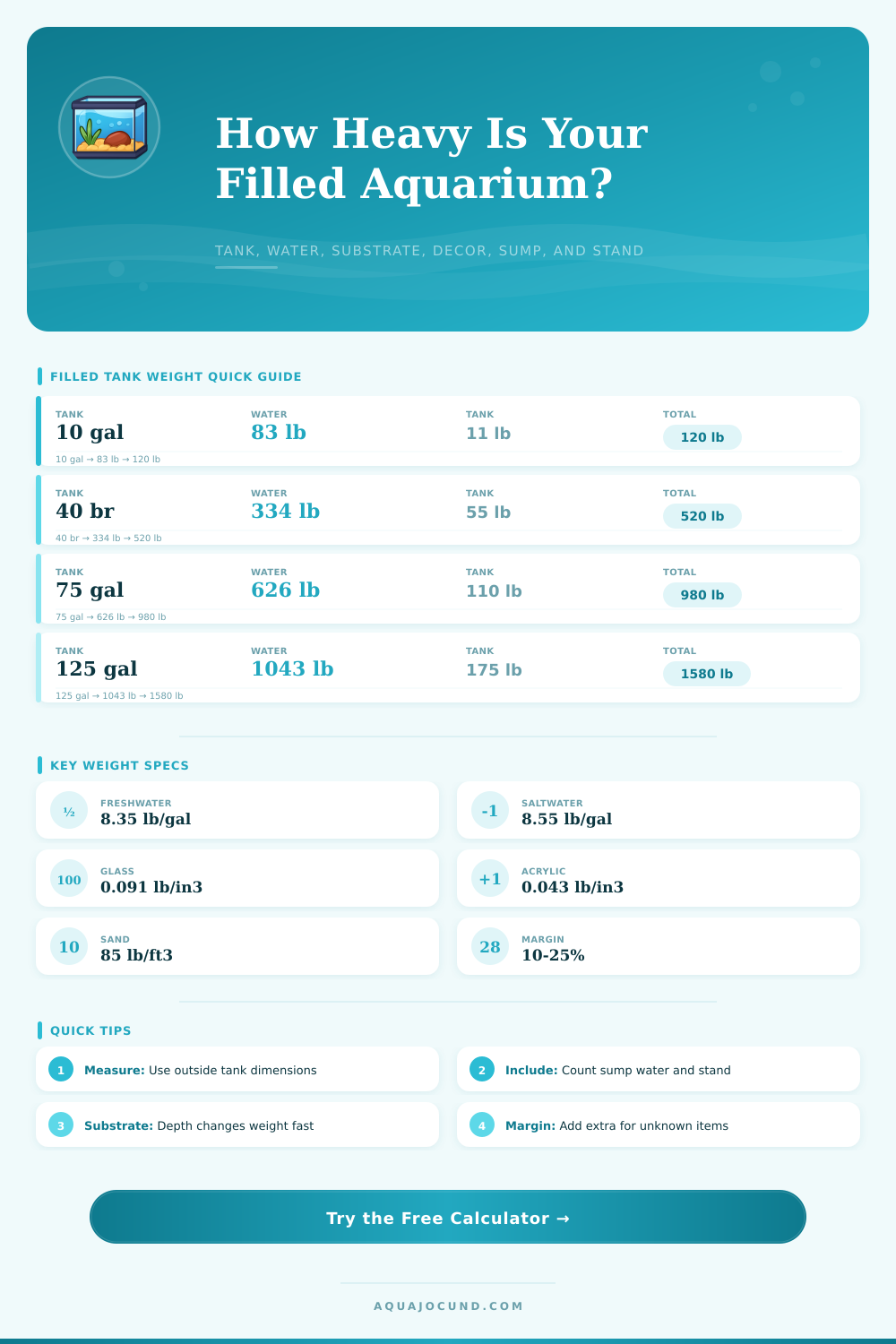
| Tank size | Common dimensions | Water weight | Typical shell | Typical total with stand |
|---|---|---|---|---|
| 5 gallon | 16 x 8 x 10 in | 42 lb | 6-9 lb | 70-100 lb |
| 10 gallon | 20 x 10 x 12 in | 83 lb | 10-14 lb | 115-150 lb |
| 20 long | 30 x 12 x 12 in | 167 lb | 25-35 lb | 250-340 lb |
| 29 gallon | 30 x 12 x 18 in | 242 lb | 35-45 lb | 360-470 lb |
| 40 breeder | 36 x 18 x 16 in | 334 lb | 50-65 lb | 480-650 lb |
| 55 gallon | 48 x 13 x 21 in | 459 lb | 75-95 lb | 690-850 lb |
| 75 gallon | 48 x 18 x 21 in | 626 lb | 100-130 lb | 900-1150 lb |
| 125 gallon | 72 x 18 x 22 in | 1043 lb | 160-210 lb | 1450-1800 lb |
| Material | Density used | Typical use | Weight behavior |
|---|---|---|---|
| Standard plate glass | 0.091 lb/in3 | Most framed tanks | Baseline shell estimate |
| Low iron glass | 0.091 lb/in3 | Clear front panels | Similar weight to standard glass |
| Tempered glass | 0.091 lb/in3 | Thin bottom panels | Density similar, thickness varies |
| Cell cast acrylic | 0.043 lb/in3 | Large displays and cylinders | Much lighter per volume |
| Thick rimless glass | 0.091 lb/in3 | Rimless displays | Uses extra thickness factor |
| Custom shell weight | User entered | Known manufacturer spec | Best when spec sheet is known |
| Substrate type | Density used | Best fit | Weight note |
|---|---|---|---|
| Bare bottom | 0 lb/ft3 | Breeding, quarantine, racks | No substrate load |
| Aquarium sand | 85 lb/ft3 | Planted, community, bottom fish | Heavy and compact |
| Rounded gravel | 75 lb/ft3 | Community aquariums | Moderate to heavy |
| Planted aquarium soil | 50 lb/ft3 | Plants and shrimp | Lighter than mineral sand |
| Crushed coral | 90 lb/ft3 | Reef, hardwater, buffers | Dense carbonate media |
| Light aquascaping soil | 42 lb/ft3 | Layered aquascapes | Lowest common dry density |
| Load result | Planning signal | Typical cause | What to check |
|---|---|---|---|
| Light | Under 100 lb/ft2 | Small tanks and broad stands | Level surface and stand fit |
| Moderate | 100-200 lb/ft2 | Medium displays and cabinets | Joist direction and stand footprint |
| Heavy | Over 200 lb/ft2 | Large tanks, rock, sump, narrow stand | Floor framing and long term deflection |
| Margin included | Final result adds selected percent | Canopy, wet media, accessories | Use the final weight for planning |
Move a fish tank one time, and you discover that a fish tank is not furniture. A fish tank is architecture. The first time someone sets up an aquarium, all they care about is the fish, the filter, and perhaps how cool that piece of driftwood looks. What they don’t think about are the floor joists upon which they stand. If overlooked, this oversight will turn a relaxing hobby into a structural engineering crisis before any water enters glass.
Water is what most people consider as just water. It’s not. It’s heavy and dense. It is unforgiving to the load bearing walls designed for bookshelves and drywall, not two hundred gallons of suspended liquid. Once you know your own dimensions, simply enter them into the calculator above, and it will do all the math for you so you don’t have to guess how much that additional inch of substrate contribute to the overall load.
How Much Does Your Fish Tank Weigh?
Most of the time, however, the water itself is the cause. It’s approximately eight point three five pounds per gallon. Because saltwater contains dissolved minerals that make it denser, that figure approach eight and a half. Take the total volume of water in your tank and multiply it out, you now have the starting weight.
On top of that add the weight of glass or acrylic shell. Before you know it, the numbers grow. That fifty-five gallon tank doesn’t sound so bad until you consider that just the water weigh almost four hundred sixty pounds. Throw in the rock, equipment, and the stand and now you’re talking about something that weighs more than most sedans.
The material makes all the difference. By volume, acrylic is roughly half the weight of glass. So if you’re retrofitting an existing space with weight considerations, or simply moving your tank around, that can make all the difference. On the other hand, acrylic tanks needs to be made from thicker panels to provide enough stiffness against bowing. So it adds some of that weight savings right back in.
Glass is heavy and rigid. Normal plate glass has a specific density. The tool assumes standard glass. It takes the surface area and thickness of the tank to calculate the weight of the glass shell using that density as a base. For normal tanks, this should work just fine. But what if you have a custom rimless tank with super thick glass? In that case, the default estimates may not be accurate. That’s why it’s always best to enter the exact specs of the shell weight given to you by the manufacturer, if available.
The real difficulty lies with the substrate. Because its depth varies drastically, a couple inches of sand can feel light in your palm yet have tons of mass over a span of 48″. For every cubic foot of sand, there is more mass than gravel or even a planted soil. In fact, if you’ve got a deep rock set up for cichlids, just the weight of your decorations may be equal to the weight of your shells. Because these items vary greatly, the tool allows you to list them separately, i.e., you can add driftwood/rock as a separate item(s). A couple slabs of slate won’t do much, while a dragon stone castle will.
And don’t overlook the sump. Many reef keepers conceal a large reservoir in a cabinet capable of holding at least twenty gallons of extra water. This weight is concentrated on one end of the stand (right beside the display tank). Then there’s equipment. Heaters, powerheads, canopies, media bags, they all add up. Include some unknowns. A ten to fifteen percent safety margin takes care of those, so avoid cutting things too close.
From this you have the total weight that it will hold at full capacity and how much that works out to be per square foot of footprint. The latter number is what you care about as far as your house goes. Floors in most houses are rated for 40 lbs/sq ft live load. However, that’s assuming a distributed load across an entire room. A tank stand puts several thousand pounds into a tiny space. If your stand legs sits on a joist, you’re usually safe. But if your legs bridge the gap between joists, there’s a possibility of deflection and even more. Know where your legs come down in relation to the structure below them. Then use the result to determine whether your floor will support the concentrated point loads prior to attempting any heavy lifting.
When you weigh the options it will determine if you can make this work in the tank you have or if you’ll need to strengthen the situation. It will also let you know if a little more acrylic would be appropriate given your space limitations. Simple math but boy is it going to cost if you’re wrong.
First measure the size of your tank. Include the water, subtract the rocks, and divide by the floor. Do it in that order and your house stays together and your hobby remains unbroken. It could of been a disaster if you didn’t check first.