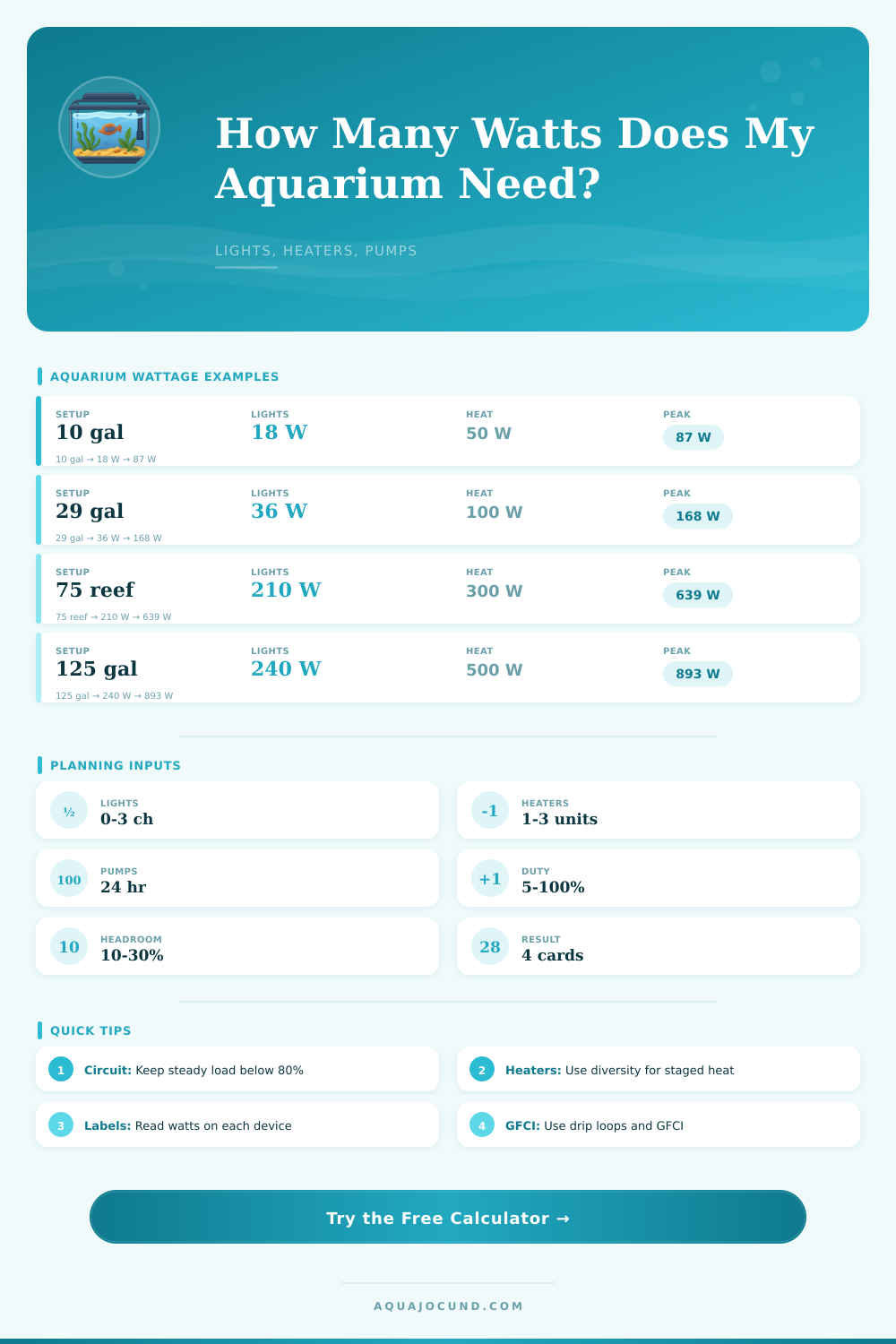
Aquarium Total Wattage Calculator
Total the connected load and realistic running watts for lights, heaters, pumps, UV, ATO, and accessories before you fill the power strip.
⚙Start With A Common Setup
📏Tank And Supply Planning
💡Lighting Channels
🌡Heaters And Diversity
Diversity reduces expected simultaneous peak, not the installed emergency wattage.
🌊Pumps, UV, ATO, And Miscellaneous Loads
Wattage Summary
Circuit load will appear here.
📊Equipment Wattage Comparison Grid
Small diaphragms are low draw but usually run all day.
Compact filters add steady load in nano tanks.
Flow, head height, and media clogging change draw.
Freshwater LEDs often peak lower than reef fixtures.
Installed watts are high, but duty cycle is seasonal.
The lamp and sleeve pump may be separate loads.
Short bursts matter for peak, barely for average draw.
Include power bars, probes, fans, and dosing heads.
📘Typical Duty Cycle Reference
| Equipment | Peak Planning | Average Duty | Notes |
|---|---|---|---|
| Main LED channel | Full fixture rating | 25-45% | Depends on ramping and photoperiod. |
| Return/filter pump | Nameplate watts | 90-100% | Usually the most important steady load. |
| Heater bank | Installed watts | 10-65% | Use diversity for staged controllers. |
| ATO and dosers | All possible motors | 1-10% | Short runtime but include in strip wattage. |
| UV sterilizer | Lamp plus pump | 25-100% | Clarifying runs may be intermittent. |
🐟Common Aquarium Load Examples
| Setup | Typical Equipment | Installed Watts | Planning Note |
|---|---|---|---|
| 5 gal betta | LED, sponge air, 25 W heater | 35-55 W | Heater dominates peak load. |
| 20 long planted | LED, HOB, heater, CO2 solenoid | 120-190 W | Average is much lower than peak. |
| 40 breeder grow-out | Dual sponge, LED, 150 W heat | 175-240 W | Air pumps run continuously. |
| 75 gal reef | Reef light, return, skimmer, wavemakers | 500-800 W | Separate wet gear across outlets. |
| 125 gal cichlid | Canister, return, LEDs, twin heaters | 650-950 W | Use drip loops and labeled plugs. |
⚡Circuit And Power Strip Planning
| Supply | Nominal Capacity | 80% Continuous | Use This Way |
|---|---|---|---|
| 120 V / 10 A | 1200 W | 960 W | Small rack or single midsize tank. |
| 120 V / 15 A | 1800 W | 1440 W | Common US branch circuit. |
| 120 V / 20 A | 2400 W | 1920 W | Useful for large reef systems. |
| 230 V / 10 A | 2300 W | 1840 W | Check local plug and breaker limits. |
| 240 V / 13 A | 3120 W | 2496 W | Keep aquarium gear GFCI/RCD protected. |
🔧Load Audit Checklist
| Check | Why It Matters | Good Practice | Calculator Field |
|---|---|---|---|
| Nameplate watts | Peak load starts here. | Read labels, bricks, and manuals. | All watt inputs |
| Heater staging | Two heaters may not fire together. | Use split setpoints if controlled. | Heater diversity |
| Always-on pumps | Small watts run every hour. | Do not ignore air and dosing gear. | Duty cycle |
| Outlet capacity | Power strips have real limits. | Compare recommended watts to rating. | Supply planning |
Then there’s that scenario where a power strip gives up the ghost because someone treated it like a magic infinite resource. That’s not bad luck. It’s physics meets lack of planning. Lots of folks think their power strips never run out. But your fishkeeping equipment is no different. Pumps, lights, heaters, they all pulls electricity. Add them up first. Otherwise, you could find yourself standing in front of a tripped breaker at 3 AM with cold fish and wet socks on.
For most of us, that means parameters like water. We test our water parameter over and over. Nitrate? Check. Ammonia? Check. Another parameter is electricity. The danger lies in ignoring the difference between installed wattage and actualy running wattage. It’s that you might assume that wattage = wattage. One-hundred-watt heaters don’t take one-hundred watts throughout the entire day. Instead, they cycles on/off to achieve and maintain temperature. That’s important to know for heat dissipation as well as your electric bill.
How to Calculate Electricity for Your Aquarium
But it doesn’t matter much for determining how big your circuit should of be. For safety reasons, always assume the worst case. In other words, assume everything will hit peak draw at once. This calculator separates the real world daily average from the emergency peak load.
Enter nameplate rating of your pumps, heaters, lights, and other accessories. Next, add in the duty cycle, which represents reality. For example, maybe your return pump runs at full blast all day long. Maybe your auto top-off system run only five percent of the time. Those inputs represent how your equipment behaves different than what’s on its label. Finally, the tool adds a safety margin factor. Typically, this ranges from 10 to 30 percent. This keeps you far away from circuit limit and protects you from any unexpected dips in voltage or aging wiring.
Everyone gets tripped up by heaters. If they put in two heater as backups, they overlook the possibility that both heaters could turn on simultaneously, which would occur if the ambient room temperature suddenly dropped a lot one frigid winter evening. To account for this. Or cases where setpoints are staggered and separate thermostats never turn on at the same time, you can modify the heater diversity using the calculator. That’s a small tweak, but it removes the fear of blowing out your wall outlet. With a dual heater configuration, there is no guessing whether the whole thing’s going to blow the fuse. Let the math worry about the likelihood of concurrent firing and you’ll be able to catch some ZZZs.
Next, there’s light. These days you’ve got multi-channel LED fixtures. There is daytime white light. There is nighttime blue light. There is moonlight and ambiance. Each channel gets their own schedule, draws their own amount of power. Manually summing that up is not only tedious but prone to error. Enter the hours and exact wattage for each color spectrum. This gives you a true understanding of how much wattage you are running at any given time. This tells you what breaker size you need. It also tells you how much money it costs. Knowing both helps you make smarter buying decisions while maintaining healthy tank.
UV sterilizers and pumps complete the unchanging load. Unlike a heater, they don’t cycle on/off and thus contribute all the time. Three small air pump operating 24/7 add up. The tool combines these smaller pulls and allows you to see how it stacks up to larger items. It makes you see the overall system instead of only the large expensive pieces. Often the small parts can use far more power than headline equipment.
Prevention is the key to electrical safety in the aquarium room. You desire quiet, reliable operation of your equipment for years to come. By planning your load, you can ensure that there’s no excess heat buildup. By doing so, you also prevent wires from sagging too far due to current flow. This turns a potential danger into a boring electricity bill.
Plug some numbers into the calculator above. Make sure that the total is well under eighty percent of your circuit rating. Your fish won’t thank you for the paperwork. However, they’ll be darn glad to stay alive during the next winter storm. Keep the load low, keep the headroom high. That’s exactly how electricity is meant to work.