💧 Aquarium Top Off Frequency Calculator
Estimate daily evaporation, salinity swing, return chamber drawdown, and the safe interval before your next freshwater top-off.
| Cover Status | Factor | Evaporation Effect | Typical Use |
|---|---|---|---|
| Open top / rimless | 1.00x | Baseline high exchange | Reef, display, planted |
| Mesh screen lid | 0.85x | Small reduction | Jump prevention |
| Glass or acrylic lid | 0.55x | Large reduction | Freshwater, low evap |
| Tight covered tank | 0.35x | Very low exchange | Betta, quarantine |
| Vented canopy | 0.75x | Moderate reduction | Large display tank |
| Open with cooling fan | 1.65x | Strong increase | Warm reef systems |
| Tank | Footprint | Surface Area | Open Top Estimate |
|---|---|---|---|
| 10 gallon | 20 x 10 in | 200 sq in | 0.17 gal/day |
| 20 long | 30 x 12 in | 360 sq in | 0.31 gal/day |
| 29 gallon | 30 x 12 in | 360 sq in | 0.31 gal/day |
| 40 breeder | 36 x 18 in | 648 sq in | 0.55 gal/day |
| 55 gallon | 48 x 13 in | 624 sq in | 0.53 gal/day |
| 75 gallon | 48 x 18 in | 864 sq in | 0.73 gal/day |
| 125 gallon | 72 x 18 in | 1296 sq in | 1.10 gal/day |
| 180 gallon | 72 x 24 in | 1728 sq in | 1.47 gal/day |
| System Type | Starting Salinity | Suggested Swing | Top-Off Priority |
|---|---|---|---|
| Freshwater / planted | 0 ppt | Use pump limit | Water line and equipment |
| Brackish | 5-15 ppt | 1-2 ppt | Moderate |
| Fish-only saltwater | 30-35 ppt | 1 ppt | Daily to every other day |
| Soft coral reef | 35 ppt | 0.7 ppt | Daily or ATO |
| Mixed reef | 35 ppt | 0.5 ppt | ATO strongly preferred |
| SPS reef | 35 ppt | 0.3 ppt | Stable ATO recommended |
| Chamber Footprint | Safe Drop | Usable Buffer | At 1 gal/day |
|---|---|---|---|
| 8 x 8 in | 1.5 in | 0.42 gal | 10 hr |
| 10 x 10 in | 2 in | 0.87 gal | 21 hr |
| 12 x 10 in | 2 in | 1.04 gal | 25 hr |
| 14 x 12 in | 2.5 in | 1.82 gal | 44 hr |
| 16 x 14 in | 3 in | 2.91 gal | 70 hr |
Aquarium evaporation is the processes by which water from an aquarium evaporates into the air. Aquarium evaporation occur due to the presence of heat and air movement within the aquarium. The rate of aquarium evaporation can change according to the season in which the aquarium is located and the room in which it is situated.
Furthermore, the type of lid for the aquarium and the level of water circulation provide within the aquarium tank can also change the rate of aquarium evaporation. It is essential to monitor the rate of aquarium evaporation in order to be able to determine when it is necessary to add freshwater to the aquarium. By adding freshwater to the aquarium, you can keep the salinity levels within a specific range require for the health and survival of the inhabitants of the aquarium.
Why Aquariums Lose Water and How to Fix It
Furthermore, by adding freshwater to the aquarium, the return pump for the aquarium will not ever have to run dry. One of the factors that can influence the rate of aquarium evaporation is the surface area of the water within the aquarium. Aquarium evaporation takes place on the surface of the water in the aquarium.
A long and shallow tank will lose more water to evaporation than a tank that is of a more cubic shape and the same volume. An open sump will contribute to the rate of aquarium evaporation due to the increase in the surface area of the aquarium. By using a calculator, it is possible to determine the rate of aquarium evaporation by entering the length and the width of the aquarium.
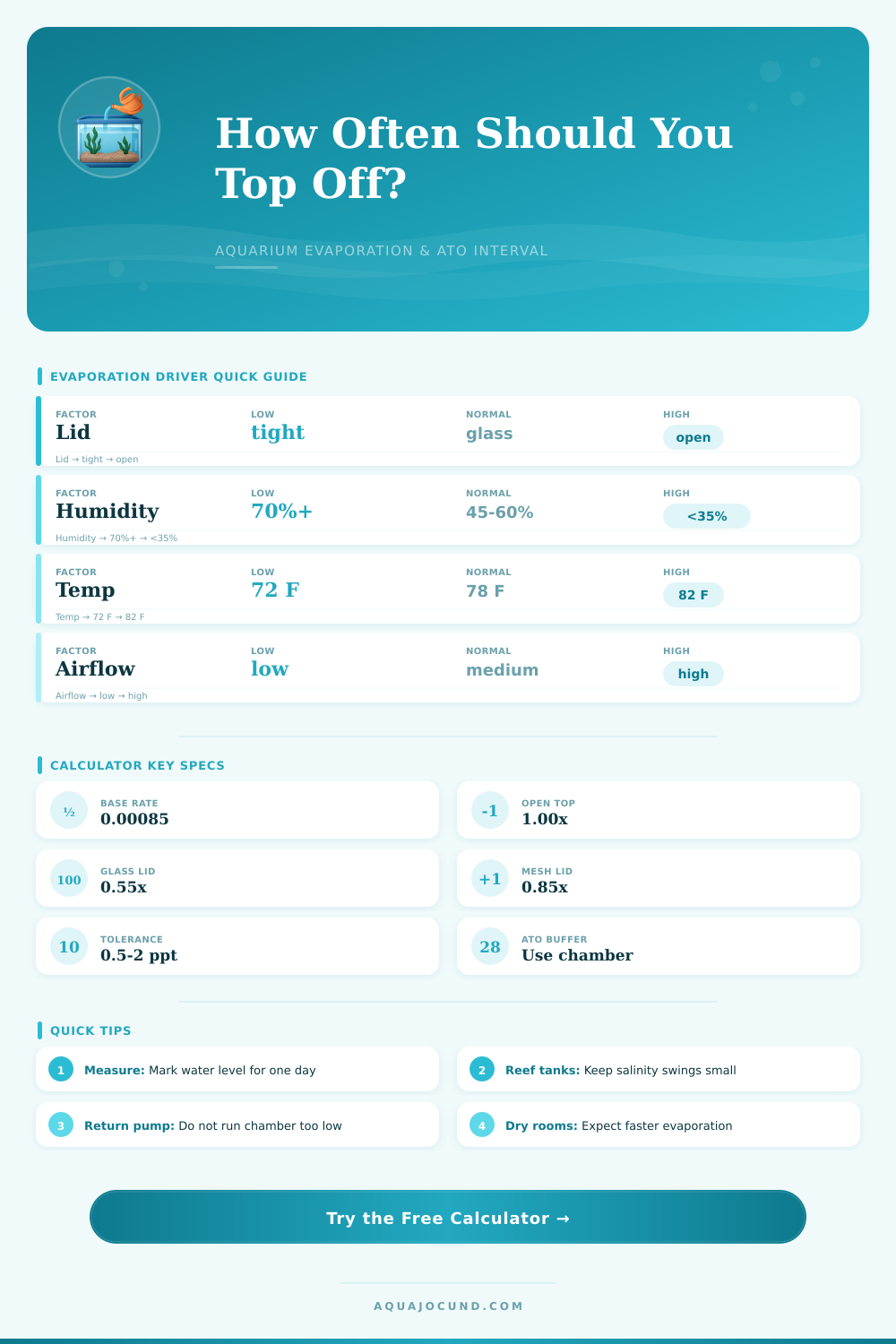
In cases in which the aquarium is of a round shape, the user will have to enter the diameter of the tank into the aquarium evaporation calculator. Furthermore, the user will also have to enter the dimensions of the sump into the calculation to account for the type of lid used on the aquarium, the humidity of the room in which the aquarium is located, the temperature of the water within the aquarium, and any airflow within the tank. The type of lid placed onto the aquarium can also influence the rate of aquarium evaporation.
For instance, if the lid is made of glass, then the aquarium evaporation will be reduced; glass lids can reduce the exchange of water from the aquarium to the air by half. Alternatively, fans that are placed into the aquarium to cool the water will increase the rate at which the aquarium evaporates; the moving air from such a fan will move the evaporation of the aquariums water above the baseline rate of aquarium evaporation for an open top aquarium. Another factor in the evaporation of aquarium water is the concept of salinity drift.
Due to the evaporation of water from the aquarium, the remaining water contains an increased amount of salt. This increase in the salt concentration within the aquarium is referred to as salinity drift. Fish-only aquarium systems are generally able to tolerate a salinity drift of one part-per-thousand.
However, salinity drift of only half of that amount often stresses SPS corals. By entering these parameters for the type of fish and organisms that live within the aquarium, the aquarium evaporation calculator can determine the length of time that will pass before the salinity drift reaches a level that is problematic for those inhabitant of the aquarium. Another constraint on the aquarium evaporation calculator is the volume of the return chamber.
If the level of water in the sump tank drop too low, the return pump may dry up or the low-water safety switch may be triggered. By measuring the footprint of the return chamber and the distance that the water level in the sump may drop before the return pump begins to be affect by the drop in water level, it is possible to calculate how much buffer the return pump has. Furthermore, the dropdown menu for the safety margin for the return pump allows for the aquarium owner to set aside some of this buffer for situations like power outages or vacations from the care of the aquarium.
Finally, many aquarium owners will find that the rate of aquarium evaporation of their specific aquarium will differ from the rate that is estimated by the calculator. There are various factors within the aquarium that may impact the rate of aquarium evaporation; skimmer air draw, overflow noise, and water movement from HVAC vents within the room are just a few variable that may impact the rate of aquarium evaporation. However, these variables are not accounted for within the initial calculation.
An override for the calculation will allow the aquarium owner to enter a single day’s measurement of the rate of aquarium evaporation. By entering a single measurement for the rate, the tool will eventually calculate an evaporation rate in units of time that will stay the same; once this time interval is establish, there is no need to re-test the rate of aquarium evaporation for that particular aquarium. The main goal of creating an aquarium evaporation calculator is to create a schedule for how often the owner of the aquarium should add freshwater to protect the chemistry of the water in that tank and the equipment within the aquarium.
For instance, the schedule might indicate that a mixed reef aquarium that has a moderate lid and average humidity within the room may require the addition of freshwater every thirty-six hours. In contrast, the same calculator may indicate that an open-top SPS aquarium in a dry room with high airflow may require the addition of freshwater every twelve hour. By considering the three constraints on aquarium evaporation, it is possible to establish a schedule for how often freshwater should be added to the aquarium.
It is essential, however, to use the longest interval of time between the requirements of each of the three constraint to ensure that the parameters of the aquarium and the inhabitants within it remain within healthy limits.