💧 Aquarium TDS Target Calculator
Plan aquarium TDS targets from livestock range, tap water, RO water, blend ratio, water change volume, and remineralizer strength.
| Livestock Profile | Low TDS | Common Target | High TDS | Planning Note |
|---|---|---|---|---|
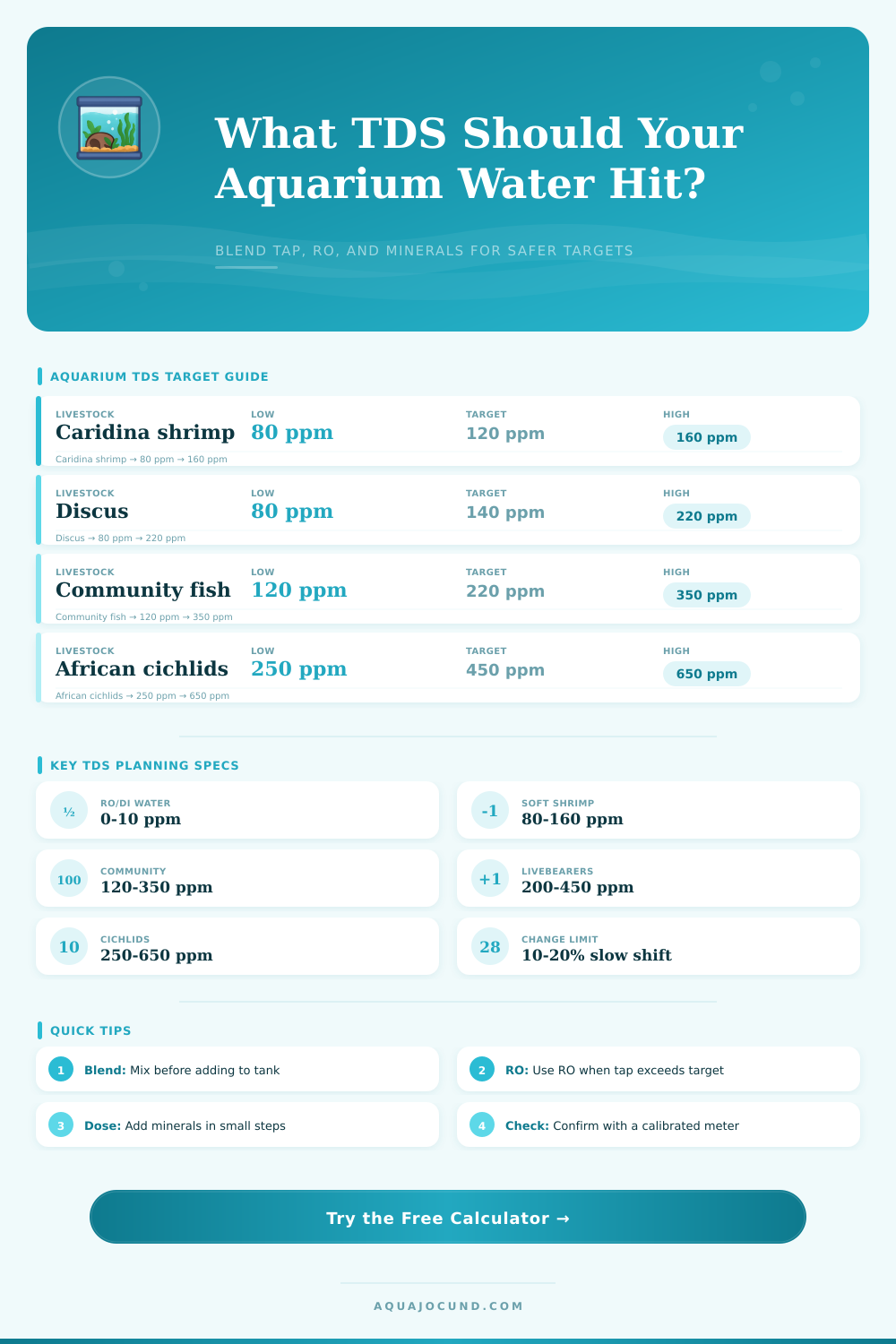
| Caridina shrimp | 80 ppm | 120 ppm | 160 ppm | Use RO plus GH-only mineral for most bee shrimp setups. |
| Neocaridina shrimp | 120 ppm | 180 ppm | 250 ppm | Stable GH and KH usually matter more than chasing one number. |
| Discus | 80 ppm | 140 ppm | 220 ppm | Keep changes gradual when lowering from harder source water. |
| General community | 120 ppm | 220 ppm | 350 ppm | A broad practical range for many tank-bred community fish. |
| Livebearers | 200 ppm | 320 ppm | 450 ppm | Mineral-rich water supports hard-water species. |
| African rift cichlids | 250 ppm | 450 ppm | 650 ppm | Pair TDS planning with KH and pH testing. |
| Mineral Type | Estimated TDS Rise | Typical Use | Profile Bias |
|---|---|---|---|
| GH-only shrimp mineral | 36 ppm per g / 10 gal | Caridina and soft shrimp tanks | Raises GH more than KH |
| GH/KH shrimp mineral | 42 ppm per g / 10 gal | Neocaridina and stable nano tanks | Raises GH and KH together |
| Planted all-in-one mineral | 30 ppm per g / 10 gal | RO water for planted aquariums | Balanced Ca, Mg, K, and traces |
| General aquarium mineral salt | 38 ppm per g / 10 gal | Community aquariums and mixed tanks | Broad mineral addition |
| Carbonate buffer / KH raiser | 55 ppm per g / 10 gal | Raising alkalinity and stability | KH-weighted TDS rise |
| Rift lake mineral blend | 60 ppm per g / 10 gal | Malawi, Tanganyika, Victoria setups | Hard alkaline profile |
| Trace mineral booster | 18 ppm per g / 10 gal | Small correction after RO blending | Light TDS contribution |
| Tap TDS | RO TDS | RO Portion | Blend TDS Before Minerals |
|---|---|---|---|
| 300 ppm | 5 ppm | 25% | 226 ppm |
| 300 ppm | 5 ppm | 50% | 153 ppm |
| 300 ppm | 5 ppm | 75% | 79 ppm |
| 450 ppm | 8 ppm | 60% | 185 ppm |
| 180 ppm | 4 ppm | 40% | 110 ppm |
| Tank | Dimensions | 25% Change | Use Case |
|---|---|---|---|
| 10 gallon | 20 x 10 x 12 in / 51 x 25 x 30 cm | 2.5 gal / 9.5 L | Shrimp and nano target mixing |
| 20 long | 30 x 12 x 12 in / 76 x 30 x 30 cm | 5 gal / 19 L | Soft community or shrimp colony |
| 29 gallon | 30 x 12 x 18 in / 76 x 30 x 46 cm | 7.3 gal / 27 L | Community blend correction |
| 55 gallon | 48 x 13 x 21 in / 122 x 33 x 53 cm | 13.8 gal / 52 L | Discus or planted water prep |
| 75 gallon | 48 x 18 x 21 in / 122 x 46 x 53 cm | 18.8 gal / 71 L | Planted or community RO blend |
| 125 gallon | 72 x 18 x 21 in / 183 x 46 x 53 cm | 31.3 gal / 118 L | Large hard-water or gradual correction |
To manages the water chemistry of your aquarium, you must find the right level of dissolved solids based off the needs of the livestock in the tank, and you must make sure that any change to the water chemistry of the tank are gradual so that your livestock dont experience stress. One of the measurements of water chemistry is the Total Dissolved Solids (TDS) of the water, which measure the amount of dissolved material in the water but does not indicate the type of dissolved material in the water. Each of the different types of livestock may require different level of TDS in there water due to the differences in the way each species of livestock process minerals in the water.
For instance, shrimp prefers water with a low level of TDS (like those found in soft streams) while cichlids require water with a more higher level of TDS (like that found in rift lakes). Most community fish species, however, require a level of TDS that is in the middle of those two extremes. By setting a target for the TDS levels in the tank based upon the needs of the livestock, you can prevent breeding, coloration, and health problem in your aquarium.
How to Manage TDS in Your Fish Tank
You can use a calculator to determine the TDS targets for your aquarium by entering the TDS levels of your tap water, the TDS levels of your source water, and the amount of water that you would like to changing in your aquarium. Because tap water is rarely at an ideal TDS level required for the livestock that live in the tank, it is common to mix tap water with water that has been treated with reverse osmosis (RO) to reach the target TDS level. RO water is nearly pure water, while tap water contain more dissolved solids.
The difference between the TDS levels of the tap and RO water can determine the ratio of tap to RO water that you use. For instance, if the TDS of tap water is three hundred parts per million (ppm) and the TDS of RO water is less than ten ppm, using a fifty-fifty mix of these two water types will reach the target TDS level for most community aquarium fish. In the calculator, you can determine in what percentages of tap and RO water you should mix to reach your target TDS level.
Since RO water contain too many minerals for the fish in the aquarium, the RO water is mixed with a remineralizer to provide the water with some of the minerals necessary for the health of the livestock. Different types of remineralizer will increase the TDS of the water at different rates. To determine the amount of remineralizer needed to reach the target TDS level of the tank, the calculator will tell you the amount of remineralizer to add to the RO water to reach the TDS level needed for the livestock in the aquarium.
The amount indicated on the calculator is important to follow, as adding too much remineralizer to the RO water can result in the TDS level of the water exceeding the target TDS level. Performing water changes in the aquarium can impact the TDS level in the tank. The TDS level may shock the livestock if the new water has a significantly different TDS level than the aquarium water.
The safety setting in the TDS calculator can help you to determine the level of change in TDS that you allow your water to change during a single water change. For example, changing fifteen or twenty percent of the water in the aquarium at one time is likely to be comfortabley for the livestock. By changing only fifteen or twenty percent of the water in the aquarium during a single process, you allow the TDS level in the tank to slowly change over several weeks to reach your target level.
The TDS level of the aquarium water changes over time for several reasons. For instance, the TDS level increase with evaporation, decreases if the aquarium features water plants (which remove some of the minerals from the water), or decreases again if the filter media in the aquarium removes some of the minerals from the water. Because the TDS level in the aquarium may change due to these factors, it is necessary to use a calibrated meter to test the water for TDS levels, as well as to perform tests for the GH and KH levels in the aquarium.
Rather than aiming to hit a certain TDS level in the aquarium at one point in time, the goal is to create a process that maintain that TDS level in the aquarium. By planning the TDS levels in your aquarium in advance, you can remove the guesswork of creating the proper blend of water. If you know the TDS of your water blend, how much remineralizer your water needs, and how much change in TDS is permitted during a water change, you will save time that might otherwise be spent dealing with the TDS level of the water in your aquarium.
Thus, using the calculations and guidelines described can allow you to spend more time watching your livestock. You’re going to recieve a lot more benefit from this method than if you dont use it.