
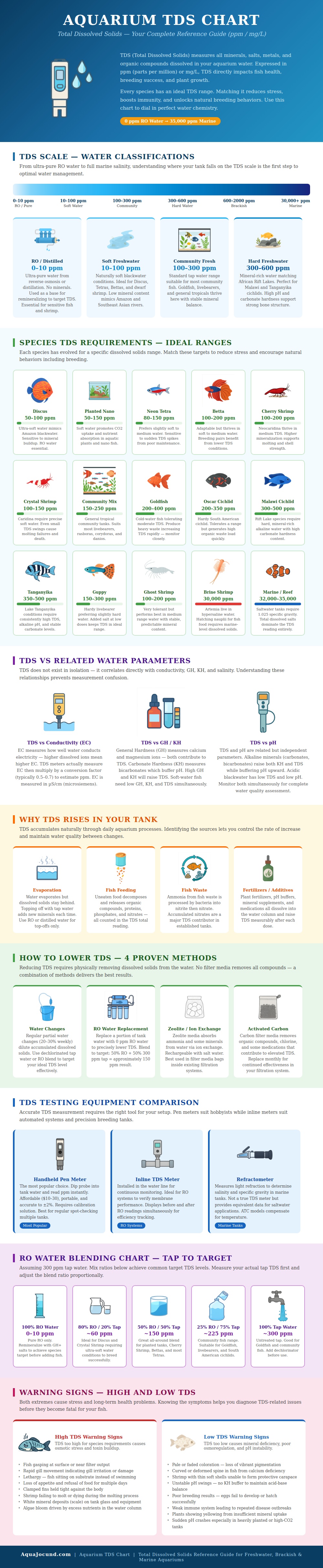
Total Dissolved Solids (TDS) refer to the total amount of dissolved substance in the water within the aquarium. The dissolved substances may include mineral, salts, and various organic compound. TDS levels are measured in parts per million (ppm).
TDS levels is important for managing the health of the fish within the aquarium, as each species of fish require a specific level of TDS to thrive. Should the level of TDS within the aquarium be too high or too low for the fish species that live within that tank, the fish may experience osmotic stress. Osmotic stress occur when the fish must perform osmoregulation to balance the amount of salts within there bodies to those within the aquarium water, but the TDS levels in the aquarium are not equal to the natural environment of those fish species.
What Is TDS in Aquarium Water and How to Manage It
Each species of fish may require a different level of TDS levels within the aquarium. For instance, fish that is native to areas with soft water and blackwater rivers require lower levels of TDS to thrive, while fish like cichlids require higher levels of TDS. Providing too low of a TDS level to a cichlid may lead to the fish developing poor bone development.
Providing too high of a TDS level for a species native to soft water may lead to those fish developing gill irritation. Due to the necessity of each species of fish to contain a certin level of TDS within their aquarium water, each aquarium cannot use the same water profile for each tank. TDS levels are related to other water parameter within the aquarium.
For instance, as the TDS levels increase within the water, the water’s conductivity will increase, as the dissolved ion in the water will allow for the water to conduct electricity. Thus, electrical conductivity is often used as an estimation tool to determine the ppm of TDS within the water. Similarly, the amount of calcium and magnesium within the water, both of which are components of TDS, cause general hardness level.
Lastly, carbonate hardness level help to buffer the pH of the water, yet the pH and TDS levels are separate measurement of the water. TDS and pH levels should be monitored within the aquarium to ensure that the health of the water are maintained. The TDS levels in the aquarium may increase over time due to a few different process within the aquarium.
For instance, the water in the aquarium evaporate over time, yet the minerals remain within the aquarium; thus increasing the TDS levels. Additionally, adding tap water to replace the evaporated water from the tank will increase the TDS levels of the aquarium water. Overfeeding the fish increase the amount of organic matter within the aquarium water, which contribute to the TDS.
Additionally, the waste from the fish also contribute to increased TDS levels within the tank. Finally, the use of fertilizers and medications for the fish also contribute to increased TDS levels. The aquarium manager may manage the TDS levels within the aquarium by change the water in the aquarium regularly.
As the water in the aquarium is changed, the TDS levels will decrease. The TDS level that is desired for the aquarium may be obtained by blending reverse osmosis (RO) water with tap water. RO water contain very low level of TDS, and adding tap water to RO water allow for the desired TDS to be achieved.
Additionally, other water treatments that contains ion exchange media or activated carbon can be used to manage the components of TDS in the aquarium. There are a variety of tool that may be used to measure the TDS in the aquarium. For instance, a handheld TDS meter can be used to measure the TDS in parts per million (ppm).
These tools is simple to use by the person managing the aquarium. Additionally, the person managing the aquarium should calibrate these TDS meters regular to ensure that the TDS levels are accurately measured. For instance, if the fish observe symptoms of high TDS, such as lethargy, gasping for air, or failed molting in shrimp, the TDS may be too high.
Low TDS levels may present symptoms in the fish such as pale color or spinal deformities. By monitoring the TDS in the aquarium, problem can be identified before the fish die.
