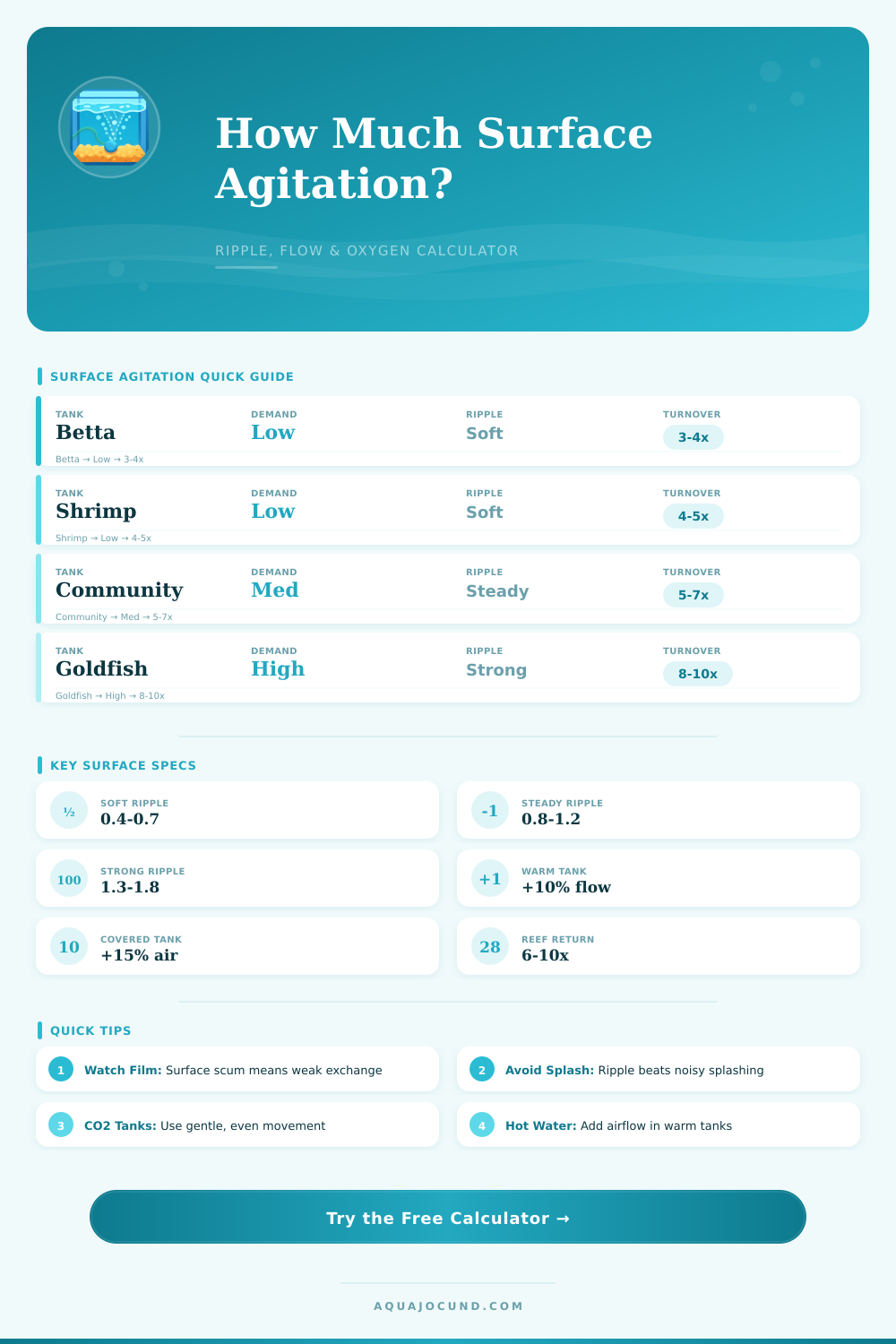
Aquarium Surface Agitation Calculator
Estimate ripple strength, return flow, oxygen exchange, and livestock demand from tank size, outlet style, temperature, and surface coverage.
📏Tank Size & Surface Inputs
⚙Outlet & Agitation Comparison
Gentle Lift
Surface Break
Wide Ripple
CO2 Friendly
Film Control
Directional Flow
Even Exchange
Use Sparingly
🐟Livestock Demand Table
| Demand Group | Typical Tanks | Target Turnover | Ripple Target | Exchange Notes |
|---|---|---|---|---|
| Low | Betta, shrimp, fry, light bioload | 3 to 4x | 0.45 to 0.75 | Keep surface moving without pushing weak swimmers. |
| Medium | Tetras, rasboras, livebearers, community fish | 5 to 7x | 0.80 to 1.20 | Steady whole-surface ripple is usually enough. |
| High | Goldfish, cichlids, crowded grow-out tanks | 8 to 10x | 1.25 to 1.70 | Use wide returns or air backup in warm weather. |
| Reef | Marine fish, coral, sump returns, wavemakers | 6 to 10x return | 1.20 to 1.80 | Surface exchange supports pH and oxygen stability. |
💧Common Tank Surface Targets
| Tank Size | Typical Dimensions | Surface Area | Community Flow | High Demand Flow |
|---|---|---|---|---|
| 5 gal | 16 x 8 x 10 in | 128 sq in | 25 to 35 GPH | 40 to 50 GPH |
| 10 gal | 20 x 10 x 12 in | 200 sq in | 50 to 70 GPH | 80 to 100 GPH |
| 20 long | 30 x 12 x 12 in | 360 sq in | 100 to 140 GPH | 160 to 200 GPH |
| 40 breeder | 36 x 18 x 17 in | 648 sq in | 220 to 280 GPH | 320 to 420 GPH |
| 75 gal | 48 x 18 x 21 in | 864 sq in | 375 to 525 GPH | 600 to 750 GPH |
| 125 gal | 72 x 18 x 22 in | 1296 sq in | 625 to 875 GPH | 1000 to 1250 GPH |
🌡Temperature, Cover & CO2 Adjustments
| Condition | Adjustment | Why It Matters | Practical Target |
|---|---|---|---|
| Warm water above 80 degF | +8% to +18% | Warm water holds less dissolved oxygen. | Add surface motion or air lift. |
| Glass lid or floating plants | +5% to +25% | Less open surface slows gas exchange. | Keep a clear moving patch. |
| Injected CO2 aquascape | -10% ripple cap | Too much agitation drives off CO2 fast. | Use even, low splash flow. |
| Saltwater or reef tank | +8% to +15% | Saltwater carries slightly less oxygen. | Aim returns at surface film. |
🌊Agitation Level Reference
| Visible Surface | Ripple Index | Best For | Risk If Overdone |
|---|---|---|---|
| Barely moving | 0.20 to 0.40 | Short term quarantine with air backup | Surface film and low oxygen |
| Soft continuous ripple | 0.45 to 0.75 | Betta, shrimp, CO2 planted tanks | Can be low for heavy bioloads |
| Steady ripple across surface | 0.80 to 1.20 | Most freshwater community tanks | Usually minimal |
| Strong rolling ripple | 1.25 to 1.80 | Goldfish, cichlids, reef returns | May stress slow swimmers |
| Splashing or breaking water | 1.80+ | Emergency aeration or degassing | Noise, salt creep, CO2 loss |
💡Calculation Tips
While you pay attention to pump flow rates and filtration media, you overlook the air above the water. Oxygen gets into the tank there; carbon dioxide leaves via that surface layer. And it’s still the most overlooked parameter in aquarium keeping.
Fish may be gasping for breath if the surface look calm because they’re trying to breathe stagnant air beneath a film of waste. Knowing how to control that interface distinguishes hobbyists with clear water from hobbyists with healthy ecosystems.
Why Air Matters in Your Tank
The calculator above handle the complex math of surface area, temperature, and livestock demand so you can focus on setup rather than spreadsheets. Your custom tank dimensions is plugged in along with factors like injected carbon dioxide or lid coverage; which both change the gas exchange rate.
For example, you might think that double-pumping equals double-oxygenating, but it’s simply not how the physics work. Pumping hard creates an even stronger current, but it does not necessarily create more surface disruption. That’s where the tool come into play: distinguishing real ripple strength from raw turnover, so it prevents wasted electricity via movement that doesn’t break surface tension.
More so than the tank size, your base needs depends on the livestock you keep. A five gallon fish tank housing a betta requires gentle agitation to disperse waste before it builds up into an ammonia problem, but not too much that a weak swimmer can’t recover. A 40g goldfish tank require strong turnover because of the large amount of waste. These needs are spelled out in the reference table which shows how soft ripples work for low demand setups (e.g., shrimp tanks) while high activity species requires steady rolling waves.
Moving lots of water isn’t as important as moving enough water to constantly refresh all the surface area. You can have hundreds of GPH with one nozzle breaking the surface tension in just half your tank, this leaves the other half stagnant, no matter what the total GPH is.
Then there’s temperature, which is too complicated for most newbies. Dissolved oxygen decreases with warm water. Cold water has far more than warm. An otherwise good set-up in the summer months during a heat wave could become deadly. This is because lower dissolved oxygen levels increases the risk of suffocation. Higher temps reduce the thermal margin so the calculator include this when recommending flow rates.
If you’re running saltwater you should be aware of two things: 1) Salinity reduces how much O2 your tank can hold compared to freshwater. You need a little more agitation to keep up with saturation levels. Because saltwater tanks holds less dissolved oxygen, they really do need slight tweaks like those mentioned above for long term success. It’s all about avoiding creeping, sneaky stress that shows itself as poor color or even just lackluster activity.
With planted tanks, there’s an inherent tradeoff: live plants produce oxygen during the day but consume it at night (as will your fish). They also respire CO2 out at night. So you must ensure sufficient surface agitation to blow off any extra carbon dioxide while they are making food from light. If you have too much splash, it can drive out the oxygen that your plants want to keep. The tool controls ripple targets if you choose heavy planting and/or CO2 injection options.
If you want violence, you don’t want wave action so much as gentle, even movement; it’s a matter of both preserving chemistry and supporting life. No matter what devices tell you, observe daily! You’ll notice when some fish is gasping at the topside corners and when the greasy surface film develops on one side. Turn it up! Or, turn it down when little fry are fighting the current and/or substrate washes into filters. Using both is a good start but observing improves the outcome.
That narrow margin between water and air is the beginning of good water quality. Every day respecting that interface pays off in health and clarity benefits. Break up the surface, keep the oxygen high, and let your livestock thrive without guessing.