Aquarium Stocking Percentage Calculator
Estimate fish load as a percentage of practical capacity using volume, footprint, adult size, biomass, behavior, filtration, oxygen, and maintenance.
⚙Unit system
📏Tank and livestock inputs
📊Stocking reference metrics
🐟Species and activity comparison grid
| Activity class | Load multiplier | Typical examples | Space pressure | Best margin |
|---|---|---|---|---|
| Micro peaceful schoolers | 0.75x | Chili rasboras, ember tetras | Low if grouped | 20-30% |
| Slim community fish | 1.00x | Neons, guppies, small rasboras | Moderate | 20-30% |
| Moderate active community | 1.20x | Platies, danios, larger tetras | Moderate-high | 25-35% |
| Fast river or open-water fish | 1.45x | Hillstream setups, rainbowfish | High swimming lane need | 30-40% |
| Deep-bodied or bulky fish | 1.65x | Angelfish, gourami, silver dollars | Body mass and height | 30-45% |
| Territorial cichlid style | 1.85x | Dwarf cichlids, mbuna, pairs | Territory and sight breaks | 35-50% |
| Goldfish or heavy waste fish | 2.40x | Fancy goldfish, messy omnivores | Waste and oxygen heavy | 40-55% |
| Marine reef fish | 1.55x | Clowns, gobies, wrasses | Territory plus oxygen | 35-50% |
📘Stocking percentage bands
| Result band | Percent used | Interpretation | Usual response |
|---|---|---|---|
| Very light | 0-40% | Large reserve for growth and behavior | Normal feeding and weekly checks |
| Light | 41-55% | Easy-going stock level | Good for new aquarists or delicate species |
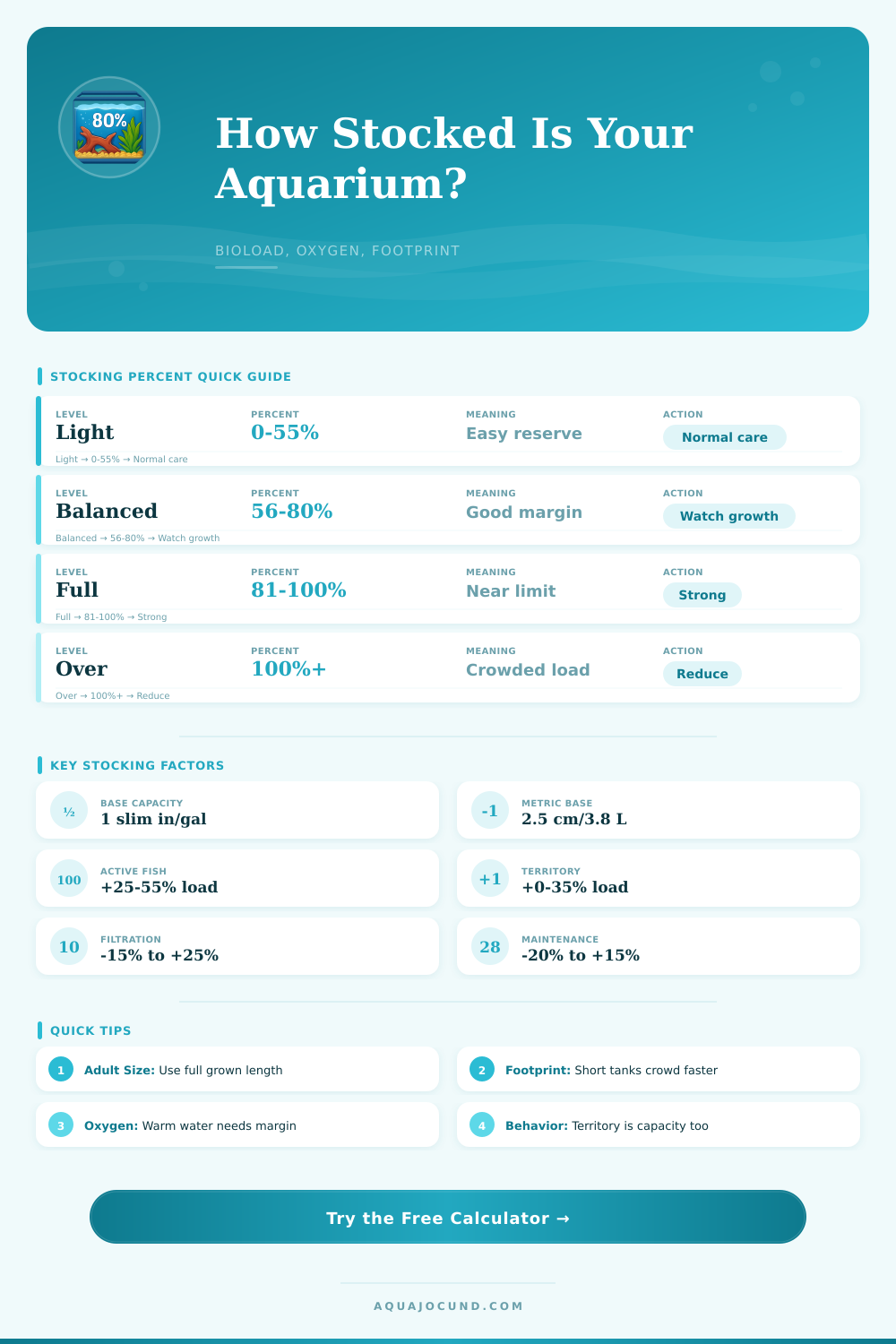
| Balanced | 56-80% | Comfortable if tank is mature | Keep routine stable and measure nitrate trend |
| Full | 81-100% | Near practical limit | Upgrade filtration, aeration, or water-change rhythm |
| Overstocked | 101-125% | Capacity is being exceeded | Reduce fish load or increase tank volume |
| Severely overstocked | 126%+ | Low margin for oxygen, aggression, or missed care | Rehome, split, or upgrade promptly |
📏Common tank size comparison
| Tank | Typical footprint | Volume | Slim-fish capacity at 80% | Notes |
|---|---|---|---|---|
| 10 gallon | 20 x 10 in / 51 x 25 cm | 10 gal / 38 L | About 8 adult inches | Nano margin matters |
| 20 long | 30 x 12 in / 76 x 30 cm | 20 gal / 76 L | About 16 adult inches | Better footprint than a tall tank |
| 29 gallon | 30 x 12 in / 76 x 30 cm | 29 gal / 110 L | About 23 adult inches | Volume helps, footprint still finite |
| 40 breeder | 36 x 18 in / 91 x 46 cm | 40 gal / 151 L | About 32 adult inches | Excellent territory layout |
| 55 gallon | 48 x 13 in / 122 x 33 cm | 55 gal / 208 L | About 44 adult inches | Long swimming lane |
| 75 gallon | 48 x 18 in / 122 x 46 cm | 75 gal / 284 L | About 60 adult inches | More width for behavior |
| 125 gallon | 72 x 18 in / 183 x 46 cm | 125 gal / 473 L | About 100 adult inches | Large schools and zones |
🔧Support factor reference
| Support factor | Low setting | Standard setting | Strong setting | Capacity effect |
|---|---|---|---|---|
| Filtration | Light sponge or small internal | Mature matched filter | Oversized canister, sump, or dense plants | 0.85x to 1.25x |
| Oxygen | Still surface | Visible ripple | Strong aeration and turnover | 0.88x to 1.18x |
| Maintenance | Every 3-4 weeks | Weekly changes | Twice weekly or automatic export | 0.80x to 1.15x |
| Temperature | Cool water holds more oxygen | Tropical baseline | Warm water lowers oxygen reserve | 0.88x to 1.08x |
| Territory | Schooling fish | Display space needed | Aggressive territorial species | Adds 0-35% load |
The scenario plays out frequently; you go to the store to get an aquarium. Then you fill it up with water and add some glass. Next thing you know, there you are in the fish section of the store holding bags full of fish. You is trying to determine how many you can add without destroying your ecosystem.
On every forum, you see the old 1″ of fish per gallon rule of thumb. Easy to recall. But this rule is dangerously incorrect for most actual aquariums as it take no account of behavior and biology. Stocking percentage are a better approach. It’s the amount of fish you have in relation to what your environment can handle.
Why Stocking Percentage Is Better Than The 1 Inch Rule
It moves away from a fixed number (inches) toward a moving ratio. You aren’t merely tracking a volume, but balancing both waste production and oxygen exchange at the same time. All you need to do is input your tank dimensions and fish profiles, and calculator does the rest. No need to guess which coefficient applies or worry about complicated calculations. Stocking percentage convert all those variables into one capacity-based metric that reflects reality.
The inputs aren’t as obvious as they appear. In particular, most folks put in their tank size but fail to consider the displacement. These include rocks, substrate, filters, and driftwood. These items takes up volume that is not available for water. So if you believe you have 30 gallons of water but there’s 20 lbs of gravel on the bottom, then you’re operating at a greater density than the label indicates.
Instead, folks use the external dimensions to make calculations based off the internal volume. After all, it’s the only part of the system that holds life! Another issue with foot print is that two identical volumes can have very different shapes (e.g., a long and skinny vs. A wide and shallow). Less surface area mean you have fewer square inches/meters where oxygen can get into the water. Fewer square inches/meters also means fewer square feet/feet of floor area to set up territorial boundaries.
Vertical height is not the only consideration for fish, they want to swim around too. If you have active fish like danios or rainbowfish, then a short aquarium lacking horizontal space will be stressful very fast. Literally, they runs out of runway. There are spatial requirements based off different activity classes. What works for a single mbuna cichlid pair doesn’t work the same way as what’s required for a school of micro rasboras. The table on the page outline those considerations.
Your stock levels should of reflect those demands. But also consider biomass. Ten small tetras may add up to the same total length as a large angelfish but the latter will generate much greater waste. So the calculator use both estimated length and weight to calculate the bioload score. Also it factors in maintenance habits and filtration strength (a neglected tank can’t support as much bioload as a well maintained one). Remember that clean water isn’t just good looking; it’s a matter of chemical balance.
All of this involves temperature too, although it’s something that hides behind the scenes. Dissolved oxygen is reduced in warm water compared to cold water. When you house your tropical fish at warm temperatures, you’re losing some of your safety margin by default. This thermal stress are accounted for in the tool and helps you avoid accidentally overcrowding in the summer months. It’s a small variable, but when the margins are thin, it matters.
You’re not trying to max out every gallon. You want some wiggle room. You want the ability to allow for growth and error. You want to create a balanced tank. If you end up somewhere within those two categories (balanced and light), you’ve created a resilient system. This provides reserve capacity. That provides breathing room, because maybe a fish becomes sick, or maybe one of your plants grows much more quicky than anticipated.
While overstocking may appear impressive on paper, it makes your system weak and prone to breakage upon pressure. This will change the way you stock and decorate your tank because you begin to think of your tank as a living machine. Instead of wondering whether or not the fish will fit, you wonder if the system can support them.
Your observations provides the truth while the math provides the boundaries. Observe behavior and water quality. They’ll be the final judges of your design. Take what you’ve got; not what you wish you had. Accept the footprint. And spare some open area. A well-breathing tank is far prettier than a full-to-the-brim one. When it’s balanced again (the wonder returns).