Aquarium Stocking by Surface Area Calculator
Estimate stocking capacity from tank footprint, oxygen exchange, adult fish size, body demand, filtration, and water-change margin.
📌Quick Presets
📐Tank Footprint
🐟Fish Demand and Maintenance Margin
Surface Area Stocking Result
⚖Species Surface-Demand Comparison
📊Demand Multipliers Table
| Demand Type | Multiplier | Best Used For | Surface Effect |
|---|---|---|---|
| Micro / very slim | 0.75x | Tiny, narrow-bodied adults | More count per footprint |
| Slim schooling | 1.00x | Small tetras, rasboras, danio-shaped fish | Baseline surface rule |
| Medium body | 1.25x | Livebearer-shaped community fish | Needs extra surface reserve |
| Deep-bodied | 1.55x | Tall or disc-shaped fish | Lower count for same length |
| Bulky waste producer | 2.10x | Thick-bodied cichlid-like fish | Footprint becomes restrictive |
| Large coldwater | 2.60x | High oxygen and waste demand | Needs very large open surface |
🌊Surface Exchange Reference
| Surface Condition | Factor | Typical Signal | Stocking Meaning |
|---|---|---|---|
| Still surface / covered | 0.75x | Little visible movement | Lower surface oxygen capacity |
| Light ripple | 1.00x | Small shimmer across surface | Baseline capacity |
| Moderate ripple | 1.25x | Consistent broken reflection | Higher gas exchange |
| Vigorous ripple | 1.55x | Strong movement without splashing | Useful reserve for active fish |
| Air stone or spray bar | 1.75x | Surface churn plus circulation | Best exchange in this model |
📏Common Tank Footprints
| Tank Size | Footprint | Surface Area | Baseline Slim Fish Capacity |
|---|---|---|---|
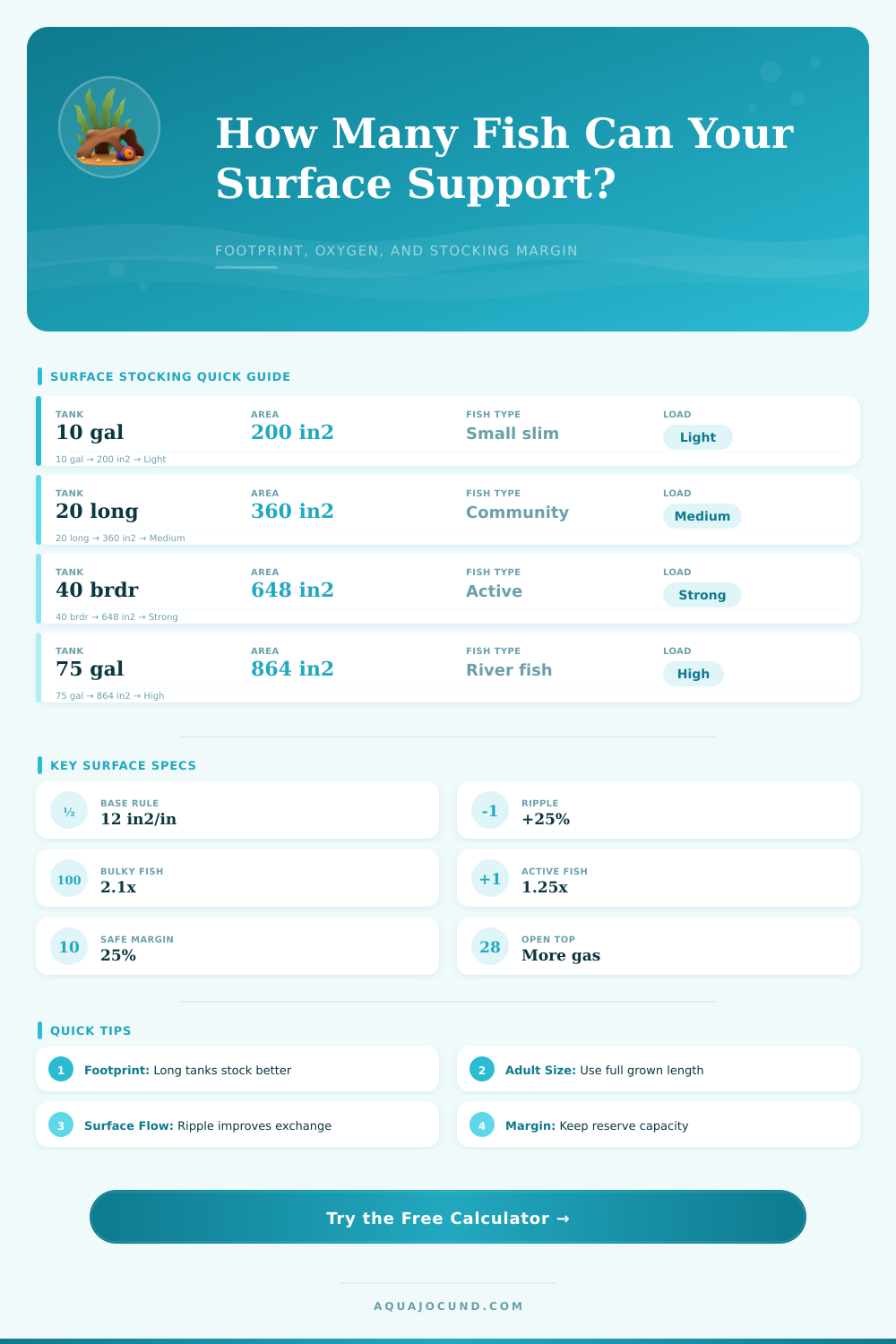
| 10 gallon | 20 in × 10 in / 51 cm × 25 cm | 200 sq in / 1290 sq cm | About 13 fish-inches with 25% margin |
| 20 high | 24 in × 12 in / 61 cm × 30 cm | 288 sq in / 1858 sq cm | About 19 fish-inches with 25% margin |
| 20 long | 30 in × 12 in / 76 cm × 30 cm | 360 sq in / 2323 sq cm | About 24 fish-inches with 25% margin |
| 40 breeder | 36 in × 18 in / 91 cm × 46 cm | 648 sq in / 4181 sq cm | About 43 fish-inches with 25% margin |
| 55 gallon | 48 in × 13 in / 122 cm × 33 cm | 624 sq in / 4026 sq cm | About 42 fish-inches with 25% margin |
| 75 gallon | 48 in × 18 in / 122 cm × 46 cm | 864 sq in / 5574 sq cm | About 58 fish-inches with 25% margin |
🔧Filtration and Water Change Adjustments
| Input | Range Used | Calculator Role | Limit |
|---|---|---|---|
| Filtration support | 1.00x to 1.22x | Adds modest biological stability | Does not replace open surface |
| Weekly water change | 0% to 90% | Adds up to 18% support | Cannot remove oxygen limit |
| Open surface | 20% to 100% | Reduces area blocked by covers or plants | Directly changes capacity |
| Safety margin | 0% to 80% | Holds reserve before full stocking | Higher margin lowers count |
Forget about gallons and “gallons per inch.” That’s a broken rule of thumb where you measure your tank size and then divide it by some number to calculate fish inches. Oxygen content in your tank isn’t related to amount of water but rather how much open water surface area there is (where the water trades gas with the atmosphere). A tall, narrow column of water has the same capacity for breathable life as a shallow pan of the same width, even if the column hold twice the liquid.
That shift in thinking will impact how you design your community. Because of this, the calculator will weight the footprint more heavily then the height. You can add much more surface area to get oxygen into the water and carbon dioxide out of the water by increasing the footprint (length x width) rather than just adding more height. Why? Because even though both tanks hold the same amount of water, a 20 gallon long tank can hold more fish than a 20 gallon high tank. More surface area mean more oxygen and more CO2 release.
Why Surface Area Matters More Than Tank Size
This is a little bit of geometry, but it explains why you shouldn’t look past the surface area when deciding on number of fish. You’ll avoid an ammonia crash from those who don’t care about surface. Body shape is another factor that the tool consider, as well as the level of activity (metabolism) of your fish. Deep-bodied angelfish of equal length displace much more water. They also typically have higher metabolisms than slim tetra species, which create less bioload per inch. These realities are reflected in multipliers used by the calculator.
In other words, you can’t simply look at a tank and say “I have enough room in there for X number of large cichlids,” then go and stock it with ten big guys. Think about demand, not just physical space. Consider waste production rate of the fish. Goldfish produce a lot of waste and need a much larger surface area. This is because each fish produces more ammonia that must be quickly processed and released.
The surface area isn’t an alternative for filtration. A strong filter can removes nitrates. However, a well-planted tank with a tight lid won’t allow enough airflow. This cause low dissolved oxygen even with a good filter. You can compensate for this in the calculator by entering lower values for the effective capacity because the plants inhibit direct contact between water and air. That’s why most aquarists leave space in the middle of the tank where ripples are created so that there is maximum exchange.
Also take into account the buffer (margin) you leave in your plans. If you plan for 25% of your capacity to remain unfilled, it is a buffer against an unexpected increase in population (e.g., from spawning tetra). It is also a buffer against equipment failure. Better to have a tank with 25% of its capacity unused but running like a dream than a tank that’s packed and needs constant intervention.
The tables on the page shows what I mean by this, illustrating how various conditions at the surface will impact these figures. Strong ripple caused by an air stone can greatly increase your capacity compared to a still, covered surface. So what makes a successful stock? It is not so much about gallons as it is about understanding the physics of gas exchange. The surface is what keeps fish alive… not the water holding them in.
The key is creating a stable environment that keeps fish from overextending. It must allow them to grow while focusing on surface area and accounting for type of fish and maintenance practices. Your system will then be one that breathes and does so successfuly.