🐟 Aquarium Stand Weight Load Calculator
Total the operating load on an aquarium stand, including water, tank shell, substrate, rock, equipment, safety factor, leg load, and floor pressure.
| Stand material | Typical total rating | Moisture tolerance | Load behavior | Best check |
|---|---|---|---|---|
| 2x4 lumber frame | 900-2000 lb | Good if sealed | Strong in vertical compression | Check joint shear and racking |
| Plywood cabinet box | 700-1600 lb | Good with sealed edges | Spreads load through panels | Check continuous top support |
| Welded steel tube | 1500-5000 lb | Needs corrosion coating | High strength, low deflection | Check welds, leveling feet |
| Aluminum extrusion | 900-3000 lb | Excellent | Modular, connection-limited | Check brackets and fasteners |
| Particleboard cabinet | 300-900 lb | Poor if wet | Can creep or swell at joints | Check water damage and sag |
| Custom stand rating | User entered | Depends on build | Use documented rating | Compare against design load |
| Aquarium | Typical dimensions | Water only | Loaded estimate | Floor pressure |
|---|---|---|---|---|
| 10 gallon | 20 x 10 x 12 in | 83 lb / 38 kg | 120-160 lb | 90-115 lb/sq ft |
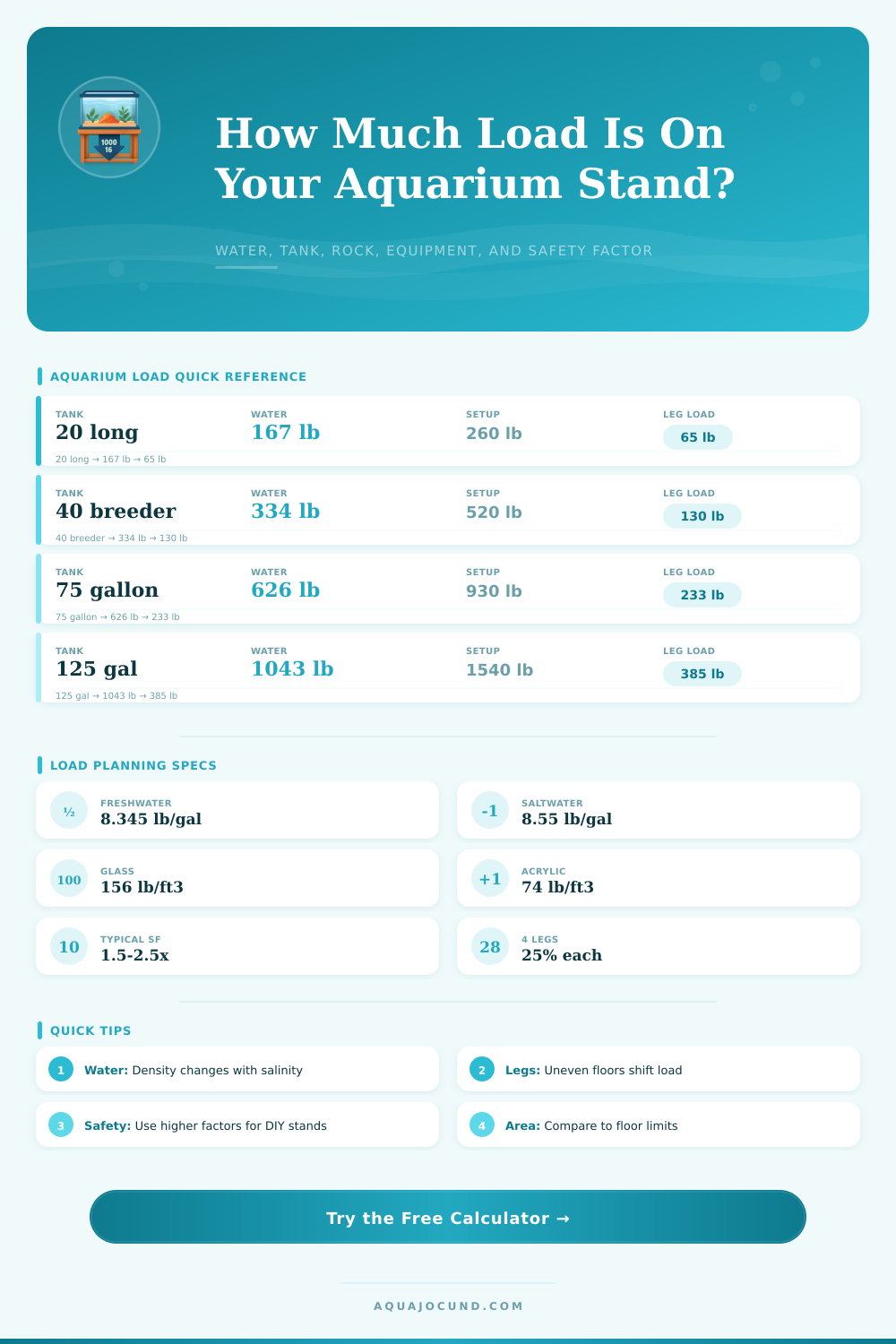
| 20 long | 30 x 12 x 12 in | 167 lb / 76 kg | 230-300 lb | 92-120 lb/sq ft |
| 40 breeder | 36 x 18 x 16 in | 334 lb / 151 kg | 450-620 lb | 100-138 lb/sq ft |
| 55 gallon | 48 x 13 x 21 in | 459 lb / 208 kg | 650-820 lb | 150-190 lb/sq ft |
| 75 gallon | 48 x 18 x 21 in | 626 lb / 284 kg | 850-1100 lb | 142-183 lb/sq ft |
| 90 gallon | 48 x 18 x 24 in | 751 lb / 341 kg | 1000-1300 lb | 167-217 lb/sq ft |
| 125 gallon | 72 x 18 x 22 in | 1043 lb / 473 kg | 1350-1750 lb | 150-194 lb/sq ft |
| 180 gallon | 72 x 24 x 24 in | 1502 lb / 681 kg | 1950-2600 lb | 163-217 lb/sq ft |
| Item to check | Formula used | Why it matters | Conservative setting |
|---|---|---|---|
| Operating load | All component weights added | Actual standing aquarium mass | Add sump water and equipment |
| Design load | Operating load x safety factor | Compares against stand rating | Use 2.0x for DIY builds |
| Leg load | Total load / legs plus bias | Finds worst bearing point | Use 15-30% imbalance |
| Floor pressure | Total load / contact area | Checks spread over flooring | Include stand self weight |
| Tank shell | Panel area x thickness x density | Glass weight can be large | Use manual weight if known |
Aquarium stand rarely fail due to a dramatic overload of weight placed upon the aquarium stand. However, aquarium stands usually fail because the person who intends to place the aquarium upon the stand underestimates the total weight of there entire aquarium. Aquarium setup include the weight of the water that will be contained within the aquarium, the weight of the rocks, substrate, and other décor for the tank, as well as the weight of the aquarium equipment.
Each of these factor must be considered in calculating the total weight of the aquarium setup. The weight of the water that will be contained within the aquarium can be calculated based off the salinity of the water that will be used within the aquarium. Water weighs 8.34 lbs per gallon when the water is freshwater, but marine water weigh 8.55 lbs per gallon.
Find Aquarium Weight and Check Stand Safety
The difference in weight between these two types of water is important to consider when calculating the total weight of the aquarium, as the differences in weight can become significant in the presence of a large number of gallons of water. For instance, 75 gallons of water contains more than 600 lbs of water. The weight of the water is simply one component of the total weight of the aquarium to be built.
In addition to the weight of the water, the weight of the aquarium itself will also contribute to the total weight of the aquarium. Aquariums made of glass will be heavier than those made of acrylic of the same size and strength. A calculator can help to account for the weight of the aquarium by allowing a user to select both the material of the aquarium as well as the thickness of the panel walls.
The calculator can use the dimensions of the aquarium to calculate the total area of the aquarium panels, and the weight of those panels. Additional component of the aquarium that contribute to the total weight of the aquarium include the substrate and the hardscape elements of the tank. For instance, a two inch layer of sand will add to the total weight of the aquarium, but a two inch layer of planted soil will add a different amount of weight to the aquarium because the planted soil is of a different density than sand.
Additionally, rocks and driftwood will also add to the total weight of the aquarium, but it is difficult to calculate the specific weight of those elements until the individual decide upon the items that will be used within the aquarium. It is important, however, for an individual to enter an honest estimate of the total weight of the substrate and hardscape elements of the aquarium. The weight of the aquarium and its components are not the only weight that must be considered when determining if the aquarium stand will be able to support the aquarium.
The weight of the equipment that will be used within the aquarium, such as sumps, reactors, or canister filters will add to the total weight of the aquarium. This weight of the equipment is constant, regardless of the amount of water that is contained within the display aquarium. An aquarium stand weight calculator will include a field for entering the weight of the aquarium equipment.
Beyond the total weight of the aquarium and its components, other considerations of the aquarium and its total weight include the safety factor for the aquarium stand. Aquarium stands are often rated by their manufacturer for the amount of weight that they are suppose to support while in operation. However, the manufacturer establishes the safety factor for the stand based upon ideal condition.
Factors such as the way in which the stand was built, the level of evenness of the flooring upon which the stand is placed, and the exposure of the aquarium stand to moisture can all contribute to a reduction in the actual weight that the aquarium stand can support. The safety factor field can be used within the weight calculator to establish a multiplier for the total weight of the aquarium, which will reveal the design load that the aquarium stand must support. This design load can be compared with the rating of the aquarium stand to determine if the stand will be safe with the placement of the aquarium.
In addition to the considerations of the total weight of the aquarium and its components, it is also important to consider the way in which that total weight is distributed. For instance, uneven flooring or a stand that is racking will cause the weight of the aquarium to be distributed upon one or two points of the stand. Considerations regarding this even distribution of the weight of the aquarium can be incorporated into the aquarium stand weight calculator, allowing an individual to determine the weight that will be placed upon the most highly stressed leg of the stand.
It is important for the stands safety to recognize the weight that is placed upon the highest stressed leg of the stand. Beyond considering the total weight of the aquarium and how that weight is distributed to the stand, it is also important to consider the pressure that the total weight of the aquarium will place upon the subfloor. The contact area between the stand and the subfloor will determine the amount of pressure that is placed upon the subfloor by the aquarium.
This consideration is important in that an individual can determine if additional blocking is necessary for the stand to distribute its weight to the subfloor, or what kind of stand is necessary to support the aquarium altogether. In general, the use of an aquarium stand weight calculator prior to the building of the aquarium is beneficial for the fact that any issues can be rectified at this initial stage in the building process. For instance, if the total weight of the aquarium is found to be too much to be supported by the aquarium stand, it may be possible to reduce the weight of the substrate that is to be used within the tank, or the weight of the rocks that are to be placed within that same aquarium.
It is easy to make these changes prior to the placement of the aquarium into the stand. However, if the stand is built and the aquarium is filled with water, it may be impossible to reinforce the stand. Even if an individual feel that the stand will be able to support the weight of the aquarium, it is impossible to know for certain, unless the calculations are performed in advance.
Furthermore, it is easy for an individual to make a decision based upon these calculations rather than upon the hope that the stand will be able to support the aquarium.