Aquarium Stand Paint Coverage Calculator
Estimate exposed stand area, primer, topcoat paint, waste allowance, and rounded container needs for a splash-ready finish.
Paint coverage estimate
| Finish type | Typical dry coverage | Useful coats | Aquarium stand fit |
|---|---|---|---|
| Water-based enamel | 320 to 380 sq ft per gal | 2 topcoats over primer | Good for cabinets, doors, and trim near freshwater tanks |
| Acrylic latex cabinet paint | 300 to 360 sq ft per gal | 2 to 3 thin coats | Easy touch-up for freshwater stands with moderate splash |
| Marine enamel | 280 to 340 sq ft per gal | 2 coats over bonding primer | Stronger choice for humid rooms and sump cabinets |
| Two-part epoxy coating | 220 to 300 sq ft per gal | 2 controlled coats | Best for high-splash interiors and saltwater sump bays |
| Polyurethane clear over stain | 400 to 500 sq ft per gal | 2 to 3 clear coats | Works for decorative wood if edges are sealed well |
| Spray acrylic enamel | 18 to 25 sq ft per aerosol can | 2 to 4 light passes | Useful for metal frames, brackets, and narrow rails |
| Stand size | Typical dimensions | Cabinet area | Paint plan |
|---|---|---|---|
| 10 gallon | 20 x 10 x 28 in | 18 to 26 sq ft | Usually 1 quart paint plus primer margin |
| 20 long | 30 x 12 x 30 in | 28 to 42 sq ft | One quart often covers 2 coats if panels are sealed |
| 40 breeder | 36 x 18 x 32 in | 44 to 62 sq ft | Plan a quart plus touch-up reserve |
| 55 gallon | 48 x 13 x 32 in | 52 to 72 sq ft | Two quarts are safer for doors and inside sealing |
| 75 gallon | 48 x 18 x 34 in | 66 to 90 sq ft | Use extra primer on bottom trim and sump bay edges |
| 125 gallon | 72 x 18 x 34 in | 92 to 130 sq ft | Expect gallon-size planning for multi-coat interiors |
| Condition or method | Coverage effect | Why it matters | Calculator factor |
|---|---|---|---|
| Bare plywood or MDF | Uses more primer | Edges and faces absorb the first coat quickly | Primer x 1.22 |
| Raw pine frame | Medium absorption | Open grain and 2x edges need full wetting | Primer x 1.14 |
| Old glossy finish | Needs bonding primer | Paint coverage may look fine but adhesion is the risk | Primer x 1.06 |
| Spray application | Higher overspray loss | Narrow rails and open backs waste more material | Loss + 18% |
| Sump splash bay | Needs reserve | Extra coating on bottom shelf and back corners helps | Area + 8% |
While it may be easy to concentrate on filtration and glass thickness, don’t forget about the stand. If you purchase a pre-built cabinet, it appear adequate from afar. Over time, water gets under the bottom shelf, damaging the wood due to humidity. Water stains form in the side of the stand and the finish begins to peel. All this doesn’t look any better then untreated wood.
Treat the wood. Why? To protect it. Applying a paint will not only make your stand look good but also increase its life. Ten year stands versus two year rotting stands is all about the surface treatment. Don’t skimp on covering your wood.
How to Protect Your Aquarium Stand
Stands aren’t simple boxes, which makes it hard to calculate paint coverage. Flat pieces of wood are easy to cover, they have big areas with no hole. Two-by-four frames is open, with lots of small areas at corners and along edges. Paint goes onto edges faster. It dries fast requiring extra paint to achieve coverage. Measuring just the length and width of your stand’s exterior won’t cut it. You’ll be short-painting. Chances are you’ll exhaust your paint supply mid-coat #3. I know: it happens all the time.
This page’s paint calculator does the math for you. It treats your open frame different than a solid cabinet. It totals the surface area of each piece, such as inside shelves, the doors, the legs, and the rails. Then it adds a number to account for the difference. All you do is tell the tool what you’re making.
Many people overlook the inside of the stand. What? You might think it doesn’t matter since the inside is invisible, but you have to seal it to protect against humidity and moisture. Who sees what’s inside and cares? This is where aquarium stands are exposed to high humidity. Feed time means water splashing. Condensation runs down the tank glass onto the cabinet. Wood absorbs that humidity through the unfinished interior surfaces. Cabinet doors bind due to swollen wood. Finish bubbles. To prolong life, you need to seal the inside.
Humidity in your aquarium room is greater then the rest of the home. Adding an interior paint factor allows you to do this easly. Treat interiors like exteriors.
How Much Paint How Much Paint? Quality is as important as quantity when choosing how many gallons of paint to buy. If you’re running a freshwater tank, latex sounds great. It has a mild odor. It is easy to clean up. But if you’ve got a leaky sump or run a saltwater system, latex isn’t your friend. Why? Because latex absorbs water. Marine Enamel or epoxy will create a plastic-like barrier that prevents moisture from getting through.
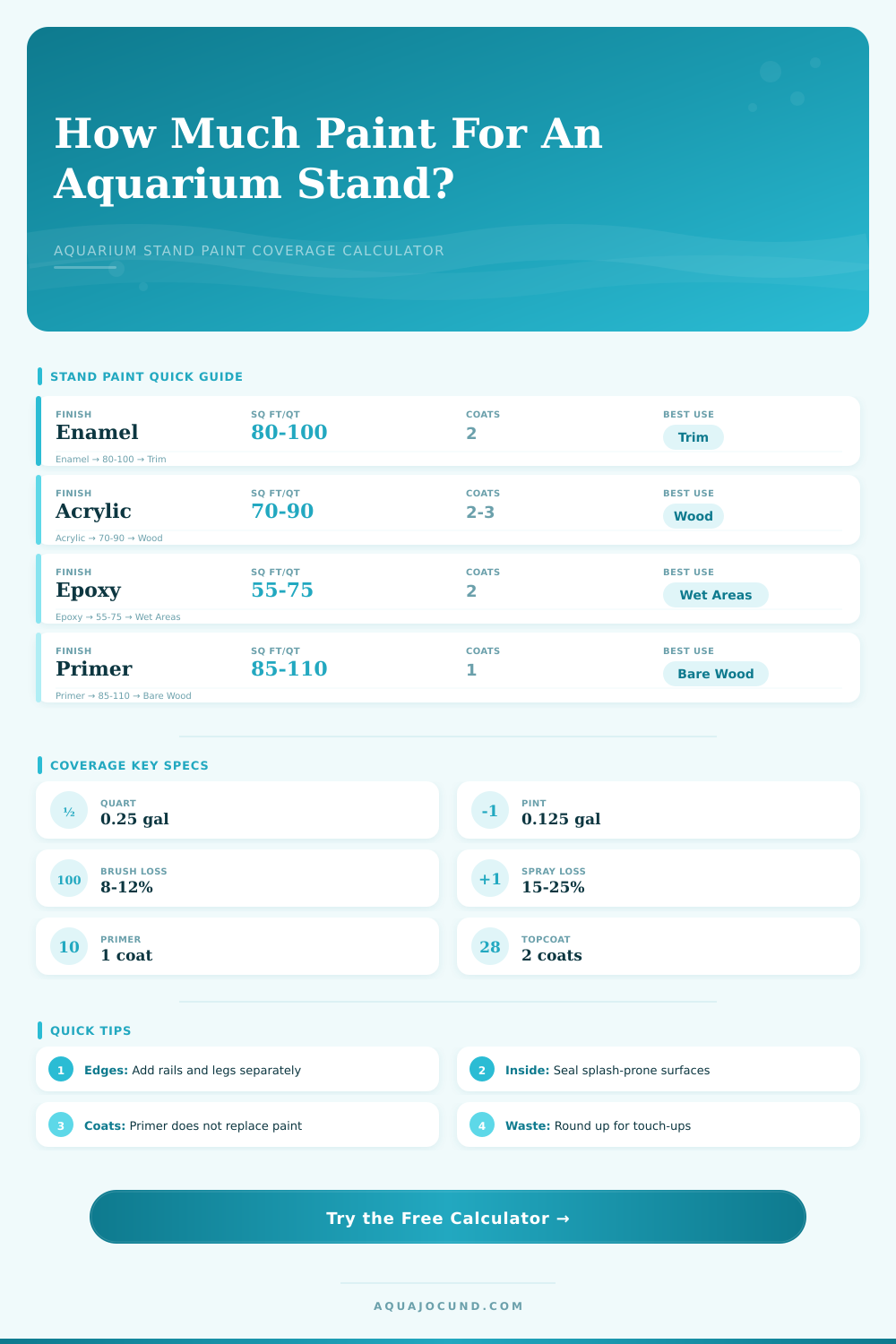
Also keep in mind that each product’s coverage vary. Epoxy is thick. It covers fewer square feet per gallon. You will need more. Check out this comparison table for epoxy, enamel, and acrylic side-by-side. As you’ll notice, the higher the durability, the lower the coverage. It is a trade-off. You pay for protection with more coats or thicker material.
Don’t overlook primer: Primer is not just a lighter shade of paint; it’s glue. It seals the pores of the wood, soaks in to the wood grain, and provides something for the topcoat to adhere to. If you don’t prime, your paint will chip. Primer is listed as a separate cost from topcoat on the calculator, which is good because frequently, you’ll want different kinds. For example, if there’s any bare wood that needs primed (to prevent tannin bleed) you might use a shellac based primer then go over that with an enamel. Keeping them as separate items keeps you from purchasing too much primer, or vice versa, and allows you to accurately budget.
How much do you get wasted depends on how you apply it. Spray is messy. Brush works well. If you’re using a spray gun, some paint goes into the air. That’s overspray. And you have to allow for that. What if I’m going to roll it? Or will you brush it? Adjust accordingly for the tool. Add in some percentage for waste. That’s not just so you don’t run out of paint. It’s so you finish and get it right. If you cut your last coat thin because you ran out of material, you’ll see streaks. And streaks on a stand under a tank is very noticeable.
Measure what you’re building Round up to the nearest gallon or quart, as the calculator does. And account for mistakes. It’s not an estimate…you don’t guess… you have enough to work with. You get a nice clean look. The stand looks great. But more importantly…the wood doesn’t stay wet.