🐟 Aquarium Stand Lumber Cut List Calculator
Turn a tank footprint into grouped rail cuts, vertical posts, cross braces, sheet panels, board counts, kerf waste, and estimated frame weight.
| Part | Qty | Cut Length | Material | Use |
|---|---|---|---|---|
| Long rails | 4 | 48.5 in | 2x4 SPF | Top and bottom front/back rails |
| Board | Pieces Assigned | Used Length | Remaining Offcut |
|---|---|---|---|
| Board 1 | Calculate to fill | - | - |
| Lumber | Actual Size | Approx Weight | Common Stand Use |
|---|---|---|---|
| 2x3 SPF | 1.5 x 2.5 in / 38 x 64 mm | 0.92 lb/ft / 1.37 kg/m | Nano and light-duty frames |
| 2x4 SPF | 1.5 x 3.5 in / 38 x 89 mm | 1.28 lb/ft / 1.90 kg/m | Most small to medium stands |
| 2x4 southern pine | 1.5 x 3.5 in / 38 x 89 mm | 1.55 lb/ft / 2.31 kg/m | Stiffer 2x4 frame option |
| 2x6 SPF | 1.5 x 5.5 in / 38 x 140 mm | 2.02 lb/ft / 3.01 kg/m | Longer front beams |
| 4x4 post | 3.5 x 3.5 in / 89 x 89 mm | 2.53 lb/ft / 3.77 kg/m | Post-style corners |
| Tank | Tank Footprint | Typical Stand Footprint | Usual Lumber Plan |
|---|---|---|---|
| 20 gallon long | 30 x 12 in / 76 x 30 cm | 30.5 x 12.5 in | 2x3 or 2x4 basic frame |
| 40 breeder | 36 x 18 in / 91 x 46 cm | 36.5 x 18.5 in | 2x4 doubled corners |
| 55 gallon | 48 x 13 in / 122 x 33 cm | 48.5 x 13.5 in | 2x4 with center braces |
| 75 gallon | 48 x 18 in / 122 x 46 cm | 48.5 x 18.5 in | 2x4 doubled corners |
| 120 gallon | 48 x 24 in / 122 x 61 cm | 48.5 x 24.5 in | 2x4 or 2x6 heavy layout |
| 180 gallon | 72 x 24 in / 183 x 61 cm | 72.5 x 24.5 in | 2x6 beam with mid posts |
| Cut Group | Formula | Included When | Calculator Detail |
|---|---|---|---|
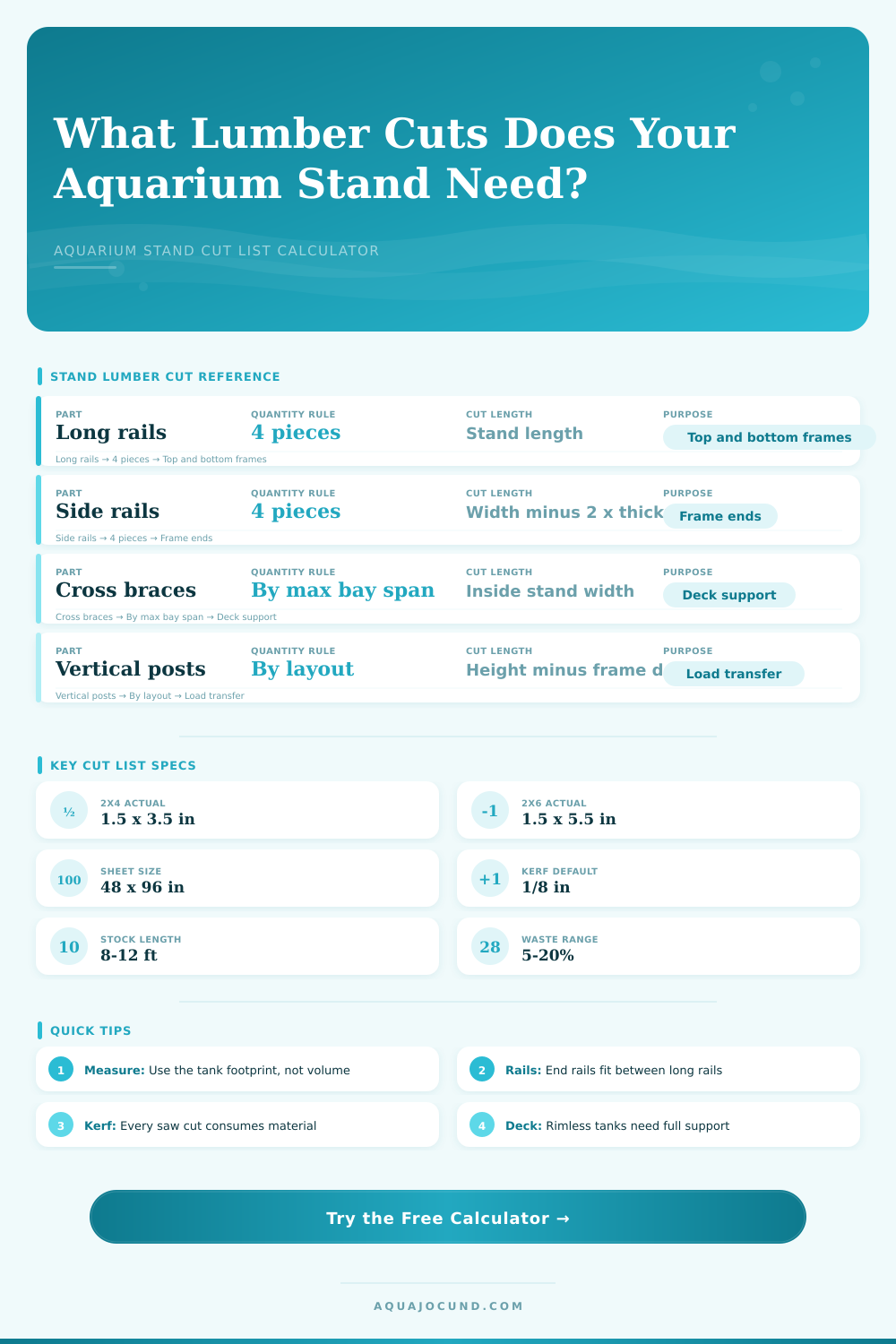
| Long rails | Stand length | All framed stands | Two top and two bottom pieces |
| End rails | Stand width - 2 x board thickness | All framed stands | Fits between long rails |
| Vertical posts | Finished height - 2 x board depth | All layouts | Subtracts top and bottom frame depth |
| Cross braces | Inside stand width | By bay-span setting | Top braces plus lighter bottom braces |
| Plywood top | Stand length x stand width | When selected | Includes panel overhang allowance |
OK. Now you’ve decided on a tank. And you’ve mapped out your tank. Next you need a stand to hold up the tank (i.e., glass and water). A stand is a structural issue, not simply a box. Cutting the wood properly and measuring correcty is what makes the difference between a good or bad stand.
Also, keep in mind that nominal lumber sizes does not equal actual lumber sizes. For example, a two-by-four is realy an inch-and-a-half-by-three-and-a-half inches. That becomes important when you’re calculating the inside rails. Measure the outside width (without subtracting for thickness of your side pieces). You’ll end up with a frame that’s too wide to fit together.
How to Build a Strong Tank Stand
The calculator automatically adjusts for side rail lengths. It subtracts out the thickness of the frame boards, making sure the pieces fits just right. No need to buy extra wood to cover your mistakes.
In a rimless tank, all that weight is at the edge of the bottom of the glass. In a framed tank, it’s spread out but there’s still weight. To prevent the top from sagging in middle (between two vertical posts) you’ll want cross braces. With this tool, you can specifies the maximum distance apart they should of be. That’s a realistic number. Too much distance between them and the plywood top will bow eventually. And even the slightest bow can cause cracks in the glass.
For most decks, setting the span at twenty-four inches will be enough. It makes sure that structure remains strong while not wasting unnecessary lumber.
When we cut a piece of wood, our saw removes material called kerf. Each cut will remove approximately one eighth of an inch. This doesn’t seem like much in a basic frame. However, if you’re making multiple cuts, those tiny fractions can realy add up. Without accounting for kerf, your resulting pieces will actualy end up being a little bit short. By default, the calculator accounts for kerf. It also accounts for bad cuts or other types of defects and adds in an additional waste percentage. Real wood tends to warp and have knots. A waste buffer of 10-15% will prevent you from running out of wood as you assemble.
This section covers plywood and sheet goods. A sheet of plywood / sheet wood is forty eight by ninety six inches. That’s a standard sheet. So even if your stand fits within those dimensions, it doesn’t necessarily mean you only need one sheet. However, if you want side paneling or your stand is wider, then it gets trickier. For example, you don’t want to waste half a sheet unless it’s cut in a way that’s efficient. The plywood calculator help determine whether you should purchase two sheets or just one. Plywood is pricey so this saves money. Plus, offcuts usually aren’t good for larger panels.
How strong the stand is depend on what type of lumber is used. Standard lumber (SPF) has lower density and stiffness compared to southern pine. That means it will bend more then the same amount of weight. You can change the wood type in the calculator. That changes the estimated strength and total weight of the frame. For larger tanks where you are building a stand, you may be able to make the frame stronger by using less stiff wood. This allows you to maintain the strength. You must consider stiffness, weight, and cost.
Measure twice. Cut once. Verify the answer from the calculator. This can be tempting to bypass. We is all in a hurry. A frame out of true is not easily rectified. You want it to feel solid. That means a rigid surface with the glass sitting flat. You will have no more concern about it. It is time to enjoy the hobby. Stability come from doing the math.