🛠 Aquarium Stand Leg Load Calculator
Estimate peak load per stand leg, leveling shim penalty, material compression margin, foot pad pressure, and floor bearing demand.
| Tank Setup | Typical Filled Weight | Common Legs | Notes |
|---|---|---|---|
| 40 breeder freshwater | 450-550 lb | 4 | Rock or deep substrate can add 80+ lb. |
| 55 gallon community | 625-750 lb | 4 | Narrow footprint increases floor concentration. |
| 75 gallon planted | 800-950 lb | 4 | Wide pads help spread point load. |
| 120 gallon reef | 1,250-1,600 lb | 6 | Include sump, rock, canopy, and water in plumbing. |
| 180 gallon display | 2,100-2,500 lb | 6-8 | Framed floors often need structural review. |
| 300 gallon system | 3,600-4,500 lb | 8-12 | Usually treated as a structural load project. |
| Condition | Factor | Use When | Result |
|---|---|---|---|
| Fully even frame | 1.00x | All legs contact equally on a flat slab | Best case |
| Minor floor variation | 1.10x | Small leveling differences, good contact | Normal |
| Typical cabinet stand | 1.20x | Wood cabinet with slight uneven sharing | Conservative |
| Uneven floor or long span | 1.35x | Long stand, middle legs light, floor not flat | Check contact |
| Corner-heavy contact | 1.50x | One corner visibly taking more load | Fix leveling |
| Support Type | Typical Bearing Target | Best Practice | Caution |
|---|---|---|---|
| Concrete slab | 500+ lb/sq ft | Use pads to protect finish and spread legs. | Check thin tile or floating flooring. |
| Wood framed near bearing wall | 200-300 lb/sq ft | Run stand perpendicular across joists. | Large tanks may exceed deflection comfort. |
| Wood framed mid-span | 100-200 lb/sq ft | Add blocking, beam support, or larger load spreader. | Avoid heavy tanks parallel to joists. |
| Old or unknown framing | 75-150 lb/sq ft | Inspect framing before filling. | Do not rely on calculator alone. |
| Wide continuous base | Lower local stress | Spreads load better than small feet. | Still confirm total load path. |
| Material | Calculator Allowable | Good Use | Watch For |
|---|---|---|---|
| 2x softwood end grain | 650 psi | Simple framed stands with full bearing. | Knots, splits, wet wood, side-grain loading. |
| Douglas fir / SPF post | 900 psi | Vertical posts under top frame rails. | Crushing at small shim points. |
| Hardwood post | 1200 psi | Compact furniture legs with pads. | Species and grain direction vary widely. |
| Laminated plywood leg | 550 psi | Cabinet-style side panels and built-up legs. | Edge voids, delamination, water damage. |
| Steel square tube | 12000 psi | Welded frames and adjustable feet. | Buckling, welds, tiny leveling feet. |
| Aluminum square tube | 5000 psi | Light modular stands. | Connector rating and tube wall thickness. |
| Concrete block pier | 1000 psi | Solid, fully supported block stands. | Hollow webs, point contact, brittle cracking. |
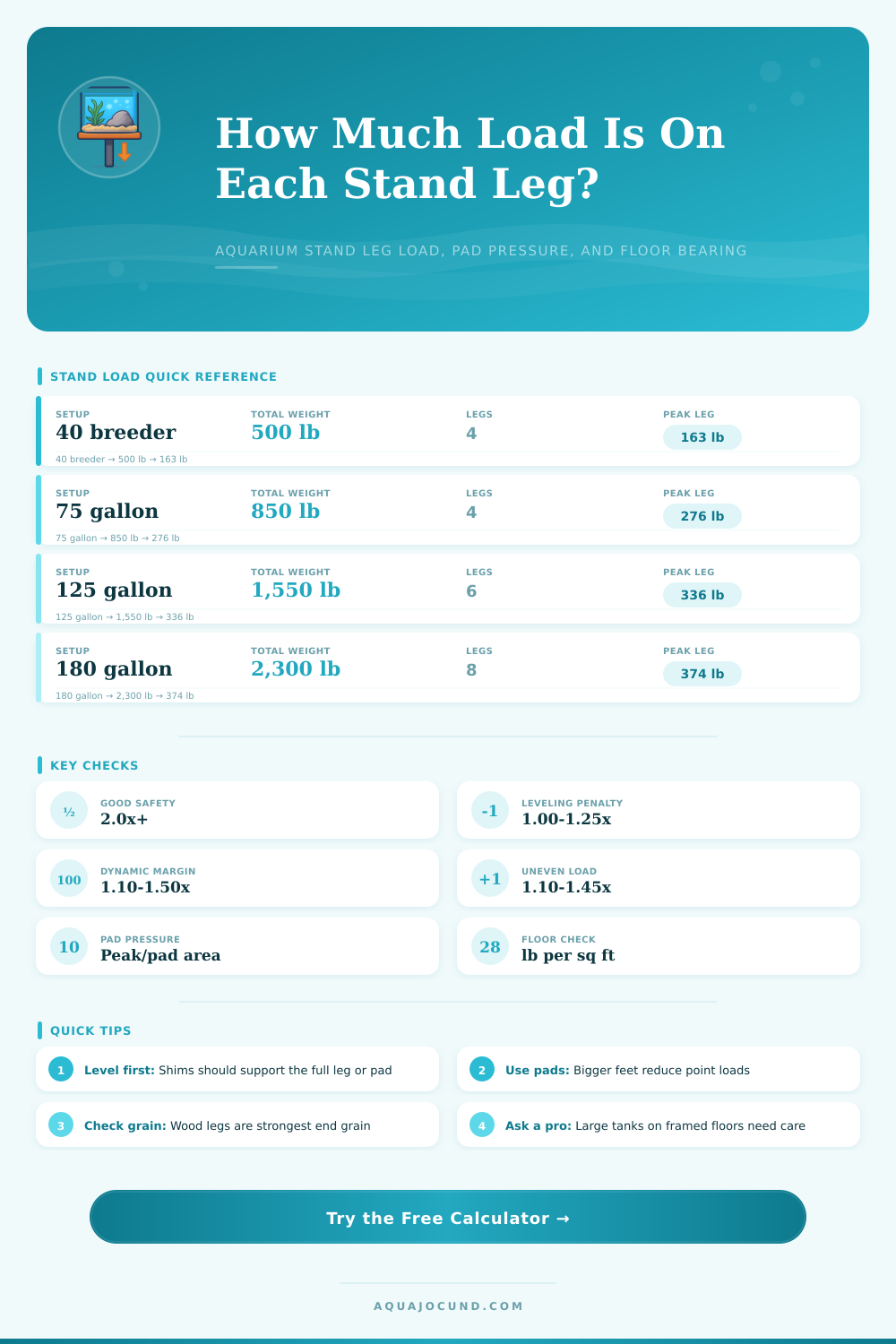
Water is heavy. When a typical 75g tank is fully loaded with rock, gravel, and water it weigh almost nine-hundred pounds. That’s like having two average-sized people standing on your living room floor… all in a little rectangle. Most hobbyists ponder the weight of the glass. Rarely do they think about way the four legs transmit that weight down to the subfloor below.
Run the numbers through the calculator above. Know what those numbers represent. Don’t let your investment be reduced to a puddle. Estimate the overall system weight (including everything), not just the water. Add up the substrate, live rock, glass, tank stand, any canopies and/or external sump. Don’t forget the hardscape. A heavy rock formation or an inch-thick layer of aquascape gravel can easily adds eighty pounds. That’s the number you plug into the tool.
Why Your Tank Stand Needs to Be Strong
Once you have that total, the tool ask for a load distribution pattern to account for how the weight is spread across your leg. It isn’t ever truly even. Floor surfaces are hardly ever totally flat, cabinets shift and settle unevenly. To account for this, the calculator prompts you to choose how the load is distributed. If it’s all rigid metal on concrete, then it’s equally shared. A flimsy wood cabinet sitting on a floor with slight warping place far greater strain on certain corners. Pick a larger multiplier to protect against the unseen risk of one leg bearing double its fair share of the burden.
Then there’s leveling. You know how everybody puts some random coin or bitty piece of plastic under their stand legs? That’s high-pressure point contact, not a wide area of support. The shim factor explains this reality. Because the load is concentrated into a tiny area even a little hard wedge can drastically increase the effective pressure on that leg. Proper adjustable feet or full-width shims keeps the load spread out. This makes a real difference over time in terms of material integrity, especially for wood legs. They’re particularly sensitive to this. Pine and other softwoods handles compression well if the force is applied straight down the grain, but crush easily if the load is skewed by improper shimming.
How Strong Is Too Strong? It’s all relative, no pun intended. Allowed pressure loads per material type are listed in the reference table on the page. Hardwoods and Douglas fir posts compress far better then typical edge laminated plywood, or even standard two-by-four softwood. Steel tubes resist compression amazingly well, although if they’re too narrow or not properly supported, they’ll buckle under pressure. Ideally you want at least twice the strength of what you expect to place inside. That cushion allows for dynamic loading such as bumping into the cabinet, cleaning the tank, or some minor amount of earth movement. Safety first! It’s never about being efficient. It’s about surviving that one weird thing that just happens.
The last test is floor bearing capacity. You might build the best stand ever but if it’s sitting on flooring that isn’t rated for the concentrated load, you’ve got problems. Joists are oriented in certain ways depending on which direction they run through wood framed floors. When you put a heavy tank parallel to the joists, you concentrate all of that weight onto only two beam. If you orient the tank perpendicularly, then the load gets spread out over several supports. This calculator tests your foot pressure versus common floor targets and flags areas where there could be risk. Almost any concrete slab will bear almost anything. Unknown old wood framing with who-knows-how-wide spans won’t.
If the tool tells you the set-up is risky, don’t blow it off. Bring in a structural guy first. Adding water after reinforcing a joist would of been much more expensive than doing so now. Heavy tanks require more thought about what’s under them (not just what’s holding them up).