🛠 Aquarium Stand Crossbeam Span Calculator
Estimate loaded beam span, deflection, brace spacing, safety factor, and top frame load sharing for aquarium stand crossbeams.
| Profile | Approx. size | Modulus E | Moment I | Section S | Planning note |
|---|---|---|---|---|---|
| SPF 2x4 on edge | 1.5 x 3.5 in | 1.2 Mpsi | 5.36 in4 | 3.06 in3 | Common wood stand rail orientation. |
| Douglas fir 2x4 on edge | 1.5 x 3.5 in | 1.6 Mpsi | 5.36 in4 | 3.06 in3 | Stiffer than typical SPF when grade is comparable. |
| SPF 2x4 laid flat | 3.5 x 1.5 in | 1.2 Mpsi | 0.98 in4 | 1.31 in3 | Much weaker for vertical bending. |
| SPF 2x6 on edge | 1.5 x 5.5 in | 1.2 Mpsi | 20.8 in4 | 7.56 in3 | Large stiffness jump for long front rails. |
| Douglas fir 2x6 on edge | 1.5 x 5.5 in | 1.6 Mpsi | 20.8 in4 | 7.56 in3 | Useful for long heavy displays. |
| Double 3/4 plywood lamination | 1.5 x 3.5 in | 0.9 Mpsi | 5.36 in4 | 3.06 in3 | Depends strongly on glue, grain direction, and fasteners. |
| 1.5 in steel tube, 14 ga | 1.5 x 1.5 x 0.083 in | 29 Mpsi | 0.158 in4 | 0.211 in3 | High stiffness material but shallow section. |
| 2 in steel tube, 14 ga | 2 x 2 x 0.083 in | 29 Mpsi | 0.391 in4 | 0.391 in3 | Often better than shallow wood where height is limited. |
| 20x40 aluminum extrusion | 0.79 x 1.57 in | 10 Mpsi | 0.14 in4 | 0.18 in3 | Profile varies by slot series; verify manufacturer data. |
| Tank size | Footprint, in and cm | Typical loaded weight | Common top frame | Typical checked beam |
|---|---|---|---|---|
| 20 long | 30 x 12 in / 76 x 30 cm | 225 lb / 102 kg | 2x4 perimeter | 30 in front rail |
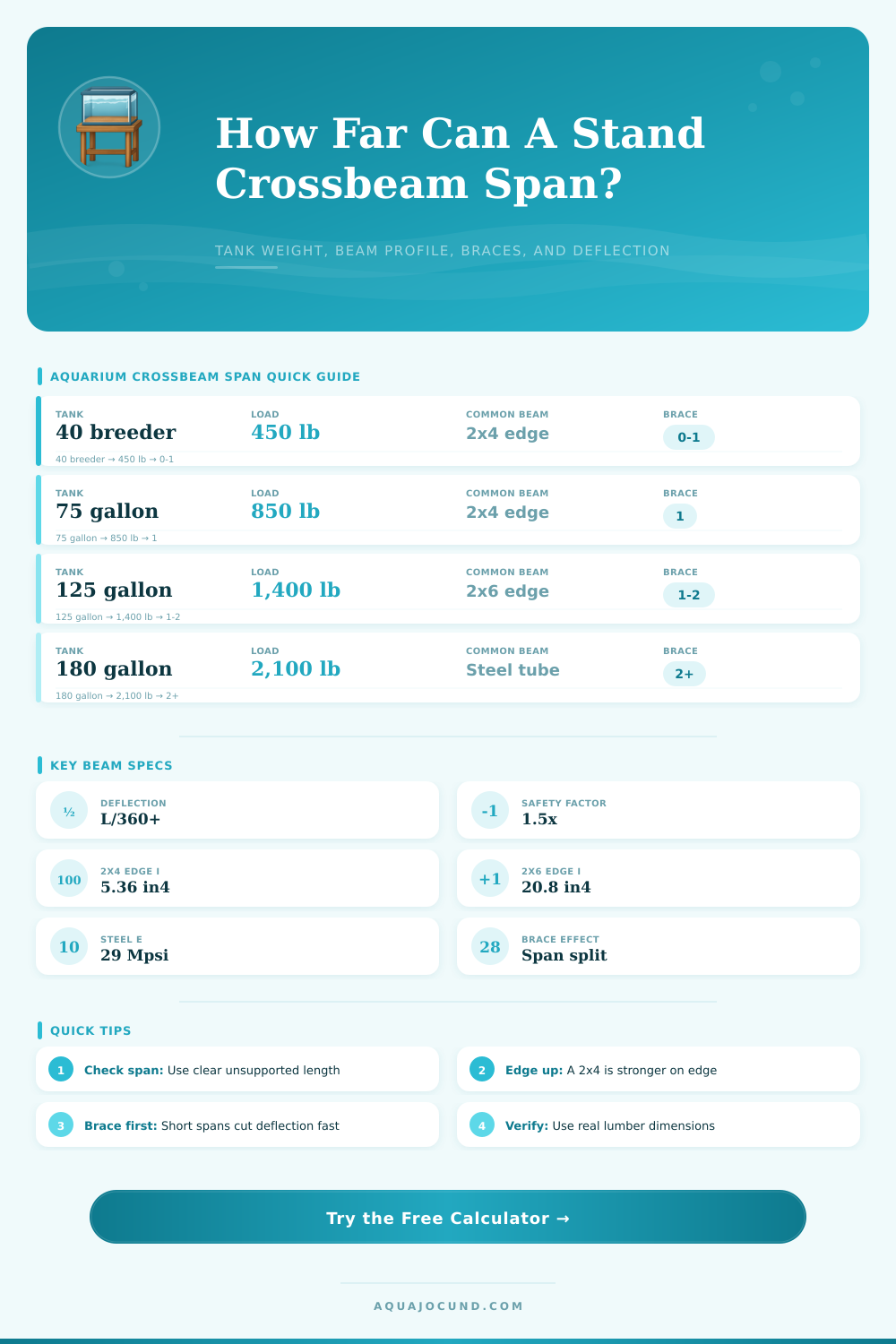
| 40 breeder | 36 x 18 in / 91 x 46 cm | 450 lb / 204 kg | 2x4 perimeter | 36 in front rail |
| 55 gallon | 48 x 13 in / 122 x 33 cm | 625 lb / 283 kg | 2x4 perimeter | 48 in front rail, often braced |
| 75 gallon | 48 x 18 in / 122 x 46 cm | 850 lb / 386 kg | 2x4 or 2x6 perimeter | 48 in rail with center brace |
| 90 gallon | 48 x 18 in / 122 x 46 cm | 1,050 lb / 476 kg | 2x6 or steel frame | 48 in rail with brace |
| 125 gallon | 72 x 18 in / 183 x 46 cm | 1,400 lb / 635 kg | 2x6 or steel frame | 72 in rail split by posts |
| 180 gallon | 72 x 24 in / 183 x 61 cm | 2,100 lb / 953 kg | Steel or heavy wood | 72 in rail with multiple posts |
| Setting | Use case | Limit at 48 in span | Calculator behavior |
|---|---|---|---|
| L/240 | Utility support where tiny movement is acceptable | 0.200 in / 5.1 mm | Most forgiving deflection choice. |
| L/360 | Common aquarium stand target | 0.133 in / 3.4 mm | Balanced stiffness check for framed tanks. |
| L/480 | Stiff top frame or sensitive trim | 0.100 in / 2.5 mm | Reduces allowable span. |
| L/600 | Rimless or very flat top support | 0.080 in / 2.0 mm | Strictest listed setting. |
| Uniform load | Weight spread along the rail | Lowest listed deflection factor | Uses 5wL4 / 384EI. |
| Center point load | Worst local concentration | Highest listed deflection factor | Uses PL3 / 48EI. |
| Layout | Default share | Best checked member | Practical note |
|---|---|---|---|
| Front and rear long rails only | 50% | Front or rear rail | Typical framed tank perimeter stand. |
| Perimeter plus center long rail | 33% | Center rail and front rail | Center rail helps wide tanks and plywood tops. |
| Full plywood top over perimeter | 40% | Front rail below sheet edge | Sheet spreads load, but long rails still matter. |
| Perimeter with cross slat grid | 25% | Each slat and perimeter rail | Useful when load is truly shared by slats. |
| Rimless tank on full support pad | 60% | Worst continuous front edge | Use a stricter deflection limit. |
| Custom load share | User input | Most critical beam | Use when you know the real tributary load path. |
A structure engineer, meet piece of furniture. A piece of furniture, meet three hundred gallons of water. That’s what happens in your house when you build a custom aquarium stand: Every aquarium hobbyist eventually has this moment. Water doesn’t give a rip if it’s made of pretty wood or has nice finishes. It only care about three things: gravity, stiffness, and how you space your support beams.
The two thing are support beam placement and material strength (stiffness). And most people makes a wild guess on those two items. They see a hunk of wood and figure “it’ll hold up.” Guess what? Your floor’s flooded and your glass is cracked.
How to Build a Safe Aquarium Stand
You input your desired tank size and the type of material you want to use. The calculator does the rest for you. You won’t have to wonder if a 2×4 is sufficient for a 40″ span. The one catch is the program assumes the top frame rails is treated like a simple beam and will flex over time.
A key variable here are called the moment of inertia, which describes how wood is oriented. A 2×4 laid flat has minimal resistance to vertical flex. Turn it on its edge and suddenly stiffness increases greatly due to depth of the beam. Depth is more important then width. Long tanks must be positioned properly. There’s no wiggle room. Compare profiles side by side and know exactly how much stiffer a 2×6 is vs regular framing lumber.
Another thing that catches folks up are load sharing. The idea is that when you have a solid plywood top on your stand, it shares the load better through the frame. Having the tank sit on the front and back rails only is putting nearly all weight on those two members. That’s why the calculator allow you to choose how it’s laid out. Because say you are laying out cross slats in a grid pattern… Then your tank is carrying some of the weight not just on the rails but also on the beams. So you’d like to know, is one beam supporting 50% of the total load? Or maybe it is just 25%. The difference between the two are the difference between having a rigid stand for years versus a sagging stand over time.
Here is where deflection limits comes into play as well. Something that appears to be “OK” may still deflect enough to cause seam stress on the glass. The most affordable upgrade are braces. Adding a vertical post (a brace) down the center of a long rail divides the unsupported length by 2, which reduce deflection significantly. Since bending forces decrease quickly the closer the rails is together, this dramatically increases stiffness. It is much better than using thicker lumber in many scenarios. The tool will help show you where each brace halves the span and makes things stiffer. Then you can play around with adding braces and see what’s “just right” for combining good strength with lower materials costs. That way you get higher stiffness using smart geometry instead of raw brute force, while also being able to source common, less expensive wood.
Why safety? Because water is both heavy and merciless. The safety factor is a multiplier to your tank’s weight to allow for things such as uneven load, equipment, and other stuff you didn’t count on. You can throw some decorations in there, maybe a heater, a filter… all of which will alter the center of gravity. Adding an additional 10-20% for those items provides plenty of cushion without needing to tear down and start from scratch. Having too much capacity is far better then being on the edge of disaster.
That’s why the chart on the page show you typical moduli for various materials (e.g., steel, aluminum). Wood is popular but you get a lot more strength in smaller profile with metal tubing. Steel, for example, has a huge modulus of elasticity vs. Pine so when loaded up, it bends very little. Steel so when loaded up, it flexes significantly.
To conclude, Building an aquarium stand is essentially calculating risk instead of hoping there won’t be any. It’s designing a support structure for several hundred pounds of water that’s constantly pressing down on it. When you understand how loads distribute, how beams should orient themselves, and what spans they can support, you’re going from guessing to engineering. The calculator will give you those numbers, but ultimately, it’ll be up to you in terms of what you choose to build.
Begin with proper bracing and clear spans. Select materials according to the needs of your intended tank size. Don’t trust what your eyes tell you. Test your design before filling the tank. A few minutes of planning now would of saved you a really wet floor later.