Aquarium Service Route Time Calculator
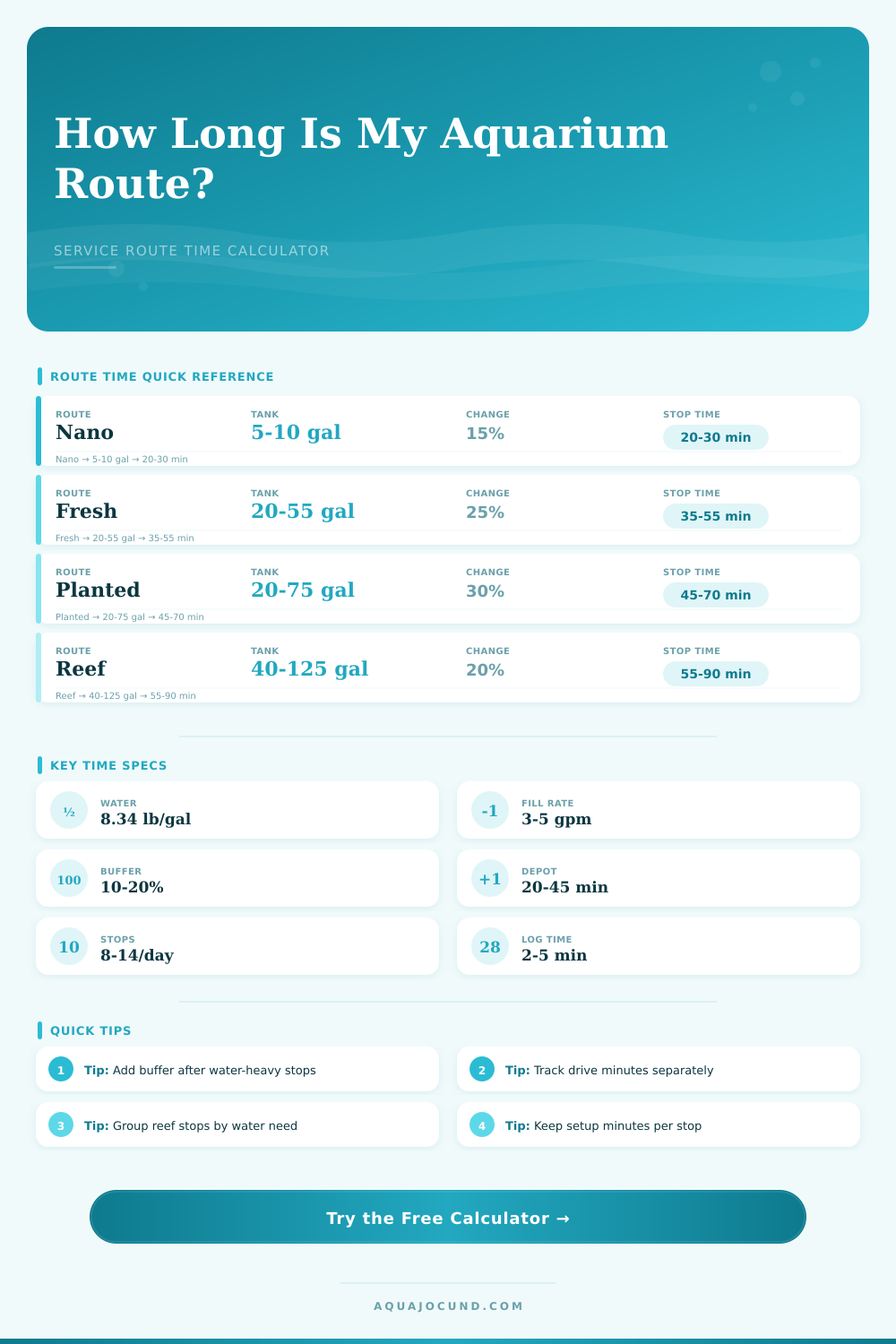
Estimate travel minutes, on-site service minutes, tank gallons, water-change volume, stops, and schedule buffer for an aquarium maintenance route.
Route Workload Estimate
| Service profile | Base stop minutes | Cleaning minutes per 10 gallons | Water handling rate |
|---|---|---|---|
| Quick nano check | 8 min | 1.2 min | 5.0 gal/min or 18.9 L/min |
| Standard freshwater | 12 min | 1.8 min | 4.0 gal/min or 15.1 L/min |
| Planted trim visit | 14 min | 2.4 min | 3.5 gal/min or 13.2 L/min |
| Reef maintenance | 18 min | 2.8 min | 3.0 gal/min or 11.4 L/min |
| Large cichlid tank | 15 min | 2.0 min | 4.4 gal/min or 16.7 L/min |
| Breeder rack systems | 10 min | 1.4 min | 4.8 gal/min or 18.2 L/min |
| Heavy algae reset | 20 min | 3.5 min | 3.2 gal/min or 12.1 L/min |
| Tank size | Dimensions in | Dimensions cm | Typical water-change volume |
|---|---|---|---|
| 5 gallon nano | 16 x 8 x 10 | 41 x 20 x 25 | 0.8 to 1.5 gal or 3 to 6 L |
| 10 gallon | 20 x 10 x 12 | 51 x 25 x 30 | 1.5 to 3 gal or 6 to 11 L |
| 20 long | 30 x 12 x 12 | 76 x 30 x 30 | 4 to 6 gal or 15 to 23 L |
| 29 gallon | 30 x 12 x 18 | 76 x 30 x 46 | 6 to 9 gal or 23 to 34 L |
| 40 breeder | 36 x 18 x 16 | 91 x 46 x 41 | 8 to 12 gal or 30 to 45 L |
| 55 gallon | 48 x 13 x 21 | 122 x 33 x 53 | 11 to 17 gal or 42 to 64 L |
| 75 gallon | 48 x 18 x 21 | 122 x 46 x 53 | 15 to 23 gal or 57 to 87 L |
| 125 gallon | 72 x 18 x 21 | 183 x 46 x 53 | 25 to 38 gal or 95 to 144 L |
| Route condition | Planning value | When to use it | Calculator input |
|---|---|---|---|
| Dense local route | 8 to 12 min between stops | Nearby homes, offices, or storefronts | Average travel minutes |
| Suburban spread | 12 to 20 min between stops | Mixed neighborhoods and arterial roads | Average travel minutes |
| Long-leg route | 20 to 35 min between stops | Few stops with longer drive segments | Average travel minutes |
| Normal buffer | 10% to 15% | Known tanks and predictable parking | Schedule buffer |
| Heavy buffer | 20% to 30% | Reef tanks, access delays, or many water changes | Schedule buffer |
Every day, there are small tasks related to aquariums that need to be done with water. There’s a cooler full of test kits. There is a truck full of bucket. The schedule appears flawless on paper but begin fraying after the 3rd stop. It’s all about accounting for those unseen minutes. This includes the slow drip of your faucet at a client site with nothing but a sink, the extra time needed to suck out a stubborn corner of algae, or struggle for parking.
Raw service time is a poor way to plan as it neglects friction present in real world. Delays should be built into the plan, and variables shouldn’t be ignored; they don’t show up on a typical schedule. Luckily, the tool above do the heavy lifting for this task. You simply input all the details about your route, tank sizes, traffic on the way, etc. It spits out a number.
How to Plan Your Time Better
This is valuable because it compels you to distinguish between service time and travel time. Many techs lumps them into a single variable, and underestimate how much of an effect driving a long distance has. When you split them apart, then you’ll know precisely what’s going on during your day. You may think a route with short drives but heavy water changes will go faster then one with long drives and quick nano tanks, but when you take into account both factors, they could be equivalent in time. That trade-off becomes obvious, and you can visualize the actual cost of every stop.
On site time is largely driven by water volume. It takes much less time to move 5 gallons of water compared to 20. And it require much less physical exertion. The tool comes with some reference data showing how much longer certain types of tanks can take per gallon. For example, you’ll see that most reef tanks tend to be longer per gallon than regular freshwater tanks. Why? This is because there is typicaly more delicate equipment being handled and water parameters needs to be more precisely maintained. So yes, the volume of water you’re moving matters, but also amount of care needed during that process.
When you service planted tank, you add an additional layer of time for trimming which has absolutely nothing to do with water. People easily forget to account for this. We want you to think about more than just the water change itself.
Most routes succeed or fail based off buffer time. Being realistic isn’t being pessimistic, it’s being a pro. There will be questions from clients. There will be poorly parked cars. Sometimes that filter simply won’t go back together properley. If you budget for perfection, then you’ll never have a perfect day.
You can dial up/down this buffer depending on the predictability of your stops. Known difficult access? You might expect tighter turns and narrower roads. Use more buffer. Wide-open driveways? Suburban stop? Use less buffer.
Will it feel like you’re fudging up your timeline? Yes. Is it doing anything other than safeguarding your credibility? No. Nothing sours a potential customer faster then arriving late to their door due to getting delayed at the previous stop. That’s why the buffer is insurance.
It’s also important to note pace. More experienced technicians gets things done faster than new hires. Over the course of eight or ten stops, that pace add up. The tool allows you to account for this variation in skill. When you’re teaching someone new, increase the time estimate so the pressure doesn’t builds up too fast. It ensures that the day stay within reach for both of you.
That’s why I think the planning process becomes valuable as your business grows. You don’t have to remain locked into those first, conservative estimates that don’t show your current abilities anymore. Adjust as your crew grows in experience, and scale your expectations accordingaly.
But what it all adds up to is building a system that works. Even if each step is challenging, when put together as a whole, it flow. Your schedule fits into place. You always leave yourself some wiggle room. You finish everything on time so you wouldn’t of had to rush things through. You walk away from your client feeling accomplished instead of rushed. It transforms a chaotic, scatter-shot approach to water changes into a controlled process.
The math click. The fish remains healthy. The clients remains satisfied. And heck, you actualy make it home before dark. Including the math helps make the work sustainable over time.