🌊 Salinity Resistivity Calculator
Convert aquarium water resistivity, conductivity, salinity, and specific gravity with temperature correction and target adjustment.
| Water type | Salinity | Specific gravity | Conductivity | Resistivity |
|---|---|---|---|---|
| Very soft freshwater | 0.05 ppt | 1.0000 | 0.10 mS/cm | 10000 ohm·cm |
| Community freshwater | 0.20 ppt | 1.0001 | 0.39 mS/cm | 2567 ohm·cm |
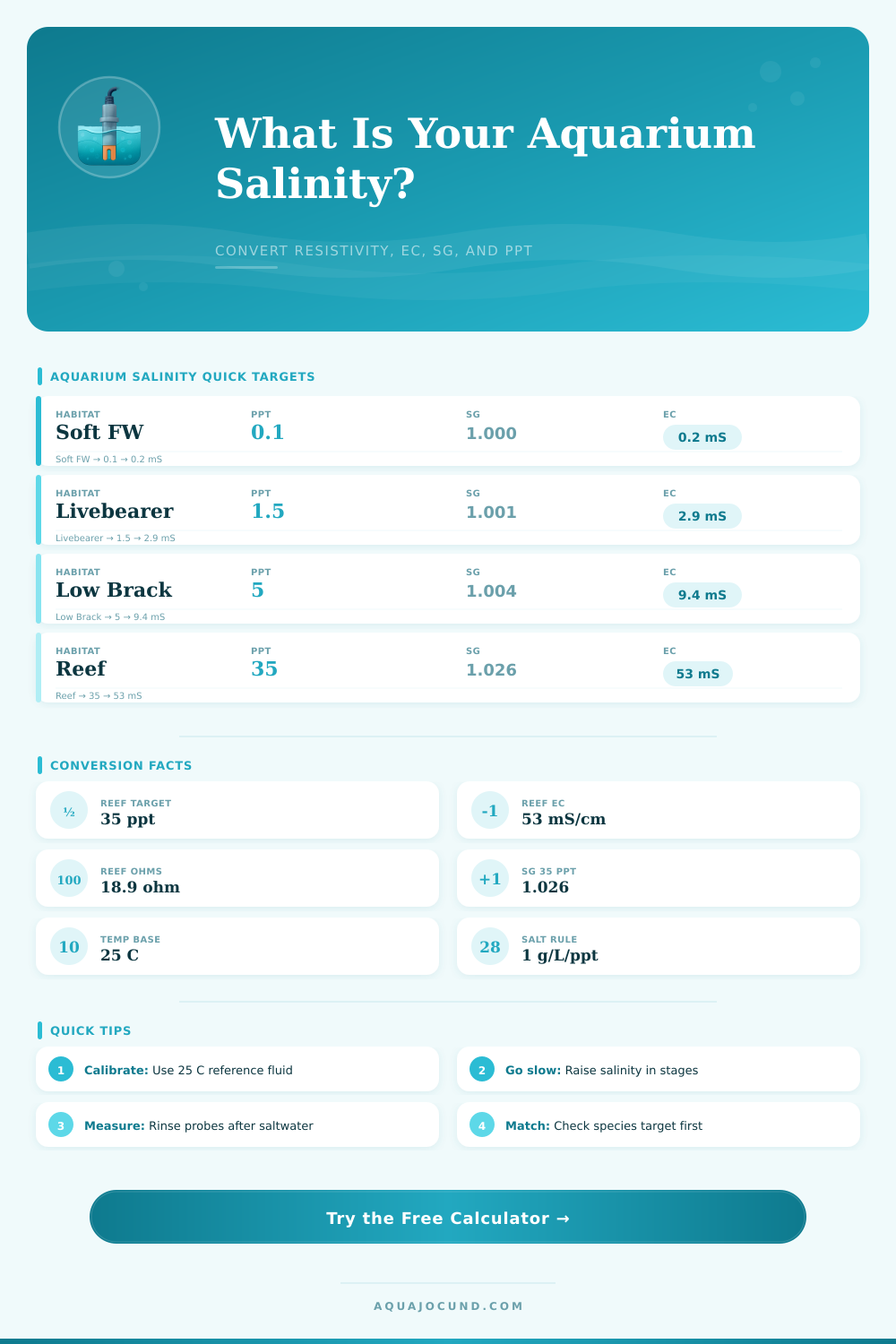
| Livebearer mineralized | 1.50 ppt | 1.0011 | 2.90 mS/cm | 345 ohm·cm |
| Low brackish | 5.00 ppt | 1.0037 | 9.44 mS/cm | 106 ohm·cm |
| Mid brackish | 15.00 ppt | 1.0111 | 26.44 mS/cm | 37.8 ohm·cm |
| Natural seawater | 35.00 ppt | 1.0260 | 52.94 mS/cm | 18.9 ohm·cm |
| Livestock group | Target ppt | Target SG | Approx EC | Use note |
|---|---|---|---|---|
| Wild betta, ram, discus | 0.05 to 0.15 | 1.0000 | 0.10 to 0.29 mS/cm | Keep stable, avoid routine salt |
| Planted community | 0.10 to 0.30 | 1.0001 | 0.20 to 0.58 mS/cm | Fertilizer raises EC reading |
| Goldfish support | 0.30 to 1.00 | 1.0002 to 1.0007 | 0.58 to 1.94 mS/cm | Short-term support only |
| Livebearers | 1.00 to 3.00 | 1.0007 to 1.0022 | 1.94 to 5.85 mS/cm | Mineralized hard water range |
| Low brackish gobies | 3.00 to 7.00 | 1.0022 to 1.0052 | 5.85 to 13.22 mS/cm | Use marine salt mix |
| Figure 8 puffer | 5.00 to 10.00 | 1.0037 to 1.0074 | 9.44 to 18.25 mS/cm | Raise slowly from freshwater |
| Monos, scats, archers | 10.00 to 20.00 | 1.0074 to 1.0148 | 18.25 to 34.00 mS/cm | Juveniles vary by species |
| Marine reef | 33.00 to 36.00 | 1.0245 to 1.0267 | 50.08 to 54.00 mS/cm | Match refractometer calibration |
| Sample temperature | EC reading | Corrected to 25°C | Why it matters |
|---|---|---|---|
| 68°F / 20°C | Lower than true 25°C value | Divide by 0.90 | Cold water can under-read salinity |
| 73.4°F / 23°C | Slightly lower | Divide by 0.96 | Small correction for room samples |
| 77°F / 25°C | Reference point | No correction | Most meters and tables use this |
| 80.6°F / 27°C | Slightly higher | Divide by 1.04 | Warm tanks can over-read EC |
| 86°F / 30°C | Higher than 25°C value | Divide by 1.10 | Important for reef and brackish tanks |
| Tank volume | Raise 1 ppt | Raise 5 ppt | Raise 35 ppt |
|---|---|---|---|
| 5 gal / 18.9 L | 18.9 g | 94.6 g | 662 g |
| 10 gal / 37.9 L | 37.9 g | 189 g | 1.33 kg |
| 20 gal / 75.7 L | 75.7 g | 379 g | 2.65 kg |
| 40 gal / 151 L | 151 g | 757 g | 5.30 kg |
| 75 gal / 284 L | 284 g | 1.42 kg | 9.94 kg |
| 125 gal / 473 L | 473 g | 2.37 kg | 16.6 kg |
Conductivity and resistivity are mathematical opposites, but both depend on temperature. Calibrate with a 25°C solution near the range you actually measure, then rinse probes with fresh water after brackish or reef use.
For livestock, change salinity gradually. A practical rule is no more than 1 to 2 ppt per day for many freshwater-to-brackish changes unless a veterinarian gives a treatment plan.
Salinity measure the amount of dissolved solid in the water and is a critical factor in the health of an aquatic animals living in the water. There are three measurement of salinity: conductivity, resistivity, and temperature. Salinity isnt just the measurement of the conductivity of the water.
Conductivity measure the dissolved solids in the water, and as salt is added to the water, the conductivity of the water increase. Resistivity is the measurement of the opposite of the conductivity of the water. The temperature of the water can change the rate at which the water molecules move in the water.
How to Measure and Keep Salt Levels in Your Aquarium
When the water is warm, the water molecules move more faster in the water, increasing the conductivity of the water. If these factors is not accounted for, people might believe that the salinity of the water is higher then the actual salinity of the tank. To account for these factor, a temperature correction model is used to even out the raw measurement data to provide the most accurate salinity measurements.
A refractometer and a TDS meter can give the salinity of the water in a display tank, but the measurements has to be calculated to understand the salinity of the water. The calculator on this page will do that calculation for you. Once the calculator calculates the salinity of the water, people can decide how to adjust the salinity in the tank.
Adding salt directly to a display tank will cause the salt in the tank to settle on the substrate of the tank. When the salt settles on the substrate of the display tank, it can create hot spots in the substrate that contains extreme salinity that can burn the gill of the fish in the tank. The salt can be mixed in a separate container and slowly added to the tank.
Using the calculator on this page, you can determine the exact amount of salt need for your tank to even out to the target salinity level. The salinity requirement for each species of fish are different. A puffer fish require a brackish water environment, while a guppy require a freshwater environment.
A puffer fish does not require the same level of salinity of a tank that house coral reef fish. If an aquarium fish is moved from freshwater to brackish water, the salinity must be change slowly. Otherwise, the fish may experience osmotic shock, which can lead to the fish dehydrating.
The quality of the salt that is used in the tank can also affect the salinity of the tank. If salt product absorb moisture from the air, the weight of the salt will not be accurate because the salt is no longer pure sodium chloride. The strength of the salt mix should be accounted for so the mineral content of the water are correct.
Stability in the salinity of the tank is the primary goal in managing a fish aquarium. A reef tank that fluctuate in specific gravity will struggle to support the growth of coral. Precise measurement of the water in the tank can help to prevent the salinity from fluctuating.
Additionally, if the fish begin to act lethargic or clamp there fins, there may be an issue with the salinity in the tank. The behavior of the fish indicate the condition of the water. Even with the calculation of the required salinity level, the observation of the fishes behavior is an essential tool to fine tune the water to accommodate the fish and the coral.
For the health of the fish and the coral, stable salinity and environments must be maintain in the display tank.