🌊 Salinity Adjustment Calculator
Calculate salt additions, freshwater dilution, or premixed water-change salinity for reef, marine, brackish, and quarantine tanks.
✅ Salinity Adjustment Results
| Mix Type | Calculator Factor | Typical Use | Notes |
|---|---|---|---|
| Reef marine salt | 1.00 g/L/ppt | Coral and reef systems | Balanced calcium, alkalinity, magnesium |
| Fish-only marine salt | 0.99 g/L/ppt | Marine fish systems | Stable salinity without elevated reef targets |
| Brackish marine mix | 0.98 g/L/ppt | Mollies, gobies, puffers | Best for long-term brackish tanks |
| Aquarium tonic salt | 1.00 g/L/ppt | Short freshwater support | Does not replace marine trace elements |
| Cichlid mineral salt | 0.65 g/L/ppt | Hard-water cichlid tanks | Raises minerals more than true marine salinity |
| Pond salt | 1.00 g/L/ppt | Ponds and quarantine | Use only clean additive-free salt |
| Hospital marine salt | 1.00 g/L/ppt | Hyposalinity or recovery tanks | Always match species tolerance |
| Custom dry equivalent | 1.00 g/L/ppt | Manual lab-style dosing | Assumes 1 ppt equals about 1 g/L |
| System or Livestock | Target Salinity | Approx SG | Adjustment Pace |
|---|---|---|---|
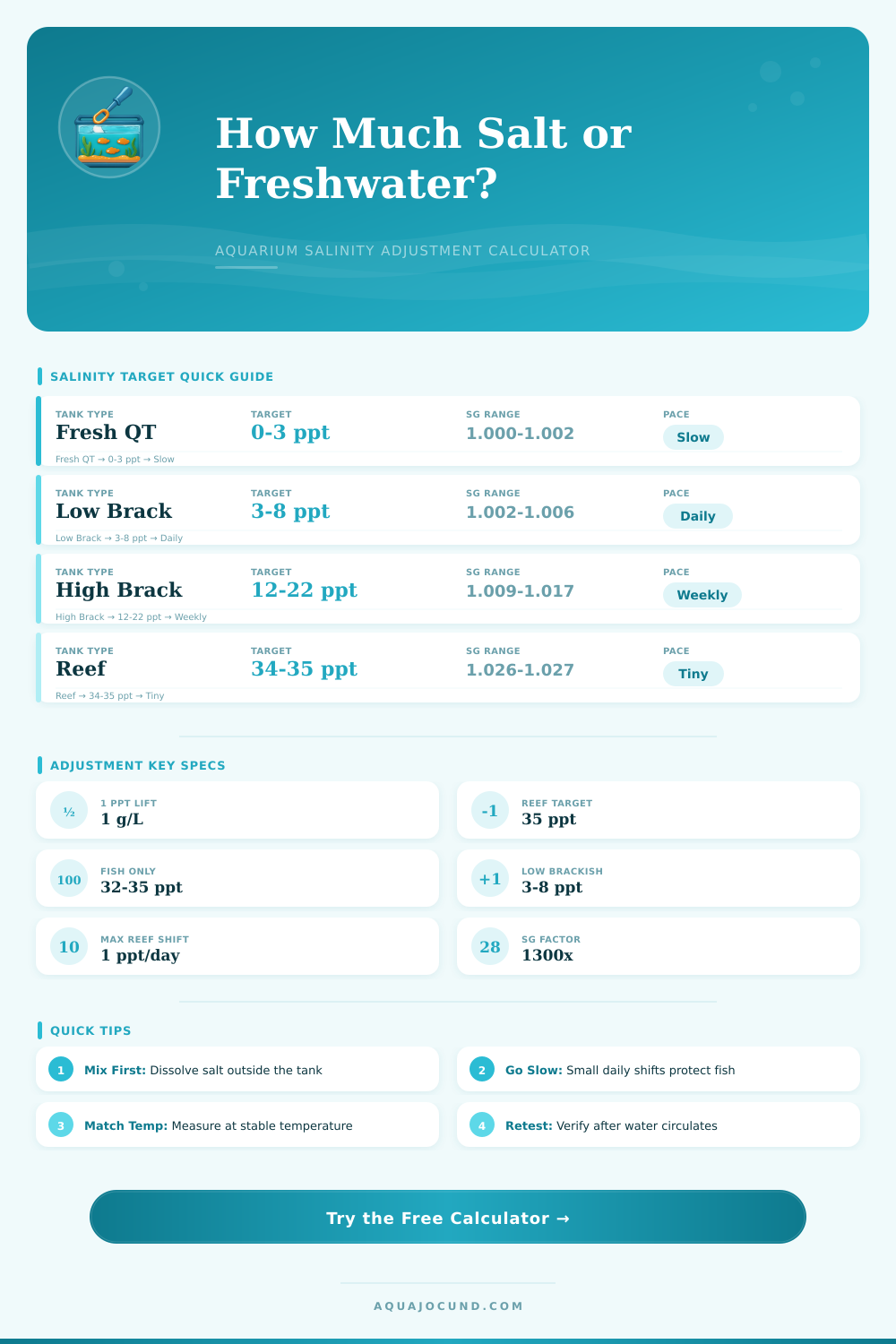
| Freshwater quarantine support | 1-3 ppt | 1.001-1.002 | Increase over several hours |
| Livebearer low brackish | 3-8 ppt | 1.002-1.006 | 1-2 ppt per day |
| Figure-eight puffer range | 5-12 ppt | 1.004-1.009 | 1 ppt per day or slower |
| Mudskipper or high brackish | 12-22 ppt | 1.009-1.017 | Weekly staged changes |
| Fish-only marine | 32-35 ppt | 1.025-1.027 | 1 ppt per day for livestock |
| Reef aquarium | 34-35 ppt | 1.026-1.027 | 0.5-1 ppt per day |
| Hyposalinity treatment | 12-14 ppt | 1.009-1.011 | Follow veterinary protocol |
| Tank Size | Typical Dimensions | Water Volume | Salt for +1 ppt |
|---|---|---|---|
| 5 gallon | 16 x 8 x 10 in | 18.9 L | 19 g / 0.7 oz |
| 10 gallon | 20 x 10 x 12 in | 37.9 L | 38 g / 1.3 oz |
| 20 long | 30 x 12 x 12 in | 75.7 L | 76 g / 2.7 oz |
| 29 gallon | 30 x 12 x 18 in | 109.8 L | 110 g / 3.9 oz |
| 40 breeder | 36 x 18 x 16 in | 151.4 L | 151 g / 5.3 oz |
| 55 gallon | 48 x 13 x 21 in | 208.2 L | 208 g / 7.3 oz |
| 75 gallon | 48 x 18 x 21 in | 283.9 L | 284 g / 10.0 oz |
| 125 gallon | 72 x 18 x 22 in | 473.2 L | 473 g / 1.0 lb |
| Situation | Suggested Limit | Why It Matters | Calculator Use |
|---|---|---|---|
| Reef with corals | 0.5-1 ppt/day | Corals react to osmotic swings | Use conservative margin |
| Marine fish only | 1-2 ppt/day | Fish tolerate small staged moves | Split large corrections |
| Brackish conversion | 1 ppt/day | Biofilter and livestock adapt slowly | Use staged water changes |
| Freshwater salt support | 1-3 ppt total | Many plants and fish are sensitive | Verify species tolerance |
| Emergency dilution | 25-50% change | Lower salinity in controlled steps | Use dilute method |
Premix outside the aquarium. Dry salt can burn tissue if it lands on fish, coral, or invertebrates. Mix in a bucket or reservoir until fully clear, heated, and aerated.
Retest after circulation. Salinity readings can drift while salt finishes dissolving, bubbles leave the sample, and temperature stabilizes.
Small changes are kinder. Use the daily limit to split a large correction into multiple adjustments, especially for reef tanks and brackish conversions.
Top-off is not a water change. Evaporation leaves salt behind, so use freshwater for routine top-off unless you are deliberately raising salinity.
Salinity are the measurement of the dissolved salts in water, which is a critical factor in the health of the livestock in an aquarium. Should the salinity in an aquarium be too high or too low, the aquarium’s livestock may experiences osmotic shock. When an organism experiences osmotic shock, its cells must work to maintain a balance between the internal and external environments of the organism’s cells.
Should the salinity change too rapid for the organism’s cells to adjust, those cells may die. For these reasons, it is necessary to use a refractometer to measure the salinity in the aquarium, and to use a calculator to determine the necessary change to the salinity of the aquarium. The different type of salt contain different amounts of minerals.
How to Measure and Change Aquarium Salt Levels
For instance, reef salt mixes contains minerals like calcium, magnesium, and alkalinity, while tonic salt contains mostly sodium chloride. Because of the different minerals in each type of salt, the density of the salt is different. Each type of salt that is used in an aquarium will affect the salinity in different ways; you must know the type of salt that is used in order to determine how much salt should be added to the aquarium to reach the target parts per thousand (ppt) measurement.
A calculator can help to determine the amount of salt that should be added due to its ability to take into account the density of the salt that you will use in the aquarium. Dry salt should never be added direct to the aquarium. The dry salt is highly concentrated.
Should dry salt come in contact with the fish or the coral in the aquarium, the salt can cause a chemical burn to the tissues of those aquarium animals. Instead, the dry salt should be dissolved in a separate container of water prior to adding the saltwater to the aquarium. The saltwater should be allowed to sit until it is fully dissolved in the separate container, and until the temperature of the saltwater has equalled that of the aquarium prior to adding the saltwater to the aquarium.
Adding the saltwater to a high flow area of the aquarium will help to ensure that the saltwater is distributed even throughout the tank. In order to lower the salinity of an aquarium, the process of dilution must be used; the salt can not be removed from the water without removing the water itself. To lower the salinity of the aquarium, some of the water in the aquarium should be removed, and replaced with an equal amount of fresh, dechlorinated water.
Changing the salinity of the aquarium slow prevents osmotic shock. One method to slowly change the salinity of the aquarium is the process of staged adjustments. Staged adjustments involve slowly changing the salinity of the aquarium over several day, rather than all at once.
For instance, changing the salinity of the tank by only one part per thousand each day is one rule that many aquarium owners follow in order to ensure the health of their tank’s livestock. Evaporation and salinity changes is two variables that must be distinguished. While evaporation will change the salinity of the tank, the effect of that change can be easily understood.
Evaporation will remove pure water from the aquarium, but will not remove the salt from the aquarium. As the water evaporates from the aquarium, the salinity will increase. In order to prevent increased salinity due to evaporation, you can “top off” the aquarium with fresh RO/DI water.
This type of water addition should only be done when the intention is to increase the salinity of the aquarium. The different types of fish requires different levels of salinity. You should evaluate each type of fish to determine the salinity levels that it requires in order to thrive.
A table of the different types of fish and there required salinity levels can be consulted to determine the correct salinity levels to use for each specific type of livestock. Additionally, you can use a calculator to help determine the rate at which the salinity of the water should be changed to these levels. Using a calculator in the adjustment of salinity, and slowly adjusting the salinity of the aquarium to the levels that each type of fish requires will ensure the health of the fish in that aquarium.