🧪 Aquarium Quarantine Duration Calculator
Estimate a risk-based quarantine timeline from livestock type, source, symptoms, treatment protocol, temperature, water quality, and days already observed.
| Livestock Group | Base Duration | Clean Period | Common Reason |
|---|---|---|---|
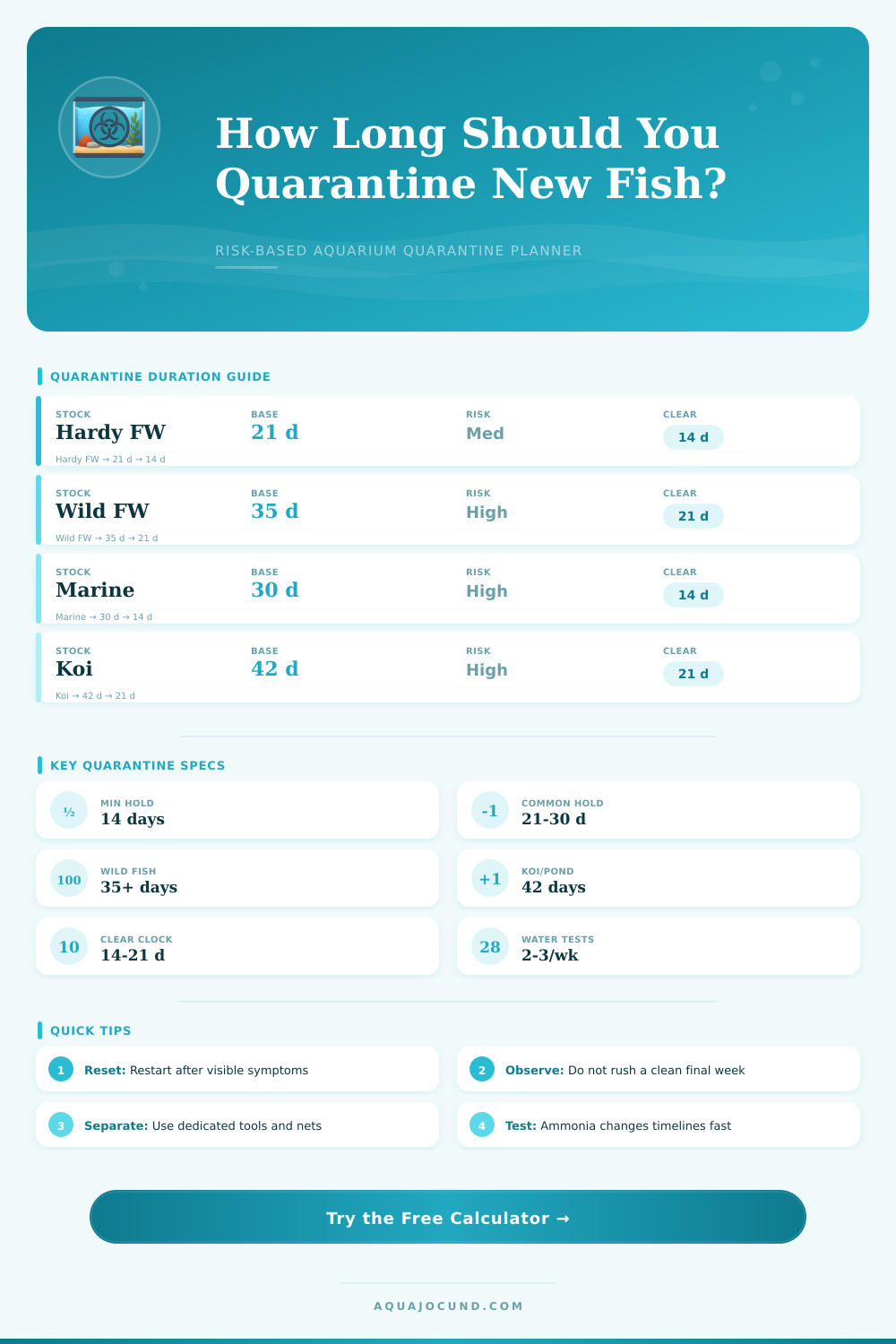
| Hardy freshwater fish | 21 days | 14 days | Enough time to see most early shipping and store-system issues. |
| Delicate freshwater fish | 28 days | 14 days | Extra feeding and stability time for stress-prone species. |
| Wild-caught freshwater fish | 35 days | 21 days | Longer parasite, weight, and behavior observation window. |
| Goldfish | 30 days | 14 days | Heavy waste load and frequent store-system exposure. |
| Koi / pond fish | 42 days | 21 days | Outdoor temperature cycles and high cross-contamination risk. |
| Marine fish | 30 days | 14 days | Allows observation or completion of a defined marine protocol. |
| Shrimp, snails, invertebrates | 30 days fishless | 14 days | Reduces transfer risk from fishless hosts, water, and shells. |
| Aquarium plants | 14 days | 7 days | Pest, algae, snail egg, and hitchhiker inspection after dipping. |
| Source Type | Adjustment | Risk Level | Use When |
|---|---|---|---|
| Known breeder / trusted local | +0 days | Low | Stable source, isolated systems, clear feeding history. |
| Local fish store system | +7 days | Medium | Shared retail water or mixed supplier turnover. |
| High-turnover retail system | +10 days | Medium-high | Many new shipments and unknown tankmates. |
| Recent import or transship | +14 days | High | Long shipping chain, fresh arrival, or wholesaler bags. |
| Rescue / unknown history | +14 days | High | Unknown exposure, mixed tanks, or poor prior care. |
| Your own healthy tank | -7 days | Low | Transfer from a known, symptom-free system. |
| Protocol | Minimum Course | Post-Course Watch | Calculator Rule |
|---|---|---|---|
| Observation only | 0 days | 14+ clear days | Uses species base, risk adders, and clean clock. |
| Deworming / internal parasite course | 14 days | 7-14 days | Ensures at least 14 days plus feeding recovery. |
| External parasite treatment course | 10 days | 14 days | Adds a clean clock after the final visible sign. |
| Broad freshwater medication course | 10 days | 14 days | Extends if bacterial signs or unstable water remain. |
| Marine copper course | 30 days | 14 days | Holds the total at no less than the copper course plus watch. |
| Marine hyposalinity observation | 28 days | 14 days | Requires a controlled salinity period plus recovery observation. |
| Salt-supported freshwater hold | 7 days | 14 days | Keeps the timeline driven by symptoms and species risk. |
| Plant dip and pest observation | 1 day | 14 days | Tracks pests, eggs, melting, and hitchhikers after dipping. |
| Condition | Add Days | Clean Clock | Why It Matters |
|---|---|---|---|
| No visible symptoms | +0 days | Species base | Continue observing appetite, breathing, and waste. |
| Minor stress or flashing | +7 days | 14 days | May be shipping stress, irritation, or early parasite signs. |
| External parasites or spots | +14 days | 21 days | Visible signs reset the clock after signs disappear. |
| Sores, fin rot, cloudy eyes | +14 days | 14 days | Water quality and secondary infections need stable recovery. |
| Severe illness or not eating | +21 days | 21 days | Weak arrivals need more time after normal behavior returns. |
| Cooler than ideal range | +3 to +10 days | No reduction | Many parasite life cycles and recoveries slow in cool water. |
| Ammonia or nitrite event | +3 to +7 days | No reduction | Water stress can mimic disease and delay recovery. |
New fish will arrive in a bag, a box, or a bucket. As soon as the new fish enter your water, the quarantine process begin. You must decide how long to quarantine the new fish.
The length of the quarantine period for your new fish will depend upon several different factor. For example, the origin of the fish will have an impact upon the length of the quarantine period. Other factors that will impact the length of the quarantine period for your new fish include the symptom that the fish exhibits, the treatment that you will provide to the fish during the quarantine period, and the stability of the water chemistry in the quarantine tank.
How Long to Quarantine Your New Fish
The calculator take into account each of these different factor in the determination of the length of the quarantine period for your new fish. Each factor contribute to the length of the quarantine period. For example, base the length of the quarantine period upon the type of fish that you are keep.
Additional days are provide based upon the origin of the fish, the visible symptom of the fish, the length of the treatment cycle for the fish, the effect of the water chemistry upon the fish, the stress that the fish endured while being transport to your home, and the stability of the water in the quarantine tank. The length of the quarantine period will be the highest length of time among these different requirements for the fish to be move to your display tank. The origin of the fish will impact the length of time that the fish must be quarantined.
Fish from retail store may be exposed to other fish and there waste before they arrive in your home. Fish from breeder are typically kept in more controlled environments. Therefore, the calculator will provide additional days to account for the arrival of fish from retail stores.
The temperature of the water in the quarantine tank will impact the length of the quarantine period. Cool water slows the life cycle of many of the parasite that may infect your fish. Cool water will require additional days to the length of the quarantine period.
Additionally, ammonia and nitrite spike in the water will stress the fish, and the condition will mask the sign of disease in the fish. Additional days are calculate for both temperature and water chemistry. The type of treatment that you provide to your fish will impact the length of the quarantine period for the fish.
For example, copper treatment for marine fish take thirty days. Other treatment will take less time than thirty days. However, there will always be a waiting period after you provide the treatment to the fish.
The length of the quarantine period cannot be less than the length of these treatment. Another factor that impact the length of the quarantine period is the length of days the fish must remain without any symptom of illness. Any visible symptom will reset the length of the fish without symptom.
For instance, if a fish exhibit a single spot or a clamped fin, a period of time without symptom must be calculate again from zero day. Therefore, the length of the quarantine period is calculate based off the length of days that the fish must remain without any symptom of illness. The stocking level within the quarantine tank will impact the length of the quarantine period.
If the number of gallon of water in the tank divided by the number of fish in the tank is less than the minimum for that type of fish, the water chemistry within the tank will change more rapid than the fish should experience. Therefore, additional day are provide for additional water change and testing of the water chemistry. Finally, the length of time that the fish will remain in quarantine is based upon the number of day that must pass before any decision is made to move the fish to the display tank.
The cost of shortening the length of the quarantine period will be the potential loss of the fish, as well as any treatment that must be provide to the fish. The cost of the length of time of the quarantine period is the length of time that you and your aquarium will take to stand still while the fish remain in quarantine, as well as the length of time that the second tank will remain occupied while the fish are being quarantine. Both of these cost will be visible to you with the length of days that the calculator provide.
Make your decision based upon these cost. The goal is to ensure that the fish are healthy before you add them to your display tank.