🌊 Powerhead Size Calculator
Match pump size, turnover, livestock needs, losses, and flow pattern before dead spots build up.
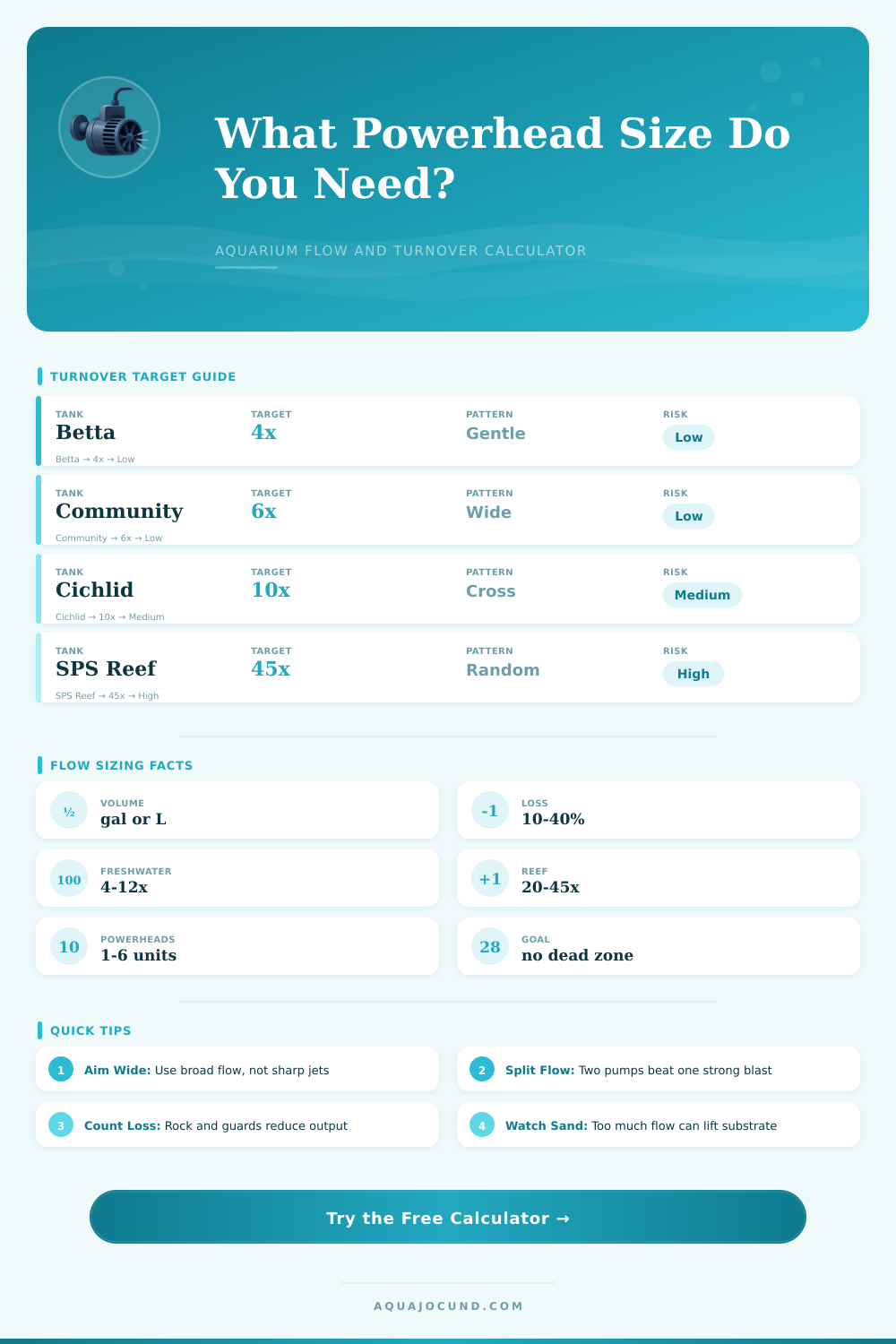
| Livestock Type | Target Turnover | Flow Style | Powerhead Note |
|---|---|---|---|
| Betta / Long Fins | 3-5x per hour | Gentle and indirect | Use low output or diffuse flow |
| Community Freshwater | 5-7x per hour | Wide circulation | One small powerhead can help long tanks |
| Planted Aquarium | 6-10x per hour | Soft whole-tank movement | Avoid blasting CO2 bubbles away too fast |
| Cichlid Aquarium | 8-12x per hour | Cross-current | Place pumps around rockwork pockets |
| Goldfish Tank | 10-14x per hour | Moderate, broad flow | Use strong filtration plus gentle circulation |
| Soft Coral Reef | 15-25x per hour | Random or sweeping | Wide-flow pumps prevent tissue irritation |
| LPS Mixed Reef | 25-35x per hour | Alternating moderate | Keep direct jets off fleshy corals |
| SPS Reef | 40-50x per hour | Random high energy | Multiple controllable pumps work best |
| Tank Size | Dimensions | Volume | Typical Flow Need |
|---|---|---|---|
| 10 Gallon | 20 x 10 x 12 in / 51 x 25 x 30 cm | 10 gal / 38 L | 40-80 GPH / 150-300 LPH |
| 20 Long | 30 x 12 x 12 in / 76 x 30 x 30 cm | 20 gal / 76 L | 120-200 GPH / 450-760 LPH |
| 29 Gallon | 30 x 12 x 18 in / 76 x 30 x 46 cm | 29 gal / 110 L | 175-290 GPH / 660-1100 LPH |
| 40 Breeder | 36 x 18 x 17 in / 91 x 46 x 43 cm | 40 gal / 151 L | 320-800 GPH / 1210-3030 LPH |
| 55 Gallon | 48 x 13 x 21 in / 122 x 33 x 53 cm | 55 gal / 208 L | 440-660 GPH / 1665-2500 LPH |
| 75 Gallon | 48 x 18 x 21 in / 122 x 46 x 53 cm | 75 gal / 284 L | 750-2250 GPH / 2840-8520 LPH |
| 125 Gallon | 72 x 18 x 22 in / 183 x 46 x 56 cm | 125 gal / 473 L | 2500-5600 GPH / 9460-21200 LPH |
| 180 Gallon | 72 x 24 x 24 in / 183 x 61 x 61 cm | 180 gal / 681 L | 3600-8100 GPH / 13600-30700 LPH |
| Factor | Typical Setting | Flow Impact | Dead Spot Effect |
|---|---|---|---|
| Clean guards, open layout | 10% loss | Most rated flow remains | Low if pump reaches full tank |
| Average rock and guards | 20% loss | Common real-world reduction | Medium in long tanks |
| Dense plants or rockwork | 30% loss | Flow breaks around hardscape | Medium to high behind decor |
| Heavy aquascape / clogged guards | 40% loss | Major output reduction | High unless pumps are split |
| Gentle directional | Single line | Best for calm fish | Can leave far corners stale |
| Wide opposing flow | Cross-current | Good general coverage | Usually low to medium risk |
| Circular gyre | Loop flow | Strong lengthwise movement | Good for long displays |
| Random / alternating | Variable flow | Best for reefs | Lowest dead-zone risk |
Achieving proper water flow in your aquarium is necesary to prevent the formation of stagnant water in the aquarium and to ensure that the tank have proper levels of oxygen in the water. If a person provides too little water movement in the tank, the waste will accumulate in the aquarium in certain areas, and the levels of oxygen will drop in those areas of the tank. However, if a person chooses to provide too much water movement, the fish in the tank will experience stress due to the movement of the water, as well as the powerfully movement of the water will damage the coral.
The powerhead size calculator takes into account the dimension of the tank, the type of livestock that will live in the tank, and the details of the pump to calculate the amount of water movement that are required for the aquarium. One of the main factor that must be considered in the calculation of the necesary water movement in the aquarium is the type of livestock that will live in the aquarium. For instance, livestock such as betta fish or long finned fish require water movement that is gentle enough to ensure that the water does not damage the fins of the fish.
How to Use a Powerhead Size Calculator
Community tanks require more movement than betta tanks, but community tanks require less movement than reef tanks. Reef tanks require rapid and random movements in the water in order to ensure that the stony corals receives the food that they need and to remove the waste that exits the coral polyps. Each of these preference for the livestock are accounted for in the calculator, as are the adjustments that must be made for the return flow from the main filter in the tank.
The output of a pump may be less than the number that is printed on the pump box. Many factor can reduce the output of the pump, including intake guards, rockwork, and the height of the tank that the water must be pumped to. Therefore, the loss selector in the powerhead size calculator allows individuals to account for these factor.
The gallons per hour that are represented in the calculator after accounting for these factor is the number that should be used in the purchase of a powerhead for the aquarium. In addition to the factors described above, the type of flow that the powerheads in the tank create is another important factor. Flow patterns in the tank will determine the evenness of the water movement throughout the aquarium.
For instance, strong water movement in only a single spot in a long tank may leave some area of the tank without any movement at all. Flow patterns such as opposing wide flow, gentle gyre, or even using two or three smaller powerhead units instead of one large powerhead allow for the even movement of water. The coverage score in the calculator will indicate if the water movements will leave some spot in the aquarium without water movement.
Factors such as algae build-up on the intake guards, clogged sponges, and complex rockwork in the aquarium will contribute to a reduction in the performance of the water pump as the aquarium age. What may work for an aquarium that is three month old may not work for an aquarium that is eighteen month old. The inclusion of the safety margin for a tank in the powerhead size calculator is for this very reason.
Adding ten or twenty percent of extra capacity to the aquarium will provide more time before the aquarium must be cleaned, as well as provide head room for the addition of more fish to the tank later on. Another important factor is the placement of the powerheads in the aquarium. The placement of the powerheads will determine the impact of the water movement upon the fish and the coral in the tank.
Powerheads should not be aimed at the fish or the coral, as the strong movement of the water will stress the fish and the coral. The powerheads should be aimed across the longest dimension of the tank, or may be bounced off of the back wall of the tank. The sand bed in the tank may also require some consideration.
Too much movement will lead to a “dust storm” in the tank, while too little movement will cause detritus to accumulate at the bottom of the rocks in the tank. Therefore, observation of the sand bed will allow the aquarist to adjust the angle or the output of the powerhead. The return flow from the filter is another factor in the calculation of how many gallon of water per hour that the powerheads should circulate through the aquarium.
Even though many individuals may only consider the dedicated circulation pumps for the tank, the return flow from the main filter should be considered as well. The return flow will count towards the required turnover of the aquarium as long as the return flow is directed into the display tank, not directly into the sump. The powerhead size calculator considers the return flow figure to ensure that individuals do not purchase powerheads that are too strong for the tank; purchasing powerheads that are too strong will create turbulence in the tank.
Once the individual has made the calculations with the powerhead size calculator, the individual can use observation to ensure that the calculated water movement is adequate. Observing the movement of the debris in the tank will show how well the water is circulating. Areas in which the fine particle appear to settle within the tank indicate that the water movement may need to be adjusted.
Additionally, the formation of a surface film in the corner of the tank may also indicate that adjustment are needed in the angle or the output of the powerheads. Changes to the aquarium may require an adjustment to the water movement calculations. For instance, if the aquarist adds rock to the tank, establishes a sand bed, or changes the type of coral that live in the aquarium, the water movement requirements will change.
Therefore, the powerhead size calculator should be run again after changing the aquarium to ensure that the tank does not experience inadequate water movement. Thus, the flow calculation is not a permanent decision, and will require adjustments each time the aquarium is changed.