Aquarium Plant Mass Ratio Calculator
Balance wet plant biomass against tank volume, growth speed, CO2, light, nutrients, fish load, and trim headroom.
📏Tank And Plant Inputs
🌿Plant Group Comparison
📊Target Ratio Reference
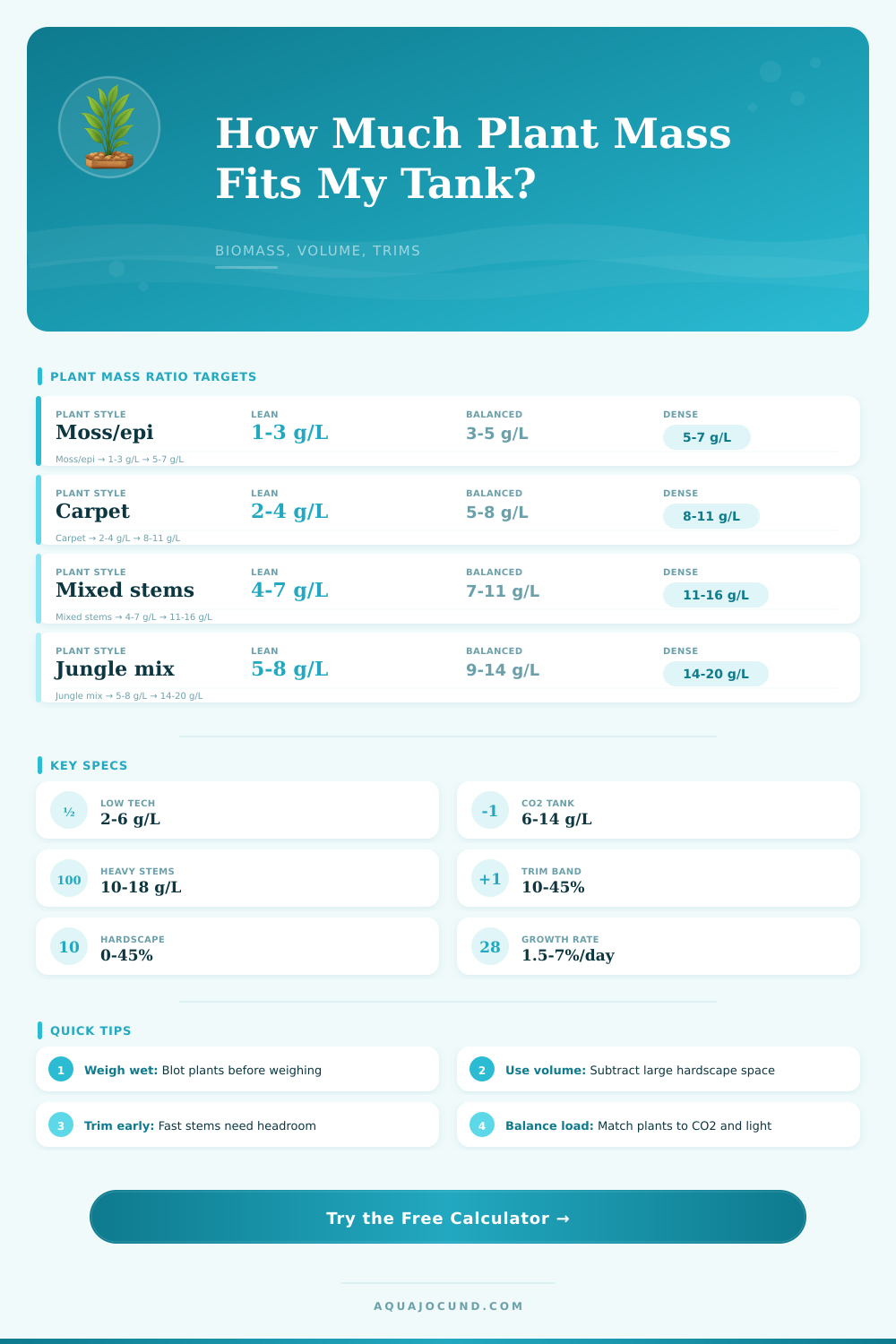
| Planting Style | Typical Wet Mass Ratio | Best Use | Trim Behavior |
|---|---|---|---|
| Open low-tech layout | 2-5 g/L (0.27-0.67 oz/gal) | Slow plants, open foreground | Monthly shaping |
| Balanced community aquascape | 5-9 g/L (0.67-1.20 oz/gal) | Mixed stems, rosettes, epiphytes | Every 2-4 weeks |
| High-energy CO2 tank | 8-14 g/L (1.07-1.87 oz/gal) | Dense stems and carpet growth | Weekly to biweekly |
| Jungle or farmed plant tank | 12-20 g/L (1.60-2.67 oz/gal) | Plant holding, nutrient export | Frequent thinning |
💧Common Tank Size Guide
| Tank | Dimensions | Volume | Balanced Plant Mass |
|---|---|---|---|
| 10 gallon | 20 x 10 x 12 in (51 x 25 x 30 cm) | 38 L | 190-340 g wet (6.7-12.0 oz) |
| 20 gallon long | 30 x 12 x 12 in (76 x 30 x 30 cm) | 76 L | 380-685 g wet (13.4-24.2 oz) |
| 40 breeder | 36 x 18 x 16 in (91 x 46 x 41 cm) | 151 L | 755-1360 g wet (26.6-48.0 oz) |
| 75 gallon | 48 x 18 x 21 in (122 x 46 x 53 cm) | 284 L | 1420-2555 g wet (50.1-90.1 oz) |
⚙Adjustment Factors
| Factor | Lower Target | Neutral Target | Higher Target |
|---|---|---|---|
| Light | Low light x0.75 | Medium x1.00 | High x1.20, intense x1.35 |
| CO2 | No CO2 x0.75 | DIY CO2 x1.00 | Pressurized x1.20 |
| Nutrients | Lean x0.85 | Balanced x1.00 | Rich x1.15, EI x1.25 |
| Fish load | Heavy swim-space load x0.95 | Normal x1.00 | High nutrient load x1.05 |
✂Trim Planning Reference
| Growth Speed | Daily Mass Gain Used | Good Trim Headroom | Watch Point |
|---|---|---|---|
| Slow | 1.5% per day | 25-45% | Old leaves and shaded rhizomes |
| Steady | 3.0% per day | 20-35% | Lower-stem shading |
| Fast | 5.0% per day | 15-30% | Canopy closing over carpet |
| Very fast | 7.0% per day | 10-25% | Surface crowding and poor flow |
Too much or too little biomass in a tank can make all aquarium plant appear weak. The leaves don’t hold there color, the stems lengthen, etc. It’s not necessarily a nutrient deficiency or lack of light, it’s usually just that amount of living plant material doesn’t fit well into the tank. That means there isn’t enough stuff for the plants to live on, nor do they has enough stuff packed in place to consume what they’ve got.
If there’s too much, then there aren’t enough nutrients to go around and the plants starves. Too little? Well, then algae takes over because no one else is consuming the nitrate and phosphate. Find a happy medium by having enough plants to keep things clean without letting them die.
How to Find the Right Amount of Plants for Your Tank
To determine this ratio, use the calculator above to input the size of your tank. It factors in what many beginner overlook: items like rock and wood that displace water volume. Just because you have a 20 gallon tank doesn’t mean it hold 20 gallons of water when half is covered with hardscapes. Less water column mean less target mass of plants. It’s why we adjust for this displacement to aim for the right mass based off available volume (i.e., the water column). After all, the plants don’t inhabit the rock; they’re in the water.
What’s the maximum biomass for my tank? This depend on lighting and carbon dioxide. If your set up is low tech with simple LED lights, it won’t support as many plant as a high-tech setup equipped with high-intensity lighting and pressurized CO2. Depending on the light source, perhaps a low-tech tank supports two to five grams/liter of wet mass, whereas a high-tech one can sustains ten or more.
Why? Overcrowding a low-light tank results in leaves that go mushy and roots that rot. Before you know it, there is no more plants to fill the volume because they’re all out of food. So why do so many folks purchase brighter lights, thinking they’ll be able to grow more plants? Because you haven’t changed your biomass target(s) and nutrient dosing to match, you’re just adding to the plant’s stress level.
The other thing is that fast growing stem plants grows very quickly (doubling their mass in a few weeks under ideal conditions). That means if your starting point is desired amount of plant material, then you’ll have to cut every three days. Instead, begin with fewer stems/plant and allow them to reach maturity over time. By doing this, the roots has time to develop and not compete with each other initially. Basically leave some growing room so the fish tank does not look overcrowded as it matures (according to the reference information).
To measure the wet mass of plants, I found it hard to get an accurate measurement, as they weigh differently when wet compared to when dried out. So accuracy isn’t necessarily important, but consistency is. Every time you measure your wet plant mass, give it a gentle pat down so that there’s no extra water on it and then shake some off before measuring. That way you can compare numbers from month to month. What you’re trying to find here is a trend line. Are the plants gaining mass? If so, they’re healthy. Not gaining mass? They might of been starved of light or nutrients.
Remember, you are looking for a tank that is manageable yet also looks alive. Too heavy and you’re constantly cutting things down on the weekend. If it is not heavy enough, you’ll have problems with algae or excess nutriants. So start with the calculated number and then observe how your particular mix respond. Tweak it accordingly. The formulas will give you an estimate but your plants will inform you whether you are headed in the right direction. If they grow steadily and there color is vibrant, you’ve got it dialed in.