Aquarium Dual Overflow Flow Split Calculator
Estimate how a two-overflow aquarium divides return flow across left and right boxes, then check weir load, drain reserve, and target balance.
| Drain Diameter | Open Channel Planning | Tuned Siphon Planning | Typical Use |
|---|---|---|---|
| 0.75 in / 20 mm | 150 gph / 568 lph | 275 gph / 1041 lph | Nano auxiliary or low-flow side box |
| 1 in / 25 mm | 300 gph / 1136 lph | 550 gph / 2082 lph | Common dual-corner mixed reef drain |
| 1.25 in / 32 mm | 500 gph / 1893 lph | 900 gph / 3407 lph | Mid-size displays with extra headroom |
| 1.5 in / 40 mm | 700 gph / 2650 lph | 1250 gph / 4732 lph | Large reef, predator, and peninsula systems |
| 2 in / 50 mm | 1200 gph / 4542 lph | 2100 gph / 7949 lph | Large displays, public-style sumps, long runs |
| 2.5 in / 65 mm | 1800 gph / 6814 lph | 3200 gph / 12113 lph | Very large display drains and shared sump trunks |
| 3 in / 75 mm | 2500 gph / 9464 lph | 4500 gph / 17034 lph | Public aquarium style systems and oversized manifolds |
| Weir Target | Planning Rate | Best Fit | What It Usually Means |
|---|---|---|---|
| Silent edge | 25 gph/in / 38 lph/cm | Living room reefs | Lower water velocity and less waterfall sound |
| Quiet mixed reef | 40 gph/in / 60 lph/cm | Most dual overflows | Balanced skim without pushing the teeth hard |
| Normal display | 55 gph/in / 82 lph/cm | Fish-focused displays | More turnover with a higher chance of trickle noise |
| Aggressive skim | 70 gph/in / 104 lph/cm | High-flow surface pull | Best only when drains and emergency paths are generous |
| Common Dual-Overflow Tank | Typical Dimensions | Return Range | Balanced Planning Note |
|---|---|---|---|
| 75 gal / 284 L reef | 48 x 18 x 21 in / 122 x 46 x 53 cm | 450-750 gph / 1703-2839 lph | Two 1 in drains can work if reserve stays conservative |
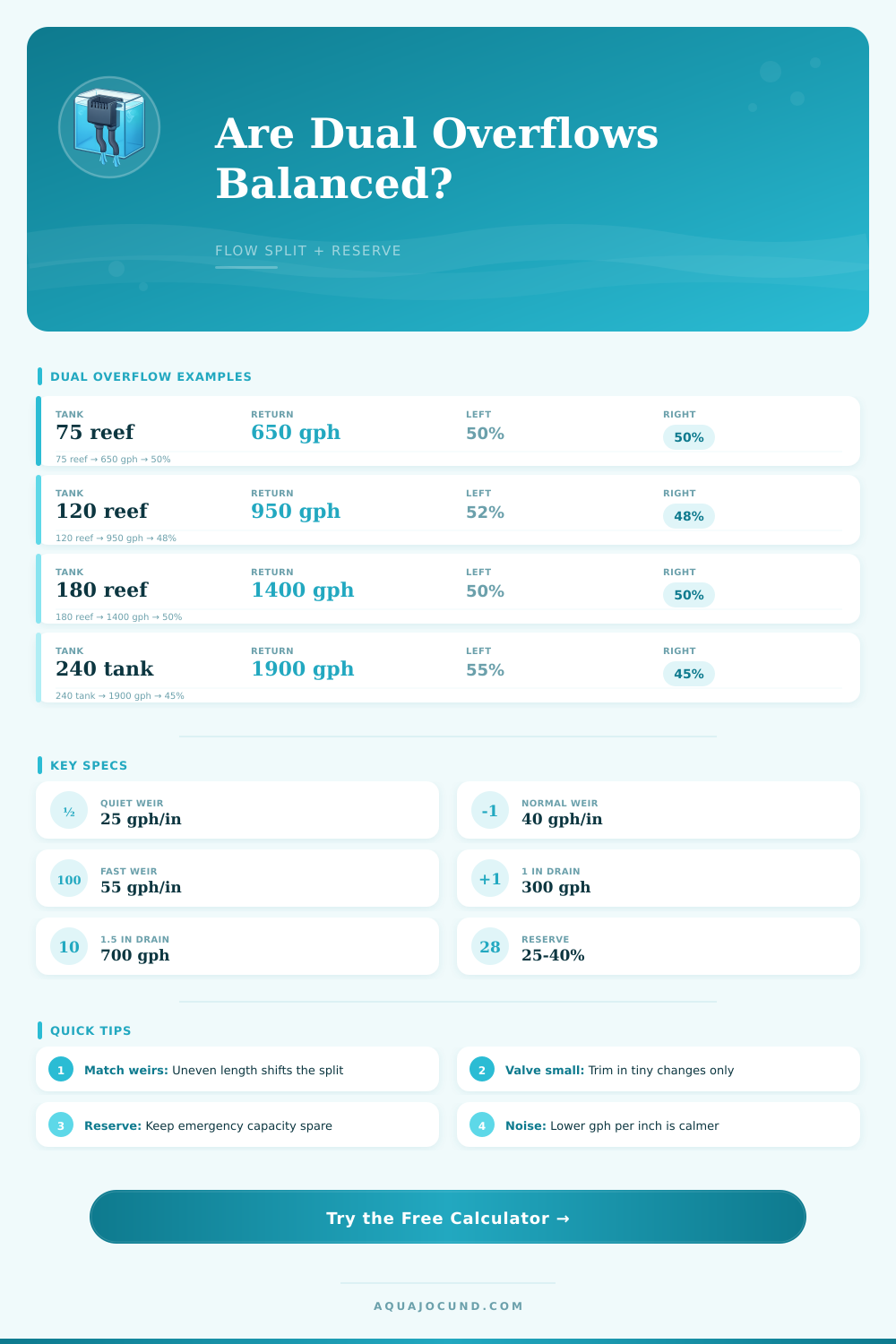
| 120 gal / 454 L reef | 48 x 24 x 24 in / 122 x 61 x 61 cm | 700-1100 gph / 2650-4164 lph | Equal weirs with 1.25-1.5 in drains balance easily |
| 180 gal / 681 L reef | 72 x 24 x 24 in / 183 x 61 x 61 cm | 1000-1600 gph / 3785-6057 lph | Longer weirs help keep each side below noisy velocity |
| 240 gal / 908 L display | 96 x 24 x 24 in / 244 x 61 x 61 cm | 1400-2200 gph / 5299-8328 lph | Large drains or multi-pipe boxes protect reserve margin |
| 300 gal / 1136 L frag | 96 x 30 x 24 in / 244 x 76 x 61 cm | 1800-3000 gph / 6814-11356 lph | Use capacity-share split if one end has a shorter path |
| Balance Symptom | Likely Cause | Calculator Input To Test | Practical Read |
|---|---|---|---|
| Left box runs louder | Left is carrying more than its share | Plumbing imbalance or valve trim | Target a smaller split error before raising pump speed |
| One overflow teeth line is high | Weir is short for the assigned flow | Left/right weir length | Capacity-share may be better than a forced 50/50 split |
| Emergency drain gets wet | Main drain reserve is too small | Drain diameter and safety reserve | Reduce return flow or increase drain capacity |
| Split changes after cleaning | Organic film or snail guard friction changed | Valve trim and imbalance | Leave enough reserve for small real-world drift |
The sound of a well tuned fish tank is a unique silence. It’s not an empty silence but rather the constant rumble of water running through filters and piping. Adding another couple overflow into the mix doesn’t really make it any quieter; it makes it more dependent off geometric factors than raw power. Enter your pump ratings and weir lengths into the calculator and let it do the rest for you. No need to convert or guess at coefficients.
Balance is the main point of most dual overflow systems. Most people who build them think that their job are to make them perfectly balanced at 50-50. And that’s where the wheels comes off the wagon for many. If you give one box the same drain diameter as another, even though its run length is much differenter, you will starve one box while drowning the other. You must know what you are trying to balance. It’s more than just balancing volume; you’re also balancing surface area, friction and pressure.
Simple Rules for Dual Overflow Systems
The length of the weir is important. More so then most realize. You want enough water falling on the end but not so much that you create a waterfall (which would sound like one). Twenty five gallons per hour per inch is a reasonable estimate for a silent edge. Seventy or more are possible with an aggressive skim. Two short weirs attempting to manage a thousand gallons an hour will be noisy. That’s because there is turbulence where the water meets the teeth line. Enter your weir dimensions and this tool will show you whether you’re pushing too much flow across too little surface. When the water fall slower, you have less air mixing in and far less trickle noise downstream.
The other key to sizing is drain size. What’s your safety margin? In theory, a one inch drain can process three hundred gallons an hour in an open channel. However, there is no margin of error if the sump fluctuate or the pump increases speed. The table on this page compares capacities of open channel plans and tuned siphons. Reserve capacity you want! Operating near maximum on your main drains means a simple foam event or clog could cause your emergency overflow to go off, and that’s typically not a fun evening.
Real life involves fine tuning knobs like Valve Trim and Plumbing Bias. Every installation isn’t exactly symmetrical. There may be a tighter fitting elbow on one side or an additional one. Real world imperfections can be simulated by entering a bias percent into the calculator. That way you can guess which valve needs adjusting without ever touching it. Balance is reached through small adjustments of the valves, big turns result in wildly swinging flows and water levels. Small adjustments let the system stabilize.
One easily overlooked factor relates to head height. How far above head height does the pump need to push the water? This will impact the true rate of delivery vs. What the manufacture rates the pump for. Planing without factoring out head loss means you’re using hopeful numbers that don’t apply in your livig room. When you take it into account, you know your drain sizes and weir lengths matches real-world needs instead of catalog specs.
So how’s that all work out? Well… In short, a dual overflow setup should of been invisible. Water should run where it wants with no struggle against the plumbing. Capacity trumps evenness; it’s more important to have slightly too much on one side than not enough on the other. Leave some slack in case something goes wrong. And dial in the valves ever-so-gently. Let the physics carry the load while you relax and admire the show rather than fix noise.