Open Swim Space Calculator
Estimate usable aquarium swimming room from tank footprint, hardscape occupied area, fish body length, schooling path length, open corridor width, and species swim zone.
Calculation breakdown
| Swim style | Minimum path | Corridor width | Open footprint cue | Zone priority |
|---|
| Tank size | Typical footprint | Base area | Open area at 20% occupied | Best open lane |
|---|---|---|---|---|
| 5 gal / 19 L | 16 x 8 in / 41 x 20 cm | 128 sq in / 826 sq cm | 102 sq in / 661 sq cm | Short slow-fish lanes |
| 10 gal / 38 L | 20 x 10 in / 51 x 25 cm | 200 sq in / 1290 sq cm | 160 sq in / 1032 sq cm | Nano schools if open |
| 20 long / 76 L | 30 x 12 in / 76 x 30 cm | 360 sq in / 2323 sq cm | 288 sq in / 1858 sq cm | Strong small-fish run |
| 29 gal / 110 L | 30 x 12 in / 76 x 30 cm | 360 sq in / 2323 sq cm | 288 sq in / 1858 sq cm | Same lane, taller water |
| 40 breeder / 151 L | 36 x 18 in / 91 x 46 cm | 648 sq in / 4181 sq cm | 518 sq in / 3345 sq cm | Wide turn corridors |
| 55 gal / 208 L | 48 x 13 in / 122 x 33 cm | 624 sq in / 4026 sq cm | 499 sq in / 3221 sq cm | Long but narrow lane |
| 75 gal / 284 L | 48 x 18 in / 122 x 46 cm | 864 sq in / 5574 sq cm | 691 sq in / 4459 sq cm | Long and wide |
| 125 gal / 473 L | 72 x 18 in / 183 x 46 cm | 1296 sq in / 8361 sq cm | 1037 sq in / 6689 sq cm | Large school runway |
| Open layout | Hardscape occupied | Lane reduction | Zone effect | Calculator meaning |
|---|---|---|---|---|
| Open schooling tank | 0-15% | 0-8% | Clear mid or upper band | Most footprint remains usable. |
| Balanced planted display | 15-30% | 8-18% | Open front lane matters | Good if path and width still pass. |
| Dense aquascape | 30-45% | 18-35% | Zones can fragment | Open score depends on lane continuity. |
| Rock wall or cave layout | 40-60% | 25-45% | Lower zone may be blocked | Better for territorial or cave fish. |
| Minimal bottom cover | 10-25% | 5-15% | Bottom zone stays open | Useful for corys, loaches, and grazers. |
| Fish length | 8x path | 10x path | 14x path | 3x corridor |
|---|---|---|---|---|
| 0.75 in / 1.9 cm | 6 in / 15 cm | 7.5 in / 19 cm | 10.5 in / 27 cm | 2.25 in / 5.7 cm |
| 1.25 in / 3.2 cm | 10 in / 25 cm | 12.5 in / 32 cm | 17.5 in / 44 cm | 3.75 in / 9.5 cm |
| 2 in / 5.1 cm | 16 in / 41 cm | 20 in / 51 cm | 28 in / 71 cm | 6 in / 15 cm |
| 3 in / 7.6 cm | 24 in / 61 cm | 30 in / 76 cm | 42 in / 107 cm | 9 in / 23 cm |
| 5 in / 12.7 cm | 40 in / 102 cm | 50 in / 127 cm | 70 in / 178 cm | 15 in / 38 cm |
I have seen it many times. Someone buys a new tank. They decorate it with driftwood, rocks, and some plants. It looks cool on the exterior. A week later you notice your fish are stressed. They is darting around the tank from decoration to decoration, hovering next to glass. The water quality must be bad, right? Wrong. Often it’s a matter of space.
Your tank contains plenty of things, but very little of it are usable space. Available swim space isn’t related to volume, it’s related to flow and geometry. Most hobbyists focus on the number of gallons. They figure a ten gallon tank have less capacity for everything when compared to a twenty-gallon tank. What they fail to realize is that fish don’t move like that.
Why Empty Space Matters for Fish
Tetras need enough length to school and form an uninterrupted line. Bettas require breathing space, which mean not being obstructed by something above them. Goldfish need enough space to turn around. You provide the dimensions, and the calculator does the math. You will no longer have to guess if your layout is overcrowded. Instead, it calculates what counts, open space remaining after decoration.
First, think about footprint. Decorative hardscape looks decorative until it becomes a maze. Filling forty percent of the tank floor with rock or wood remove that much swimming room. That hurts the most if you are an active swimmer. Your commuter danio gets stuck in a crowded tank. Use the table as a reference to see how various levels of occupancy break up swim zone.
It’s not just about overall open space but also length of any one continuous lane. Block it with a rock or piece of leaf? Doesn’t count. Think in terms of body lengths and widths. You’re the fish; how would YOU feel about having so little room to move? Do they use inches and centimeters? They think in terms of body lengths and widths.
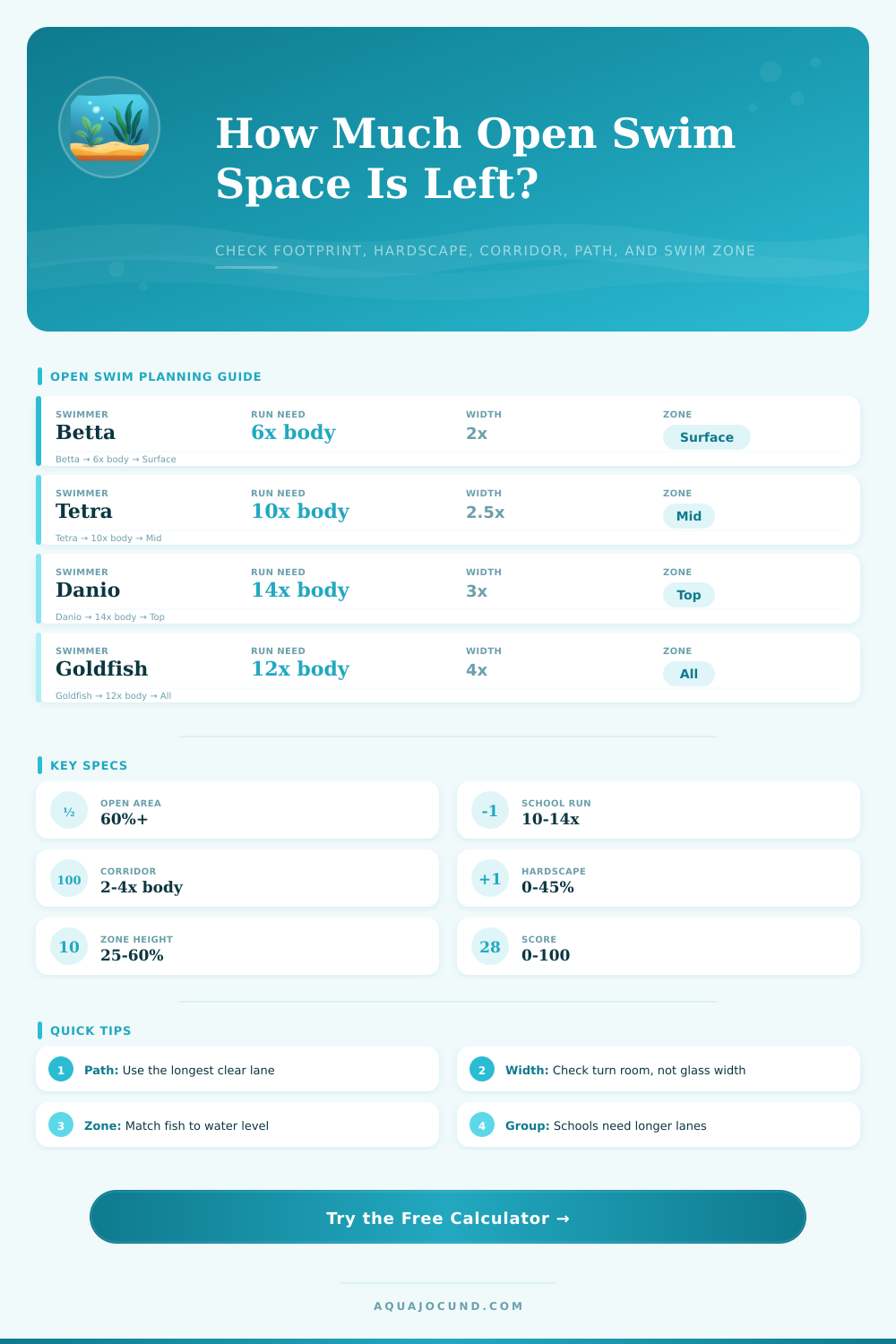
To safely accelerate and decelerate, they need ten to fourteen times their body length from which to operate. The larger that multiplier is, the more room a fast swimmer need. If you’ve got a three-inch fish, you’d better give them at least thirty inches of open space in which to school comfortabley. Standard tanks measure forty-eight inches long. Sounds like plenty, right? Then take away the area surrounding the gravel and the filter intake zone. It adds up quick.
As much as length matters, so does width. How wide are the corridors? Are there places where fish can easily turn? If you have length but only three body widths clear, your fish won’t be happy because that’s too narrow, especially with deep bodied fish such as angelfish. These guys wants enough side-to-side space to move and flare their fins. The tool assesses this by comparing what you’ve measured for corridor vs. Your selected species profile. It helps avoid the typical error of housing active open-water swimming species in displays meant for vertical activity (i.e., tall tanks).
Another little detail is aligning swim zones. If you’ve got floating plants all over surface, that’s bad news for surface dwellers. Likewise, when there’s no clear access to bottom dwelling substrate due to rock walls clogging the way, that spells trouble for bottom feeders. Your open areas should match where fish naturaly prefer to live in the water column so they aren’t confined or battling gravity. It doesn’t matter much on its own, but it makes a big difference later.
The score is a guideline, it’s not the law. The higher the score, the more likely the shape support the behavior of the selected species. A lower score means you must choose slower fish or remove hardscape. Better to have less decoration initially and go from there rather than filling the tank and wondering why your fish are looking unhappy.
You should of thought about the empty room. Nowhere to go equals no life in the display. Clear the lanes.