🐟 Metronidazole Aquarium Dosing Calculator
Convert a confirmed metronidazole target into product scoops, tablets, or capsules for water-column dosing, food-soak batches, redose schedules, and water-change top-ups.
✅ Dose calculation result
| Mode | Main formula | Best input to verify | Result shown | Common source of error |
|---|---|---|---|---|
| Water-column | Target mg/L x net liters | Actual water volume after displacement | mg active and product units | Using nominal tank size instead of net water |
| Food soak | Target mg/g x food grams | Food weight for the full batch | Batch mg and product units | Estimating food volume instead of weighing it |
| Water change | Current mg/L x changed liters | Change percent and current level | Replacement redose amount | Redosing the whole tank after a partial change |
| Safety margin | Base dose x margin factor | Scale precision and product consistency | Adjusted active amount | Adding a margin when the label already includes one |
| Tank | Typical dimensions | Nominal volume | Example net volume | Use in calculator |
|---|---|---|---|---|
| 5 gal hospital | 16 x 8 x 10 in | 18.9 L | 15-18 L | Small measured doses |
| 10 gal QT | 20 x 10 x 12 in | 37.9 L | 30-36 L | Use direct volume if marked |
| 20 long | 30 x 12 x 12 in | 75.7 L | 62-72 L | Good for food or water math |
| 29 gal | 30 x 12 x 18 in | 109.8 L | 90-103 L | Height changes dilution |
| 40 breeder | 36 x 18 x 16 in | 151.4 L | 125-142 L | Measure after decor |
| 75 gal | 48 x 18 x 21 in | 283.9 L | 230-265 L | Large error if guessed |
| 125 gal | 72 x 18 x 22 in | 473.2 L | 390-445 L | Displacement matters |
| Measurement | Example active amount | Calculator field | How to verify | Precision note |
|---|---|---|---|---|
| Powder scoop | 100-250 mg active | mg per scoop | Read the scoop statement on the label | Level the scoop consistently |
| Tablet | 250-500 mg active | mg per tablet | Use the printed active ingredient amount | Split tablets only if scored or weighed |
| Capsule | Often 250 mg active | mg per capsule | Confirm aquarium-safe contents | Do not assume human fillers are suitable |
| Bulk powder | User measured | custom unit mg | Use a milligram scale | Record the actual active mass |
| Scenario | Input used | Calculator operation | Output meaning | Check before dosing |
|---|---|---|---|---|
| Full planned redose | Interval and days | Counts dose points in the window | Planning total, not a command | Retest water and observe fish first |
| Partial water change | Change percent | Changed liters x current mg/L | Medication removed by water | Use current level, not initial dose |
| Food batch | Food grams x feedings | Batch grams x mg/g target | Active mg mixed into food | Confirm all food will be eaten |
| Measured-loss buffer | Margin percent | Base mg x margin factor | Adjusted amount to weigh | Avoid stacking multiple buffers |
Base the calculation on active ingredient. A scoop, capsule, or tablet may include carriers, binders, or filler. Enter only the metronidazole milligrams listed for that measured unit.
Replace only the medication removed with water. A 25% water change removes about 25% of the dissolved water-column dose, before considering degradation, filtration, or label-specific instructions.
Metronidazole can be used to treat both internal and external parasites in freshwater and marine aquarium fish. To use this medication, you have to convert the target concentration to an amount of metronidazole. Many people make the mistake of using the nominal tank volume rather than the actual volume of water that the aquarium can hold due to the amount of space that the substrate and rocks occupy in the tank.
Furthermore, the scoop of metronidazole may contain fillers that mean the scoop dont contain that amount of actual metronidazole. Metronidazole remains dissolved in the water column in the tanks. As such, if you perform a water change, you will also be removing some of the metronidazole from the tank.
How to Dose Metronidazole in Your Fish Tank
To account for this, you can calculate the amount of metronidazole that needs to be added to the tank during a water change based on the percentage of water that is changed. The redose field in the calculator will calculate this amount for you so that you dont under-dose your fish or over-dose them over time. Food soak dosing is another method for adding metronidazole to the tank.
In this case, you soak the food in metronidazole, and the fish consume the metronidazole through the food. In this case, the concentration that is targeted is not in relation to the volume of water in the tank, but in relation to the amount of metronidazole per gram of food. Furthermore, because the fish will only eat the food that is offered to them, the amount of metronidazole needed for food soak dosing is less than the amount needed for water column dosing.
The binder margin allows for the addition of extra metronidazole to account for any that may be lost in the soaking of the food. You must decide which method of administration is better for your species of fish and the type of parasite that they has. The calculator will calculate the amount of metronidazole needed based on the daily food weight and the number of times that the fish are fed.
Many aquarium owners can mistake the tank volume. The nominal tank volume assumes that the aquarium is an empty vessel that is filled to the rim with water. However, the actual volume of water that the aquarium can contain is less due to the addition of substrate and decorative items.
The displacement percentage field allows for the subtraction of the volume of decorations in your aquarium. Alternatively, the direct-volume option allows you to measure the volume of water in your tank directly. Either field will allow you to calculate the actual volume of water in your aquarium in liters.
Multiplying this value by the concentration of metronidazole will provide the total amount of milligrams of metronidazole that is needed. The strength of the metronidazole can vary from brand to brand. For instance, one brand of metronidazole may contain 250mg of metronidazole per scoop, but another similar brand may only contain 100mg of metronidazole per tablet of the same weight.
The product-selection drop down menu provides some of the common strengths. You can also enter a custom value in the field provided for the dosage of metronidazole in each scoop or tablet. Because you remove the amount of water in the aquarium during a water change, the same percentage of metronidazole is removed from the tank.
Therefore the amount of metronidazole that should be added to the aquarium during a water change is equal to the volume of water that is changed multiplied by the current concentration of the metronidazole in the aquarium. The calculator will provide this amount for you to ensure that you dont have to calculate this dosage yourself. If you do not use the redosing calculation, the amount of metronidazole in the tank may significantly decrease over time and the fish could be adversely affected.
Margins can be used for a variety of reasons. For instance, using the positive margin can help to account for inaccuracies in the scales that you may use to measure the water or the scoops of metronidazole that you add to the aquarium. Furthermore, using a negative margin will allow you to under-dose your fish if the species that you are treating with metronidazole is sensitive to the medication.
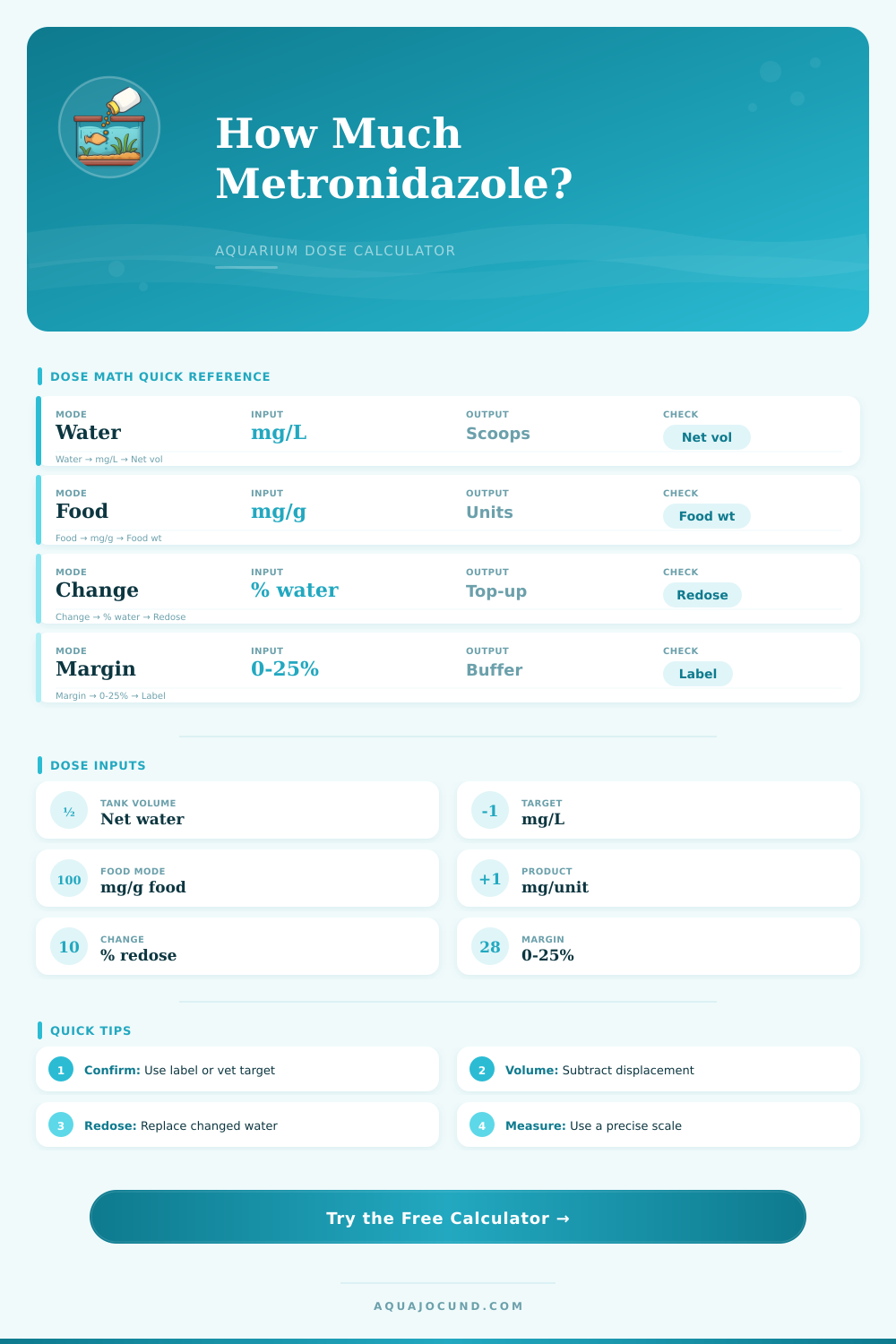
However, you should take care in the setting of margins because your total amount of metronidazole could move significantly away from the target amount if multiple margins are applied. The reference tables at the bottom of the dosing page contain the mathematical formulas that is used to calculate the amount of metronidazole that should be added to the aquarium in each mode of administration. For instance, the water column dose calculation is simply the multiplication of the concentration of the metronidazole and the net volume of water in the aquarium.
The food soak dosage calculation is the multiplication of the target dosage of metronidazole in milligrams per gram of food times the total weight of the food that will be fed to the fish during the feedings. The replacement of water change calculation is the multiplication of the volume of the water change and the concentration of the metronidazole in the aquarium prior to the water change. These mathematical calculations can help to ensure that the amount of metronidazole that is calculated with the calculator is correct and within the expected range of dosage amounts.
The real aquariums that exist in fish tanks have a variety of variables that the calculator cannot account for. For instance, the water temperature can impact the degradation of the metronidazole in the water. Activated carbon and other chemical filters in the aquarium can also remove the metronidazole from the water.
Finally, the individual fish may exhibit sensitivity to the medication. The calculator is just a starting point; you must also use your judgement and knowledge of your fish to make adjustments to the protocol that is suggested by the calculator. Furthermore, the goal of the addition of the metronidazole to the aquarium is to add the same amount of medication as the protocol requires to be added.
Therefore, you must account for the actual amount of water in the aquarium, the actual strength of the metronidazole product that you use, and the actual amount of metronidazole that may be lost to the maintenance of the aquarium.