Aquarium Medication Water Change Calculator
Estimate concentration remaining after water changes, medication decay, and redose strategy for quarantine or hospital tanks.
| Medication Profile | Default Target | Common Redose Style | Water-Change Math Note |
|---|---|---|---|
| Chelated copper | 2.0 mg/L reference target | Dose replacement water or restore by test | Copper binds to surfaces, so concentration math should be checked with a compatible copper kit. |
| Ionic copper | 0.20 mg/L reference target | Small tested corrections | Narrow range; calculate deficit but verify before adding more. |
| Formalin malachite products | 1.0 label-level dose | Often full scheduled redose after change | Because products vary, label level is treated as a dimensionless concentration scale. |
| Methylene blue | 3.0 mg/L reference target | Restore target in clean hospital water | Blue dye can stain and can be removed by carbon, light, and water changes. |
| Praziquantel | 2.5 mg/L reference target | Maintain for the label interval | Large water changes can shorten exposure unless changed water is redosed. |
| Aquarium salt | 1.0 g/L reference target | Dose changed water only | Salt remains until water is removed; top-off water normally receives no salt. |
| Water Change | Medication Left Before Redose | Deficit to Target | Typical Use |
|---|---|---|---|
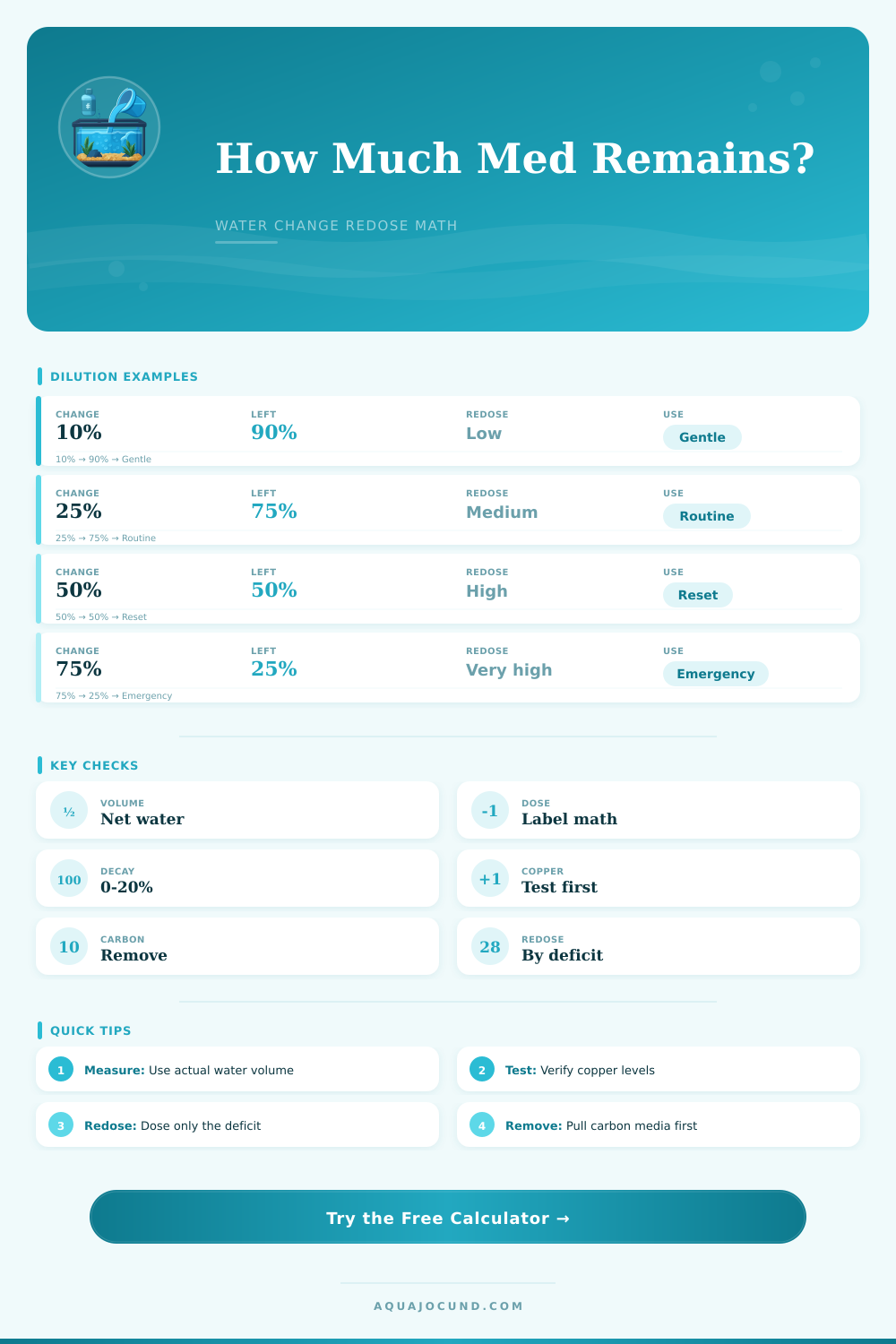
| 10% | 90% of current concentration | 10% of target if already at target | Gentle maintenance during sensitive treatments. |
| 25% | 75% of current concentration | 25% of target if already at target | Common hospital tank change with moderate redose. |
| 33% | 67% of current concentration | 33% of target if already at target | Frequent ich-style change schedules. |
| 50% | 50% of current concentration | 50% of target if already at target | Large ammonia-control or reset change. |
| 75% | 25% of current concentration | 75% of target if already at target | Major dilution where full redose math matters. |
| Common Tank | Typical Dimensions | Net Treated Water | 25% Replacement Dose at 1 Label Level |
|---|---|---|---|
| 5 gal | 16 × 8 × 10 in / 41 × 20 × 25 cm | 4.0-4.6 gal / 15-17 L | About 1.0-1.2 gal worth of product. |
| 10 gal | 20 × 10 × 12 in / 51 × 25 × 30 cm | 8.0-9.2 gal / 30-35 L | About 2.0-2.3 gal worth of product. |
| 20 long | 30 × 12 × 12 in / 76 × 30 × 30 cm | 16-18 gal / 61-68 L | About 4.0-4.5 gal worth of product. |
| 40 breeder | 36 × 18 × 16 in / 91 × 46 × 41 cm | 32-36 gal / 121-136 L | About 8-9 gal worth of product. |
| 75 gal | 48 × 18 × 21 in / 122 × 46 × 53 cm | 60-68 gal / 227-257 L | About 15-17 gal worth of product. |
| 125 gal | 72 × 18 × 21 in / 183 × 46 × 53 cm | 100-114 gal / 379-432 L | About 25-29 gal worth of product. |
| Redose Policy | Formula Used | Best Mathematical Fit | Risk Check |
|---|---|---|---|
| Restore whole tank | Add target - post-change concentration | Measured copper, dyes, and treatments with known therapeutic range. | Can overdose if the current concentration estimate is wrong. |
| Dose new water only | Add target x changed fraction | Salt, copper maintenance, and stable long-course treatments. | Does not correct decay or adsorption losses. |
| Half deficit | Add 50% of target - post-change concentration | Sensitive fish or conservative ramp-up. | May stay below the useful treatment level. |
| No redose | Post-change concentration only | Ending a course or intentionally diluting medication. | Treatment concentration falls quickly over repeated changes. |
| Formula Step | Symbol | Expression | What It Means |
|---|---|---|---|
| Pre-change loss | Cdecay | Cstart x (1 - decay) | Medication removed by time, organics, media, light, or binding. |
| Water-change dilution | Cafter | Cdecay x (1 - change) | Concentration left if replacement water has no medication. |
| Redose concentration | Cadd | Depends on selected policy | Amount of concentration added back after the change. |
| Product amount | Dose | Cadd / label rise x volume / label volume x label amount | Converts concentration deficit into your product label units. |
Treating a sick fish require that there be a steady concentration of medication in the water in which the fish live, and treating a sick fish isnt usually a one-dose process. Most medications requires that there be a certain concentration of the medication in the water in which the fish live in order for that medication to work effective to treat the sick fish. In order to control the ammonia (which is harmful to fish) and to ensure that the fish are comfort in there environment, water changes are performed.
However, water changes also removes some of the medication from the water. If some percentage of the water in the aquarium is changed, that same percentage of the medication is also removed. Consequently, it is necessary to determine both how much medication remains in the tank after the water change, and how much medication should be added to the tank after the water change in order to avoid adding too many medication to the water in the tank.
How to Keep Medicine at the Right Level in a Fish Tank
The actual volume of water in the tank is often less than the volume of the tank as label. Decorations in the tank, fish substrate, the filter housings, and the water in the air gap at the top of the tank all take up some of the volume of the tank. Thus, the amount of medication that is dosed into the aquarium based off the tank label may result in the medication concentration in the tank being less than the amount that is label by the medication manufacturer.
A calculator can help determine the actual volume of the tank (based upon the length, the width, the height of the tank, and the percentage of the tank that is filled with hardscape) so that the fish owner avoids under-dosing the medication. Medication does not remain at the same level in the aquarium between water changes. For example, copper medication often bind to the surfaces within the tank, and medications like methylene blue fade in the water if they are exposed to the light.
Furthermore, some antibiotics lose some of their potency if there is too much organic matter in the tank. The decay field within the calculation tool allows the owner of the fish tank to account for the loss of potency of the medication prior to calculating the amount of water that should be change. Although the loss of potency of a medication is often small (such as 5 percent per day), the loss of that percentage each day can result in a significant shortfall in the amount of medication that is within the tank after just a few days of ignoring the loss of potency.
Thus, ignoring the loss of potency is likely to result in the sick fish being treated with a concentration of medication that is less than that which is label on the medication package. Because of the loss of potency of the medication, it is necessary to develop a redosing policy for the medication. One redosing policy is to redose the entire tank each time that water is changed.
Such a redosing policy may be appropriate if the medication has a large safety margin. An alternative policy is to only dose the amount of water that is being changed. However, this policy does not account for the loss of potency of the medication.
Another policy is the half-deficit policy, which is used in cases that are more cautious than the policy of only dosing the amount of water that is changed. Thus, there is no redosing policy that is always the right policy. The reference tables indicate the way in which the concentration of medication decline with water changes.
For example, a ten-percent water change will leave ninety percent of the medication in the tank, but a fifty-percent water change will reduce the amount of medication by half. Consequently, these tables allow for the owner of the fish tank to determine whether the schedule for changing the water is maintaining the medication in the tank, or whether the medication level are declining to the point where they may no longer be effective in treating the sick fish. Because salt does not decay in the tank (unlike most medications), it is not removed by the carbon filter, and salt remains in the tank until it is physically remove from the tank (through a water change), the treatment of the fish tank with salt allows for the dosage of salt to be only provided to the amount of water that is changed.
Such an identification of the difference in the behavior of salt relative to other medications is incorporate into the calculation tool to avoid suggesting to the owner a dosage of salt that is unnecessary to provide to the fish. Because copper has a very narrow range between the level that is considered to be therapeutic for the fish and the level of copper that is considered to be toxic to the fish, care is required when adding copper-based medications to the tank. Furthermore, the concentration of chelated and ionic copper can drop after water changes.
These characteristic of copper are represented in the software by the warning text that appear if the owner selects copper as the medication to be dosed into the tank. Because of these characteristics, the same caution is required for any medication whose effective range is narrow. Although the fish do not read medication label, the fish do respond to the concentration of the medication that is within the water where they live.
Thus, one goal of the medication dosage calculator is to ensure that the concentration of the medication that is within the tank is as close as possible to the target concentration of the medication as label by the medication manufacturer. Thus, if the dosage calculator is used in conjunction with test kit for monitoring the actual levels of the medication within the tank, sick fish can be treated effective.